
When B2B buyers and growing fragrance brands ask, "are mason jars safe for candles," they are usually trying to balance rustic aesthetics with commercial product liability. Relying on standard food-preservation jars for open-flame production creates severe thermal fracture risks, failed retail compliance audits, and costly product recalls. Evaluating container engineering through a rigorous suitability checklist solves this sourcing dilemma.
Standard food-grade mason jars are not automatically safe for commercial candle production.1 While engineered to withstand uniform water-bath canning temperatures, they often lack the wall-thickness uniformity, annealing profiles, and straight-sided geometry required to resist localized open-flame thermal stress. Buyers must verify candle-specific glass specifications and conduct full burn testing before bulk procurement.2
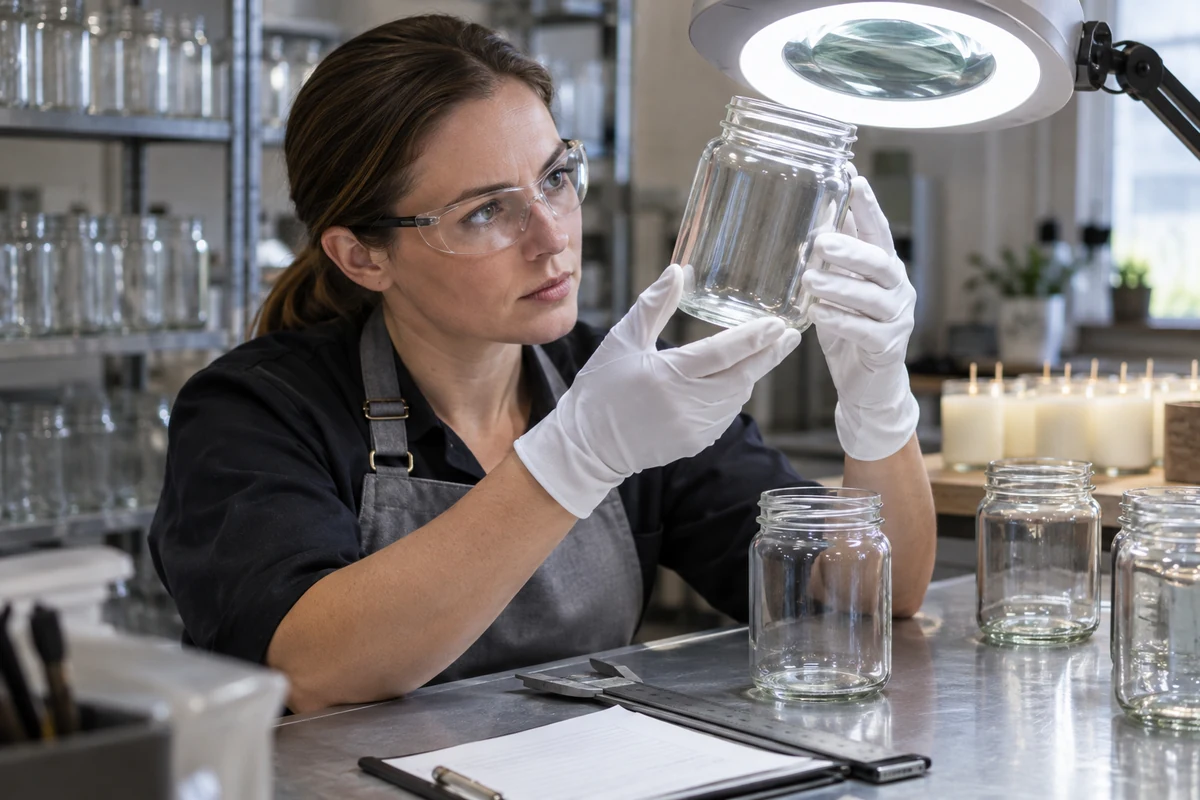
Understanding the distinction between food packaging and open-flame vessels is the first step toward protecting your brand. Below, I break down the glass thermodynamics, structural geometry, and supplier verification protocols you need to evaluate before placing your next bulk container order.
How Do You Identify the Exact Jar and Intended Use?
Sourcing managers often assume that any heavy-looking glass jar can handle a candle flame. Discovering that your wholesale batch of rustic containers cracks during winter shipping or fails retail burn tests can halt your entire product launch. Identifying the original manufacturing intent of the glass prevents these catastrophic supply chain failures.
To identify if a mason jar is suitable for candle making, buyers must distinguish between food-canning glass and purpose-built candle vessels. Canning jars are designed for uniform hydrostatic heat in boiling water, whereas candle jars require specialized annealing and uniform wall distribution to survive localized, dry-heat thermal shock from an open flame.3
The Physics of Canning Safe vs. Candle Safe
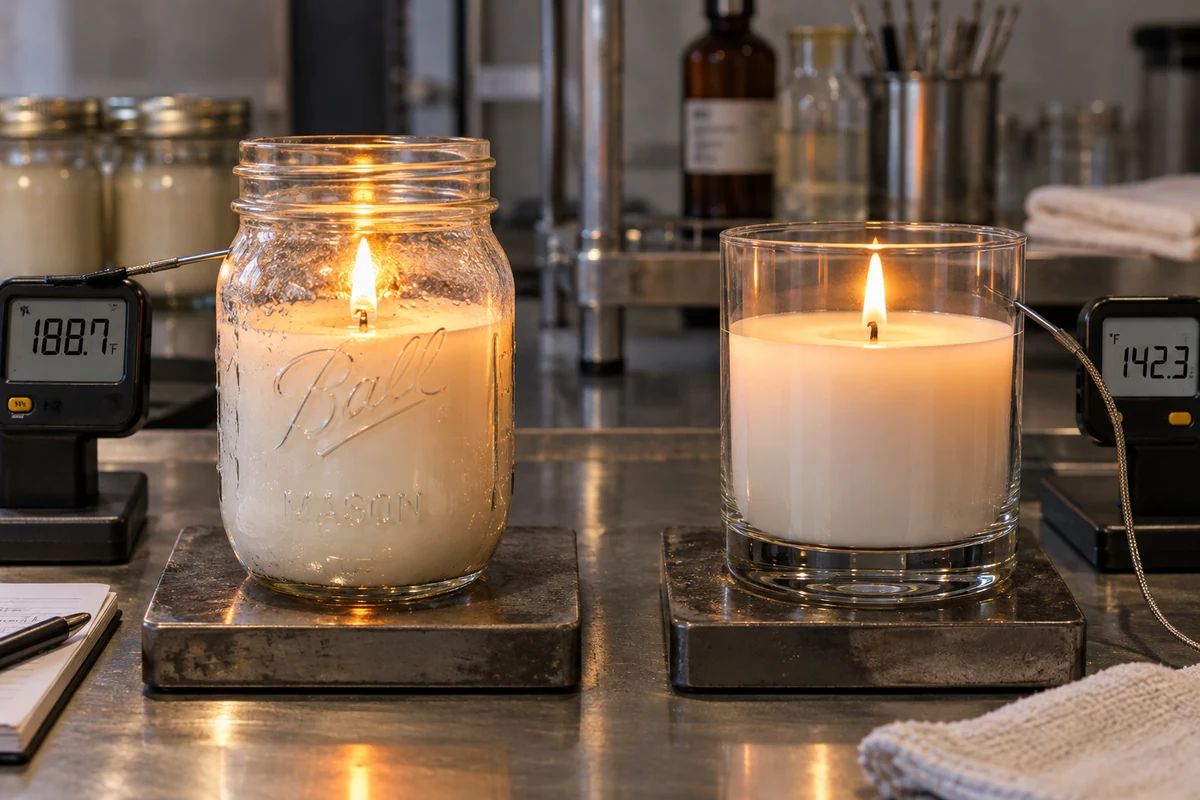
In my twenty years of working with 1,500°C molten glass at Shenzhen Bright Glassware, the most persistent misconception I encounter is that "canning safe" equals "candle safe." Many emerging founders ask, "can you use mason jars for candles if they are rated for pressure canning?" From a physics standpoint, these two applications subject glass to completely different stress profiles.
When a food manufacturer processes jam or pickles in a water bath, the entire mason jar is submerged in boiling water. The heat transfer is wet, uniform, and gradual across the entire surface area of the glass.
Conversely, a burning candle subjects the container to localized dry-heat thermal stress. The core of a candle flame reaches several hundred degrees Celsius. If the wax pool shifts or the wick leans slightly off-center, a single spot on the interior glass wall heats up rapidly while the exterior wall remains exposed to cooler room air. Standard soda-lime food jars are rarely annealed to handle this uneven expansion.
Structural Weaknesses at the Thread and Shoulder
Traditional mason jars feature deep external threads for two-piece metal canning lids and a pronounced neck shoulder.4 During the press-and-blow glass forming process, these sharp angles and thread reliefs naturally create variations in wall thickness.
In food storage, these variations do not matter. In candle manufacturing, unequal wall thickness traps residual internal stress. When the flame heats the thinner neck area faster than the thicker body, the glass can fracture cleanly around the shoulder.
Bottom Thickness and Surface Protection
Food-grade canning jars are engineered with relatively thin bottoms so heat from boiling water can penetrate quickly to sterilize the contents.5 Candle vessels require the exact opposite engineering.
During the final third of a candle's burn cycle, the metal wick sustainer sits directly against the bottom of the jar. Heat radiates downward intensely. At Shenzhen Bright Glassware, we engineer our luxury candle jars with a heavy base free of chill marks. This thick glass base acts as a physical thermal barrier, reducing the risk of basal cracking and helping protect the consumer's tabletop from heat damage.
| Engineering Feature | Standard Food Mason Jar | Purpose-Built Candle Jar |
|---|---|---|
| Primary Heat Profile | Uniform wet heat (boiling water bath) | Localized dry heat (open flame radiation) |
| Neck Geometry | Narrowed shoulder with deep threads | Straight-sided or wide-mouth opening |
| Base Construction | Thin base for rapid heat transfer | Heavy base for thermal insulation |
| Surface Finish | Embossed logos, measurement marks, mold seams | Smooth, optically pure walls for labeling/printing |
| Annealing Target | Hydrostatic pressure resistance | Point-source thermal shock resistance |
Why Must You Inspect Design, History and Supplier Guidance?
Procurement teams frequently try to cut costs by sourcing surplus food jars or recycled glass containers. However, filling containers that have hidden micro-fractures, severe internal waviness, or unknown usage histories introduces extreme liability into your product line. Inspecting structural geometry, verifying container history, and reviewing formal supplier documentation eliminates these blind spots.
Inspecting jar design and history requires checking for structural defects like bubbles, mold seams, and narrow shoulders, while completely avoiding used or repurposed food jars. Buyers must request formal technical documentation from the manufacturer confirming the glass formulation and annealing process are intended for candle applications.6
Why Used Jam Jars and Repurposed Containers Fail
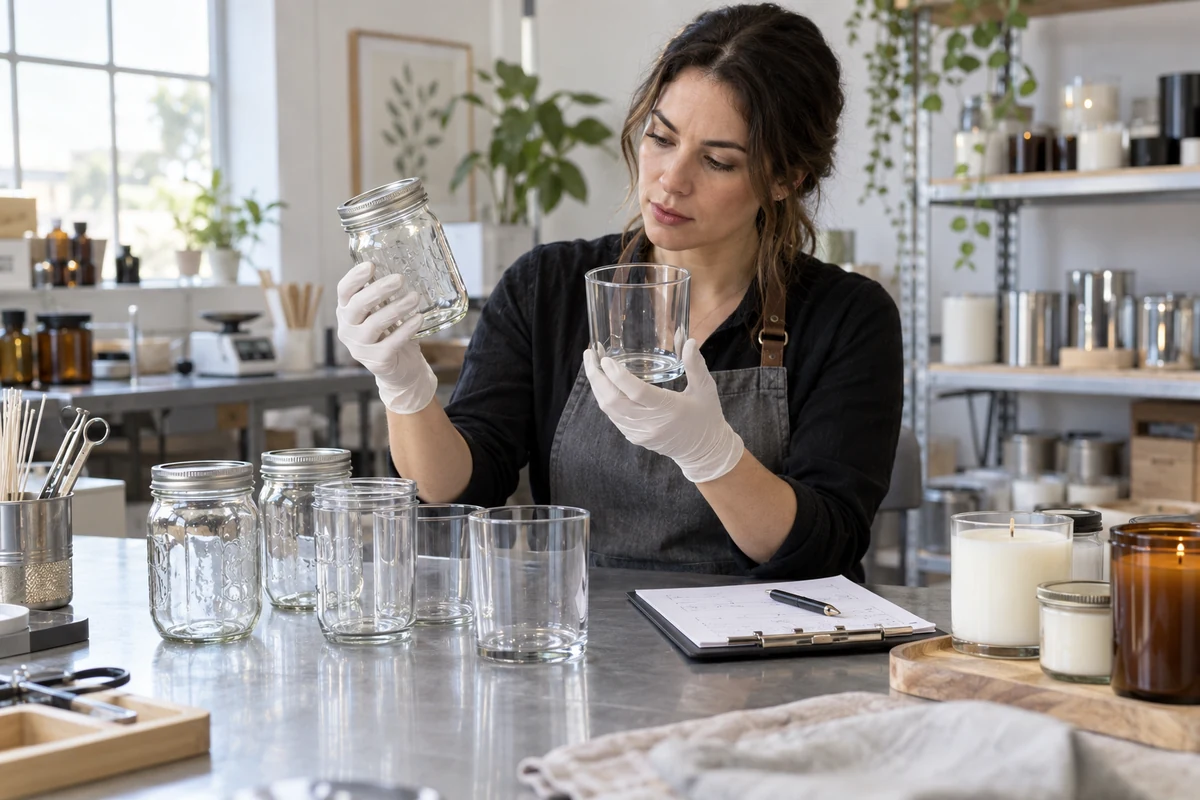
Small-batch makers often ask, "can you use jam jars for candles if they are thoroughly washed?" For any commercial brand or B2B buyer, the answer is a strict no.
Glass is a brittle material that accumulates microscopic surface damage over its lifecycle—a phenomenon known in glass engineering as reducing the material's practical strength. A used jam jar or a bulk-packed food jar has already endured mechanical impacts on filling lines, thermal cycling during pasteurization, and abrasion during transit. These invisible micro-fractures act as stress concentrators. Once exposed to the localized heat of a candle flame, a micro-fracture can propagate into a full crack without warning.
Optical Purity and Commercial Scalability
Beyond safety, traditional mason jars create severe bottlenecks when scaling a brand from local markets to national retail chains. Standard canning jars feature raised fruit embossing, volume measurement lines, and prominent vertical mold seams.7 Furthermore, low-cost food glass often exhibits internal "waviness" (baffle marks) and trapped air bubbles.
- Bubble Hazards: Air bubbles larger than 1mm trapped near the shoulder or base weaken the structural integrity of the glass wall under heat.
- Labeling Failures: Automated pressure-sensitive labeling machines cannot apply labels smoothly over raised embossing or heavy mold seams, resulting in wrinkling and peeling.
- Decoration Limits: High-end secondary decorations—such as automated screen printing, hot stamping, or matte color spraying—require optically smooth, defect-free outer walls.
Reviewing Supplier Technical Guidance
Never assume a glass container is suitable for candles based solely on its visual thickness or weight. Responsible procurement managers require suppliers to clarify the intended use of the vessel in writing.
When evaluating a manufacturer, check whether their catalog explicitly categorizes the SKU as a candle vessel rather than a food storage jar. Request technical drawings that specify critical tolerances, including wall thickness minimums, base thickness, and neck finish dimensions. If a supplier only provides food-contact compliance documents (such as FDA or LFGB reports) without addressing thermal performance or annealing protocols for candle use, treat the vessel as unverified for open-flame applications.
How Do You Assess the Complete Candle Configuration?
Even when you source a custom-engineered, candle-grade glass jar, the container alone does not guarantee a safe product. Pairing an approved jar with the wrong wax formulation, an oversized wick, or an incompatible lid can still cause dangerous overheating and soot accumulation. Assessing the complete candle system as an integrated configuration is essential before approving mass production.8
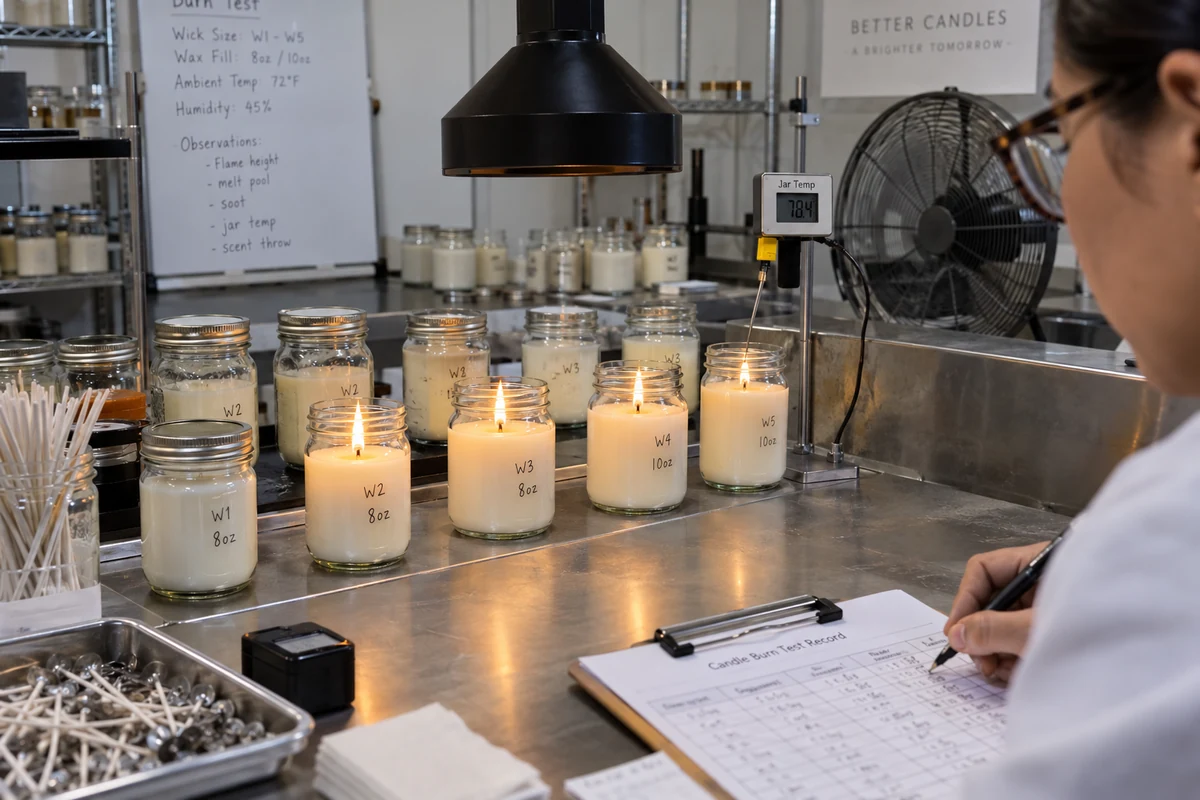
Assessing the complete candle configuration means testing the specific glass jar alongside the exact wax blend, fragrance load, wick size, and closure system. Because narrowed jar necks trap heat and alter airflow, buyers must validate the entire assembly through professional burn testing against recognized industry standards like ASTM F2417.
The Geometry Problem: Airflow Turbulence in Narrowed Necks
The classic mason jar silhouette features a wide body that tapers inward at the shoulder to a narrower neck. While visually nostalgic, this geometry creates complex fluid dynamics during combustion.
In a standard straight-sided tumbler, cool air flows smoothly down along the inside of the glass walls to feed the flame, while hot combustion gases rise straight up out of the center. In a jar with a narrowed shoulder, this convection loop gets disrupted once the wax level drops below the neck:
- Heat Trapping: The angled glass shoulder reflects radiant heat back down into the melt pool rather than allowing it to dissipate upward.
- Oxygen Starvation and Turbulence: Rising hot air collides with incoming cool air at the constricted neck opening.
- Wick Instability: Even well-calibrated cotton wicks (such as the CDN/Stabilo series commonly used in soy wax blends) begin to flicker violently once the burn reaches the lower half of the jar. This instability causes mushrooming, heavy black soot buildup on the glass rim, and elevated glass temperatures.
- Flashover Risk: If the trapped heat pushes the entire wax pool past its flashpoint, the surface of the wax can ignite—a dangerous phenomenon known as candle flashover.
Neck Tolerances and Closure Compatibility
If your brand aesthetic demands an apothecary or rustic look, closure compatibility is another critical configuration factor. Traditional mason jars use two-piece stamped tin lids that rust easily when exposed to high fragrance loads or humid warehouse environments.
Modern candle brands typically upgrade to natural wood, bamboo, or electroplated metal lids with silicone fitments. However, food-grade mason jars often have loose dimensional tolerances around the neck ring. At Shenzhen Bright Glassware, we control neck finish tolerances tightly so that custom kiln-dried wooden lids, metal screw caps, or bail-and-trigger closures fit securely without cracking the glass rim or losing fragrance seal integrity.
Mandatory Qualification Testing
Because container geometry, ambient temperature, fragrance oil flashpoints, and wick sizing interact unpredictably, no glass supplier can issue a blanket safety guarantee for your finished candle.
Buyers must conduct comprehensive burn testing on the exact production configuration.9 We always advise clients to have their finished candles evaluated by qualified third-party laboratories against applicable standards, such as ASTM F2417 (Standard Specification for Fire Safety for Candles) in North America or EN 15493 in Europe. Only empirical burn testing confirms that maximum container temperatures and flame heights remain within safe operational limits from the first light to the end of the burn cycle.
How to Choose a Verified Procurement Route for Candle Jars?
Sourcing glass jars from general packaging wholesalers, cash-and-carry restaurant supply stores, or unverified trading companies exposes your brand to inconsistent glass batches and high transit breakage. When a factory changes its mold equipment or annealing speed without telling the distributor, your defect rate skyrockets. Following a structured, factory-direct procurement checklist secures consistent quality and supply chain transparency.10
To choose a verified procurement route, partner directly with an experienced B2B glass candle jar manufacturer rather than sourcing food-grade jars through general distributors. Use a five-point engineering checklist to audit annealing protocols, straight-sided geometry, optical clarity, dimensional tolerances, and export-grade protective packaging before placing bulk orders.

The 5-Step Candle Jar Suitability & Procurement Checklist
If your product roadmap calls for vintage, apothecary, or farmhouse-style containers, do not compromise by purchasing supermarket canning jars. Instead, use this five-step checklist to audit your glass manufacturer and specify a purpose-built vessel:
- 1. Candle-Grade Annealing Verification: Ask the supplier how their annealing lehr curve is calibrated. Purpose-built candle jars require extended, controlled cooling cycles to relieve internal thermal stress. Request documentation regarding their internal thermal shock testing procedures (such as hot-to-cold water differential checks) to verify batch consistency—and always treat supplier test reports as baseline documents that your team should independently verify during incoming quality control (IQC).
- 2. Straight-Sided or Wide-Mouth Geometry: Modify the classic mason jar silhouette to eliminate sharp, heat-trapping shoulders. We frequently help brands develop custom apothecary molds or customize existing straight-sided jars that retain a vintage look (using amber spraying, embossing, or lug finishes) while maintaining an open, unobstructed airway for clean combustion.
- 3. Optical Purity and Defect Limits: Establish clear AQL (Acceptable Quality Limit) standards with the factory before mass production. Specify acceptable thresholds for mold seams, scratch resistance, internal waviness, and seed bubbles (typically disallowing bubbles over 1mm in critical stress zones).
- 4. Precision Neck and Base Specifications: Require technical drawings confirming a heavy, uniform base for tabletop insulation and precise neck tolerances. If you are sourcing lids, inner liners, and retail gift boxes alongside the jar, consolidate the project with a single turnkey supplier who can verify physical fitment across all components prior to shipment.
- 5. Export-Grade Protective Packaging: Bulk-packed food jars rattle against each other on ocean freight pallets, creating invisible micro-fractures before they ever reach your filling line. Insist on export-ready packaging—such as individual Egg-Crate dividers, 12-unit inner cartons, and reinforced five-ply corrugated master cartons—to prevent glass-on-glass contact during international transit.
[Concept / Vintage Aesthetic] ↓ [Engineering Review: Eliminate Sharp Shoulders & Thin Bases] ↓ [Sample Prototyping & Dimensional Fitment (Jar + Lid + Box)] ↓ [Client Burn Testing (Wax + Wick + Fragrance Validation)] ↓ [Mass Production with Extended Annealing & Export Packaging]
By shifting from off-the-shelf food jars to engineered candle glassware, you retain the visual charm your customers love while building your brand on a foundation of reliable manufacturing quality.
Frequently Asked Questions About Mason Jar Candle Safety
Are all mason jars suitable for making candles?
No, not all mason jars are suitable for making candles. Standard retail mason jars are engineered for food preservation and water-bath canning, which involves uniform wet heat. They often feature thin bases, uneven wall distribution at the neck threads, and heat-trapping shoulders that can crack under the localized dry heat of a candle flame.
Can you use mason jars for candles if they are brand new?
Even brand-new food-grade mason jars carry risks for commercial candle production. While new jars lack the wear-and-tear of used glass, their geometry (narrowed necks that disrupt airflow) and standard food-container annealing profiles still make them prone to soot buildup, erratic wick performance, and thermal stress fractures during extended burns.
Can you use jam jars for candles to save on packaging costs?
Repurposing used jam jars or sourcing thin-walled culinary jars for candles is strongly discouraged for commercial brands.11 Used jam jars accumulate microscopic surface scratches and transit damage during their initial lifecycle. When subjected to high localized temperatures during the final third of a candle burn, these micro-fractures frequently cause the glass to shatter.
Does a "canning safe" or "boiling water safe" claim prove candle suitability?
No, a canning-safe or boiling-water claim does not prove a jar is safe for candles. Boiling water subjects glass to a uniform temperature of 100°C across its entire surface. A candle flame generates much higher point-source temperatures, creating severe temperature gradients between the hot interior wall near the wick and the cooler exterior glass.
Conclusion
Asking "are mason jars safe for candles" is the right starting point for any safety-conscious fragrance brand or procurement manager. While traditional canning jars offer undeniable rustic appeal, their thin bases, constricted shoulders, and food-grade annealing profiles introduce serious thermal and combustion risks into commercial candle production. Achieving both vintage aesthetics and open-flame reliability requires purpose-built candle glassware, strict quality control, and thorough burn testing of your complete candle configuration.
At Shenzhen Bright Glassware Co., Ltd., we bring over 20 years of B2B glass manufacturing and custom packaging experience to help brands transition from risky off-the-shelf food jars to engineered candle containers. From custom apothecary molds, amber spraying, and heavy-base tumblers to perfectly matched wooden lids and retail boxes, we manage your entire packaging project under one roof. Contact our engineering and sourcing team today to request samples and build a safer, higher-margin candle line.
"Candles Business Guidance", https://www.cpsc.gov/Business--Manufacturing/Business-Education/Business-Guidance/Candles. Research on soda-lime glass properties indicates that food-grade jars are engineered for uniform wet heat, not localized dry heat, making them prone to thermal stress fractures under candle use. Evidence role: general_support; source type: research. Supports: Standard food-grade mason jars are not designed to handle the localized thermal stress caused by candle flames.. Scope note: The findings may vary depending on specific glass formulations and manufacturing processes. ↩
"Candles Business Guidance", https://www.cpsc.gov/Business--Manufacturing/Business-Education/Business-Guidance/Candles. Industry standards such as ASTM F2417 outline the importance of burn testing to evaluate the safety of candle containers under operational conditions. Evidence role: expert_consensus; source type: institution. Supports: Burn testing and specification verification are critical for ensuring the safety and reliability of glass containers used in candles.. Scope note: Standards may vary by region and specific product configurations. ↩
"Design and Preparation of Localized Heat-Resistant Coating", https://pmc.ncbi.nlm.nih.gov/articles/PMC9332788/. Educational resources on glass engineering explain how annealing processes differ based on intended use, with candle jars requiring higher resistance to localized thermal stress. Evidence role: mechanism; source type: education. Supports: Canning jars are optimized for uniform wet heat, while candle jars are designed to withstand localized dry heat.. Scope note: Specific annealing protocols may vary by manufacturer. ↩
"Packaging Glasses: From Containers to Encapsulation ... - PMC", https://pmc.ncbi.nlm.nih.gov/articles/PMC12897758/. Research on glass container design highlights how sharp angles and uneven wall thicknesses can trap residual stress, making jars vulnerable to thermal shock. Evidence role: mechanism; source type: research. Supports: The deep threads and pronounced neck shoulders of mason jars contribute to uneven wall thickness, increasing the risk of thermal stress fractures.. Scope note: Findings may depend on specific manufacturing techniques and glass formulations. ↩
"Candles Business Guidance", https://www.cpsc.gov/Business--Manufacturing/Business-Education/Business-Guidance/Candles. Studies on glass container engineering show that thicker bases are necessary to prevent basal cracking under high localized heat. Evidence role: mechanism; source type: research. Supports: Thin bottoms in food-grade jars are not designed to withstand the intense heat radiated by candle flames.. Scope note: Specific base thickness requirements may vary by candle design. ↩
"What Is the Role of Technical Documentation?", https://contiem.com/what-is-the-role-of-technical-documentation/. Industry guidelines recommend obtaining technical documentation to confirm glass formulation and annealing processes for thermal stress resistance. Evidence role: expert_consensus; source type: institution. Supports: Technical documentation from manufacturers helps verify that glass containers meet the requirements for candle production.. Scope note: Documentation practices may vary by manufacturer and region. ↩
"Rethinking wine packaging with Label'Glass", http://www.my-muse.com/en/home/insights/label-glass.html. Educational resources on packaging design explain how surface features like embossing and seams can disrupt automated labeling and decoration processes. Evidence role: general_support; source type: education. Supports: Raised embossing and mold seams on canning jars interfere with labeling and decoration processes in commercial candle production.. Scope note: Specific challenges may vary depending on the labeling and decoration methods used. ↩
"Candles Business Guidance", https://www.cpsc.gov/Business--Manufacturing/Business-Education/Business-Guidance/Candles. Standards like ASTM F2417 recommend testing the complete candle system to evaluate safety and performance under operational conditions. Evidence role: expert_consensus; source type: institution. Supports: Integrated system testing is crucial to ensure the safety and performance of candles.. Scope note: Testing protocols may vary by region and specific product configurations. ↩
"Candles Business Guidance", https://www.cpsc.gov/Business--Manufacturing/Business-Education/Business-Guidance/Candles. Standards such as ASTM F2417 provide methodologies for burn testing to evaluate the safety and performance of candle configurations. Evidence role: case_reference; source type: institution. Supports: Comprehensive burn testing is necessary to confirm the safety and reliability of the final candle product.. Scope note: Testing results may depend on specific configurations and environmental conditions. ↩
"Procurement Review Checklist User Guide", https://gta.georgia.gov/procurement/agency-technology-procurement-reviews/procurement-review-checklist-user-guide. Educational resources on procurement practices recommend using structured checklists to verify quality and transparency in glass container sourcing. Evidence role: expert_consensus; source type: education. Supports: A structured procurement checklist helps ensure consistent quality and transparency in sourcing glass containers for candles.. Scope note: Checklist requirements may vary depending on the specific procurement context. ↩
"Are candle glass jars safe to reuse?", https://www.facebook.com/groups/candlemakingclub/posts/1779472349499316/. Research on glass lifecycle effects shows that surface damage reduces the material's practical strength, increasing the risk of fractures under heat. Evidence role: general_support; source type: research. Supports: Used jam jars and thin-walled culinary jars are unsuitable for candles due to accumulated surface damage and structural weaknesses.. Scope note: Findings may depend on the extent of damage and specific glass formulations. ↩
Keep Reading