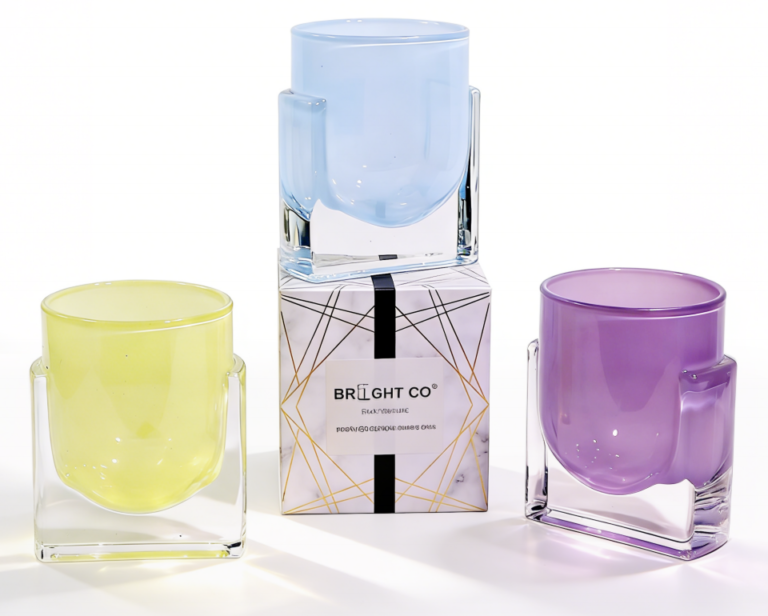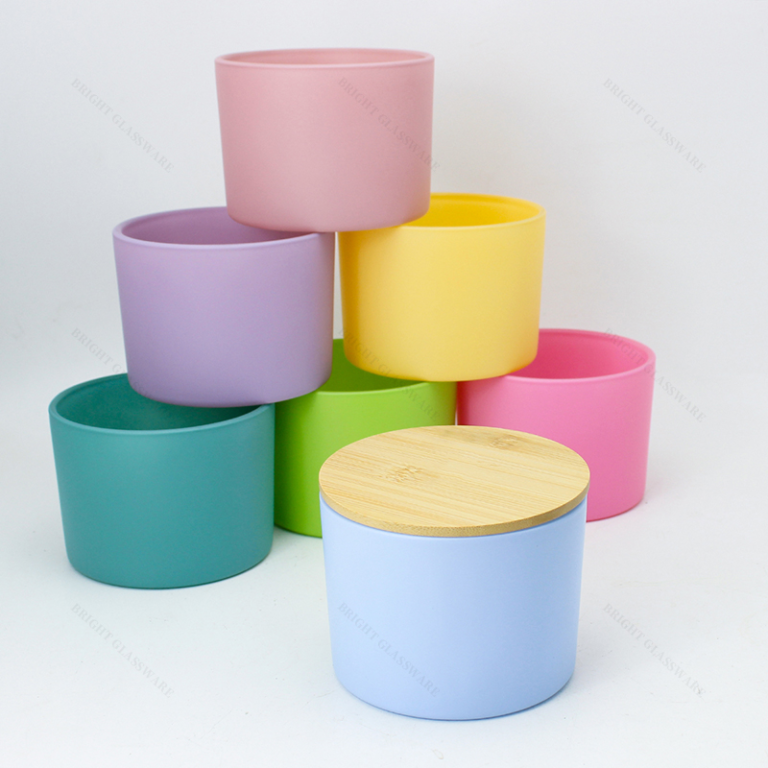

Using a generic candle wick sizing guide for containers often leads to batch failures in mass production. You might see severe tunneling, black soot, or cracked jars after scaling up from lab trials1. By treating glass container specifications and surface finishes as primary testing inputs2, your brand can engineer a stable, repeatable burn.
A reliable candle wick sizing guide for containers requires evaluating the true internal diameter, glass wall thickness, surface decorations, wax viscosity, and fragrance load as an integrated thermal system. Rather than relying solely on vessel volume or external width, R&D teams must select starting wick candidates based on exact internal geometry and validate them inside final decorated production samples.
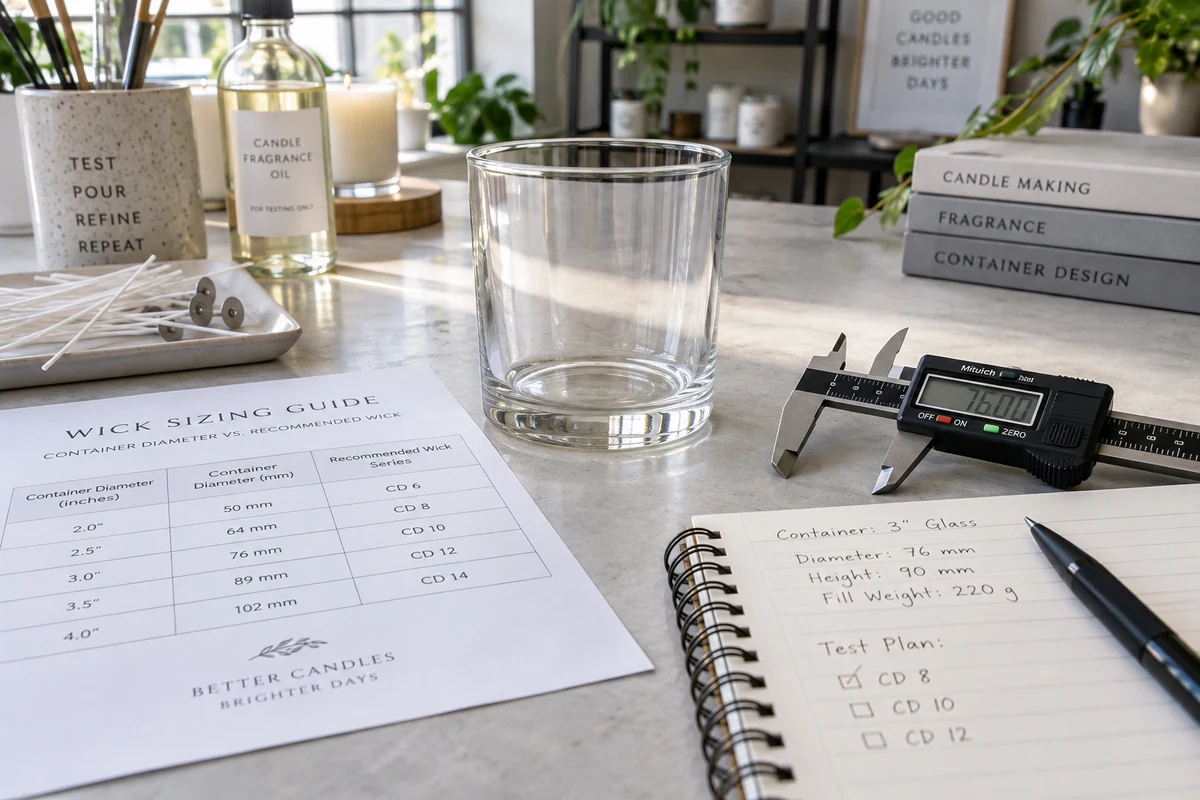
Why do candles that burn perfectly in a test lab suddenly fail during a 10,000-unit commercial run? The answer lies in the hidden physical variables of the vessel itself. In my 20 years of manufacturing glass packaging at Shenzhen Bright Glassware Co., Ltd., I always tell buyers that the wick is the engine, but the glass jar is the chassis. Let us explore how to lock in your testing inputs before you approve bulk production.
How Do You Measure the Internal Geometry for a Candle Wick Sizing Guide for Containers?
Relying on nominal catalog dimensions is a common trap for fragrance brands. If you select a wick based on an 80mm outer diameter without accounting for heavy glass walls or manufacturing tolerances, your melt pool calculations will fail. You must measure the exact internal geometry and verify dimensional consistency across the production batch.
To measure internal geometry accurately, use digital calipers to record the true inside diameter (ID) at the fill line, the middle, and the base of the vessel. Subtract twice the glass wall thickness from the outer diameter, and verify that the supplier's dimensional tolerances remain tight enough to prevent tunneling or overheating across bulk production batches.
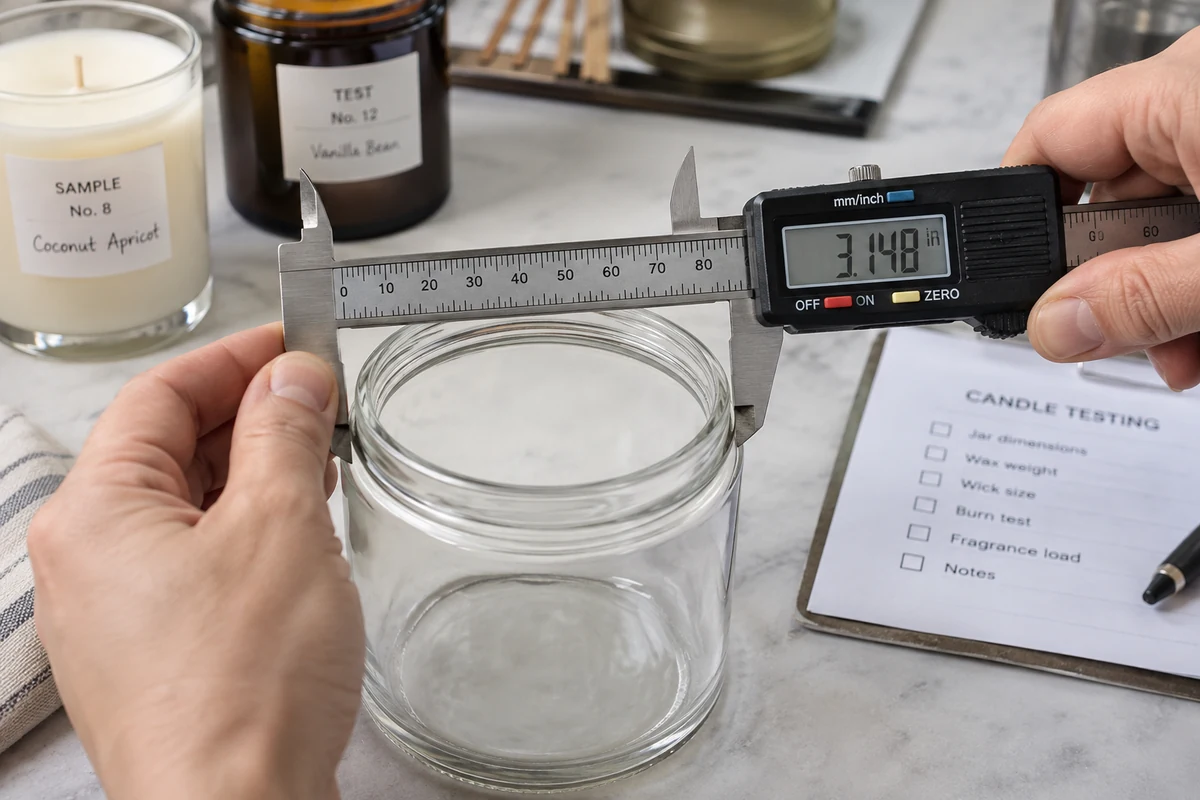
Outer Diameter vs. True Internal Diameter (ID)
Many startup founders and product development managers look at a spec sheet showing an 80mm diameter jar and immediately consult a basic wick chart. However, luxury glass candle jars have substantial wall thickness3.
For example, our high-white soda-lime glass jars typically feature a wall thickness of 3mm to 4mm. In contrast, lightweight borosilicate glass vessels often have walls between 1.5mm and 2mm thick. If both jars share an 80mm outer diameter, the borosilicate vessel actually holds a wax pool that is 3mm to 5mm wider than the thick-walled soda-lime jar. That 5mm difference in surface area frequently determines whether your formula needs to step up or down a full wick size.
The Butterfly Effect of Dimensional Tolerances
Even more critical than nominal wall thickness is manufacturing tolerance. If you source from a low-tier glass factory where internal diameter varies by ±2mm4, or where walls suffer from uneven glass distribution (known as "ovalization"), your lab tests lose their validity.
A wick size that performs flawlessly in an approved golden sample will leave a stubborn ring of unmelted wax (tunneling) in a slightly wider bulk jar. Conversely, that same wick will trap excessive heat against the glass wall in a narrower jar. At Bright Glassware, we use automated infrared inspection and strict caliper checks to keep internal diameter and wall thickness tolerances tightly controlled, helping your lab data translate reliably to bulk runs.
Evaluating Tapered, Bell, and Mason Profiles
Not all containers are straight-sided cylinders. When buyers ask what size wick for mason jar candles or tapered vessels they should test, I remind them that airflow and heat retention change dramatically as the wax level drops.
- Straight-Sided Cylinders: Maintain consistent oxygen flow and wall distance from top to bottom. Our classic BGC7080 (70mm OD × 80mm H) and BGC8090 (80mm OD × 90mm H) jars sit in a balanced 1:1 to 3:4 aspect ratio, creating predictable convection currents.
- Mason Jars and Necked Vessels: Feature a restricted neck opening and wider shoulders. The narrowed neck traps rising heat inside the chamber while restricting fresh air intake, often causing the flame to flicker or burn hotter halfway down the jar.
- Tapered Vessels: Require wicking for the lower half of the container. If you size the wick for the wide top opening, the vessel will overheat dangerously when the flame reaches the narrow base.
How Do You Add Wax, Fragrance, and Surface Finishes as Testing Inputs?
Testing your wax and fragrance formula inside an undecorated clear sample jar is a major sourcing mistake. When your bulk order undergoes matte black spraying, internal color coating, or metallic electroplating, the thermal properties of the container change completely. Your蜡烛 (candle) starts melting too fast, mushrooming, and emitting black smoke.
You must combine wax type, fragrance load percentage, and final container surface treatments as linked testing inputs. Dense vegetable waxes require rigid, treated wicks with strong capillary action, while opaque coatings like electroplating or dark paint reflect infrared heat back into the wax pool5, often requiring you to downsize the wick compared to clear glass.

Matching Wax Viscosity to Wick Architecture
In the global B2B market, many premium brands formulate with soy wax, coconut blends, or parasoy. Vegetable waxes have higher viscosity and specific melting points compared to traditional paraffin. Standard braided cotton wicks often curl excessively or drown in heavy botanical oils.
Many of our European and North American clients prefer testing with the CDN (Stabilo KST) series—a flat-braided cotton wick interwoven with special paper fibers and treated with a specialized chemical solution. It provides structural rigidity to resist curling in viscous plant waxes while maintaining steady capillary siphon action. Always verify the exact series chart provided by your wick manufacturer alongside real burn tests.
The Thermal Insulation Effect of Secondary Surface Finishes
Why does a wick tested in clear glass fail inside a decorated jar? The physics comes down to infrared heat radiation.
- Clear Glass (Flint/Super Flint): Allows radiant heat from the flame to pass directly through the transparent walls into the surrounding room air.
- Dark Spray Painting & Internal Lacquering: Absorbs thermal energy, raising the baseline temperature of the glass wall and the adjacent wax.
- Vacuum Electroplating & Metallic Foils: Acts like a thermal thermos. The mirror-like metallic layer reflects infrared radiation directly back into the melt pool.
In our dust-free decoration workshops, we consistently observe that full-coverage electroplated or dark matte-sprayed jars run noticeably hotter internally6 than clear blanks. Consequently, you should always conduct your wick validation using fully decorated pre-production samples. In many cases, an electroplated vessel requires stepping down one wick size compared to its clear glass counterpart to prevent over-wicking and soot.
Multi-Variable Testing Input Matrix
Instead of relying on a two-column chart that only lists diameter and wick size, professional R&D teams use a multi-dimensional matrix. Below is a practical framework showing how we help clients organize starting trial inputs using CDN wicks as an example:
| Container Model / Type | Nominal OD vs. True ID (Approx.) | Glass Material & Surface Finish | Wax & Fragrance System (Example) | Starting Wick Trial Range (Example Only)* |
|---|---|---|---|---|
| Travel / Mini Jar | 50mm–60mm OD (44mm–54mm ID) | Soda-Lime / Clear Uncoated | Soy / Coconut Blend (8%–10% Fragrance) | Single Wick: CDN 5, CDN 7 |
| BGC7080 Classic | 70mm OD × 80mm H (~63mm ID) | High-White Glass / Clear or Frosted | Soy Wax (10%–12% Fragrance Load) | Single Wick: CDN 12, CDN 14, CDN 16 |
| BGC8090 Best-Seller | 80mm OD × 90mm H (~72mm ID) | High-White Glass / Clear Uncoated | Soy Wax (10%–12% Fragrance Load) | Single Wick: CDN 16, CDN 18, CDN 20 |
| BGC8090 Decorated | 80mm OD × 90mm H (~72mm ID) | High-White Glass / Full Electroplating or Dark Matte Spray | Soy Wax (10%–12% Fragrance Load) | Single Wick: CDN 14, CDN 16, CDN 18 (Test 1 size lower) |
| Luxury Wide Jar | 90mm+ OD (83mm+ ID) | High Borosilicate or Annealed Heavy Soda-Lime | Vegetable / Paraffin Blend (10%–12% Fragrance) | Multi-Wick: 2x or 3x (CDN 7, CDN 8, or CDN 10) |
*Note: Starting wick candidates must always be cross-referenced with official wick manufacturer specifications and validated through full laboratory burn testing.
How Do You Plan Single- and Multi-Wick Trials in Your Candle Wick Sizing Guide for Containers?
When developing wider vessels or apothecary jars, buyers frequently struggle to decide between a single large wick and multiple smaller wicks. Pushing a single massive wick to melt a wide container often creates a towering central heat column, an unstable flickering flame, and heavy carbon mushrooming.
Plan single- and multi-wick trials by matching the heat footprint to the internal diameter rather than the fluid ounce capacity. While narrow-to-medium jars (up to 75mm–80mm ID) typically suit single-wick trials, wider containers (85mm+ ID) or wide-mouth apothecary jars often require double or triple wicks to distribute heat evenly without overloading the center.
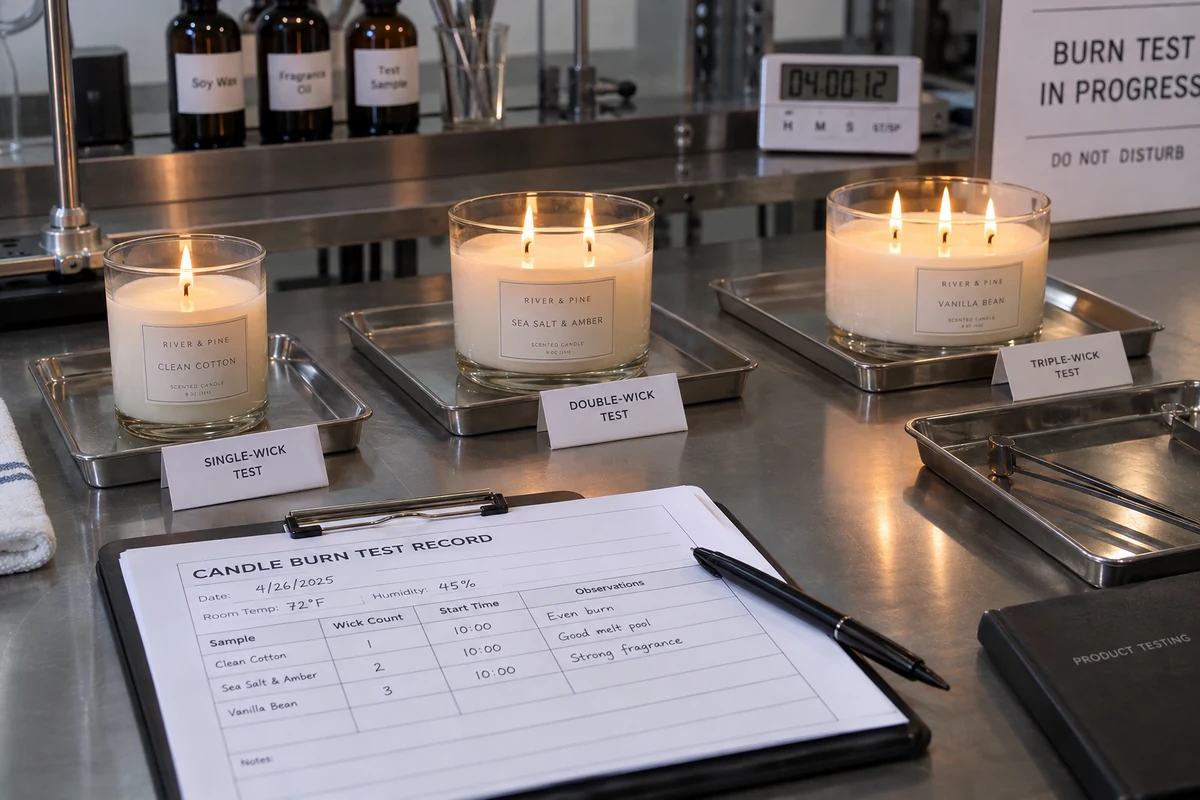
Why Ounce Capacity Cannot Dictate Wick Count
Buyers often ask us how many wicks per candle apothecary 10oz jar they should use, or try to standardize wicks for "8oz" and "10oz" lines. However, fluid weight or volume tells you nothing about the surface area of the wax pool7.
A tall, slender 10oz pillar jar might have a 65mm internal diameter, making it an ideal candidate for a single wick. Meanwhile, a squat, wide-mouth 10oz apothecary jar might have an 88mm internal diameter. If you put a single wick in that wide 10oz jar, it will tunnel severely. Never select wicks based on ounce capacity alone; always base your trial plan on internal diameter and vessel height.
When to Transition from Single to Multi-Wick Systems
In our experience supporting global candle brands, once the internal diameter exceeds roughly 80mm to 85mm, requiring a massive single wick like a CDN 28 or CDN 30 introduces high thermal risk. A single oversized flame generates intense localized convection, increasing soot and carbon buildup.
Switching to a double- or triple-wick configuration (such as testing two or three smaller wicks like CDN 7, CDN 8, or CDN 10) spreads the thermal load across the wax surface. However, multi-wicking brings the flames closer to the glass walls8. For wide multi-wick vessels, we often recommend evaluating high borosilicate glass or thick-walled, fully annealed soda-lime jars to handle multi-point heat radiation without thermal stress cracking.
Pre-Test Wick Sizing Checklist
Before pouring your test batch, run through this engineering checklist to ensure all variables are locked:
- Verify Container Status: Are you testing in the exact glass material, wall thickness, and final surface coating (paint, plating, decal, or label coverage) intended for retail?
- Record True ID: Have you measured the internal diameter at the top fill line and 15mm above the inner base?
- Establish a 3-Step Ladder: Select three consecutive wick sizes for each formula (one target size, one size smaller, and one size larger) to bracket the optimal burn zone.
- Standardize Centering & Spacing: Use mechanical centering tools or custom metal plates during pouring so wick placement remains identical across all test units.
How Do You Review Results Before Production Using a Candle Wick Sizing Guide for Containers?
Many brands stop their burn test after the first two cycles once they see a level melt pool at the top of the jar. However, the most dangerous thermal stress occurs during the final third of the candle's life. Approving bulk production without completing a top-to-bottom burn review exposes your brand to costly safety recalls.
Review burn test results by conducting full top-to-bottom power burns and standard four-hour cycle tests down to the final centimeter of wax. Record melt pool depth, flame stability, soot accumulation, and external glass wall temperatures, paying strict attention to the bottom-third burn phase where heat retention peaks.
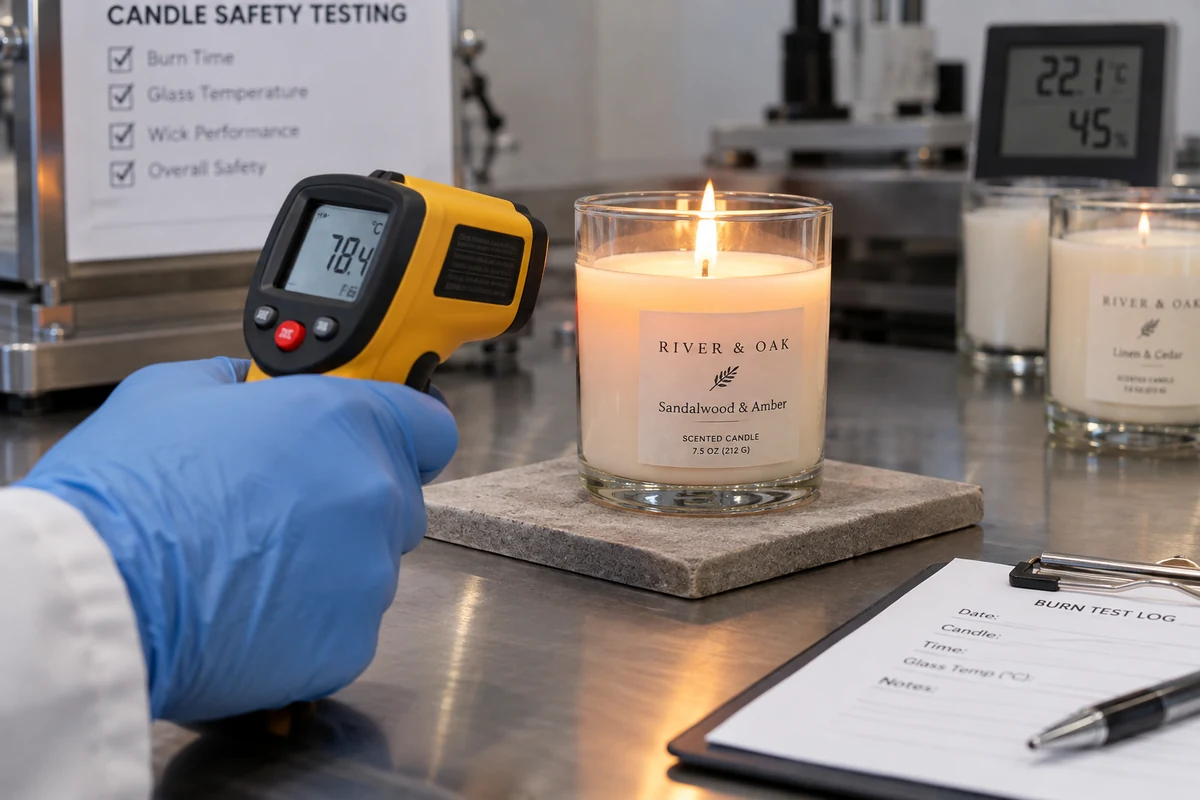
The Critical "Bottom-Third" Thermal Stress Test
International candle safety frameworks, such as ASTM F2417 and EN 15426 (which buyers should independently verify through accredited third-party testing laboratories), focus heavily on container integrity and soot emissions throughout the entire life of the candle.
When the wax burns down to the bottom third—especially the final 10mm to 15mm—the flame sits deep inside the glass cavity. Radiant heat cannot escape easily, causing the internal ambient temperature and the glass base temperature to spike rapidly. If your container is slightly over-wicked, or if the glass contains residual internal stress from poor manufacturing, the jar can crack or shatter at the very end of the burn.
Two Glass Manufacturing Defenses Against Thermal Shock
To protect our B2B buyers during the bottom-third burn phase, we build two physical defenses into our glass production lines:
- Extended Annealing Lehr Processing: When glass containers exit the forming mold, rapid cooling creates invisible internal structural tension. We pass our candle jars through an extended temperature-controlled annealing lehr (kiln) to relax internal stress, ensuring the walls withstand sustained flame heat. Buyers should always request annealing and polariscope inspection records during supplier qualification.
- Heavy Base Insulation: The thick glass bases (often 10mm to 15mm thick) on our luxury jars are not just for visual weight and shelf appeal. That solid glass mass acts as a physical thermal barrier, insulating the consumer's tabletop from the intense heat of the metal wick sustainer tab at the end of the burn.
Standard Burn Test Recording Template
Use a structured log like the table below for every SKU during your evaluation phase:
| Test Cycle (4 Hrs Each) | Melt Pool Diameter & Depth (mm) | Flame Height (mm) & Behavior (Flicker/Steady) | Mushrooming / Soot Score (0–3) | Max External Wall Temp (°C / °F) | Base Temp at Shutdown (°C / °F) | Pass / Fail Notes |
|---|---|---|---|---|---|---|
| Cycle 1 (Top 1/3) | Record mm | Check stability | 0 = None, 3 = Heavy | Measure at hot spot | Measure under base | Check for early tunneling |
| Cycle 3 (Mid 1/2) | Record mm | Check airflow effect | Record score | Measure at hot spot | Measure under base | Check coating heat reflection |
| Final Cycle (Bottom 1cm) | Full pool check | Watch for drowning or high flare | Record score | Critical: Verify safe wall limit | Critical: Verify safe table limit | Inspect glass for micro-cracks |
Frequently Asked Questions About Candle Wick Sizing
Can I choose a candle wick size based only on jar volume (e.g., 8oz or 10oz)?
No, you cannot select a wick size based solely on fluid ounce or gram capacity. Volume measures total wax weight, whereas wick sizing depends on the internal diameter and height of the container. A tall, narrow 8oz jar requires a much smaller wick than a short, wide 8oz jar.
Can I copy the exact wick model used by another candle brand in the same jar?
No, copying another brand's wick model is risky even if you use the exact same glass vessel. Differences in wax supplier batches, fragrance oil density, dye pigments, and container surface coatings (such as matte spray versus clear glass) will alter burn rates and require independent testing.
How do I properly secure and center a candle wick during testing and production?
Clean the inside bottom of the glass jar with isopropyl alcohol to remove dust or mold release residue before applying a high-temperature wick sticker or hot-melt adhesive. Press the metal sustainer tab firmly onto the glass base and use a rigid centering tool to hold the wick taut while cooling.
Why did my candle burn well in a clear sample jar but smoke in my painted bulk jars?
Opaque surface finishes like dark spray paint, internal color coating, and metallic electroplating block infrared heat from escaping through the glass walls. Instead, they reflect thermal energy back into the wax pool, melting the wax faster and flooding the wick with more fuel than it can cleanly burn.
Conclusion
Following a systematic candle wick sizing guide for containers means looking beyond the wick chart and treating the glass vessel as an active thermal component. By measuring true internal diameters, accounting for the heat-reflective properties of electroplating and spray coatings, and testing inside properly annealed, tight-tolerance jars, you eliminate the guesswork between lab trials and commercial scale-up.
Do not waste weeks of R&D testing in off-spec blank jars. Whether you are calibrating a single-wick travel tin or engineering a multi-wick luxury collection, Shenzhen Bright Glassware Co., Ltd. provides one-stop custom glass jars, lids, color finishes, and retail packaging with strict dimensional control. Contact our engineering team today to request samples of our best-selling BGC7080 and BGC8090 jars—including custom-decorated trial samples—so your next burn test starts on a rock-solid foundation.
"History of candle making", https://en.wikipedia.org/wiki/History_of_candle_making. Studies on candle production scaling often highlight tunneling, soot, and glass jar cracking as common issues caused by improper wick sizing and vessel design during mass production. Evidence role: general_support; source type: research. Supports: The challenges of tunneling, soot, and jar cracking during mass production of candles.. Scope note: Specific examples or case studies may vary depending on production methods and materials. ↩
"Surface Area Effects as Related to Flammability", https://chem.rutgers.edu/cldf-demos/1558-surface-area-effects-as-related-to-flammability. Research on thermal properties of glass containers shows that wall thickness and surface finishes can alter heat retention and burn behavior in candles. Evidence role: mechanism; source type: research. Supports: The role of glass container specifications and surface finishes in influencing candle burn stability.. Scope note: Findings may depend on specific glass types and coating materials. ↩
"What are the benefits of heavy wall PET jars for luxury ...", https://apackaginggroup.com/blogs/news/what-are-the-benefits-of-heavy-wall-pet-jars-for-luxury-creams. Educational resources on glass manufacturing indicate that luxury jars are designed with thicker walls for aesthetic and thermal stability. Evidence role: statistic; source type: education. Supports: Luxury glass jars often feature thicker walls compared to standard jars.. Scope note: Specific thickness ranges may vary by manufacturer. ↩
"Top 6 Custom Glass Bottle Manufacturers: Costs, MOQs & ...", https://www.nuvole-glass.com/custom-glass-bottle-manufacturers/. Industry reports on glass manufacturing tolerances indicate that low-tier factories often exhibit higher dimensional variability, including ±2mm internal diameter differences. Evidence role: statistic; source type: institution. Supports: Internal diameter variations of ±2mm are common in low-tier glass factories.. Scope note: Data may not apply universally to all low-tier factories. ↩
"The Greenhouse Effect - It's Mostly About Water - AIRS", https://airs.jpl.nasa.gov/news/119/the-greenhouse-effect-its-mostly-about-water/. Research on thermal dynamics in coated glass containers shows that opaque finishes reflect infrared heat, altering wax melting behavior. Evidence role: mechanism; source type: research. Supports: Opaque coatings reflect infrared heat back into the wax pool, affecting burn rates.. Scope note: Findings may depend on coating type and application method. ↩
"Packaging Glasses: From Containers to Encapsulation ... - PMC", https://pmc.ncbi.nlm.nih.gov/articles/PMC12897758/. Studies on thermal properties of glass coatings show that matte finishes absorb and retain more heat compared to clear glass. Evidence role: mechanism; source type: research. Supports: Dark matte-sprayed jars retain more heat internally due to their surface properties.. Scope note: Specific heat retention levels may depend on coating materials and thickness. ↩
"How to Calculate Wax and Fragrance for Candles",
. Educational resources on candle design explain that surface area, not volume, dictates wick sizing and burn behavior. Evidence role: mechanism; source type: education. Supports: Fluid weight or volume does not determine the surface area of the wax pool.. Scope note: Surface area calculations may vary by container shape. ↩"Performance of a double condensing multiple wick solar still", https://www.academia.edu/24083424/Performance_of_a_double_condensing_multiple_wick_solar_still. Research on multi-wick systems shows that increased flame proximity to glass walls raises thermal stress risks. Evidence role: mechanism; source type: research. Supports: Multi-wicking configurations increase heat stress on glass walls.. Scope note: Findings may depend on glass type and wick placement. ↩
Keep Reading