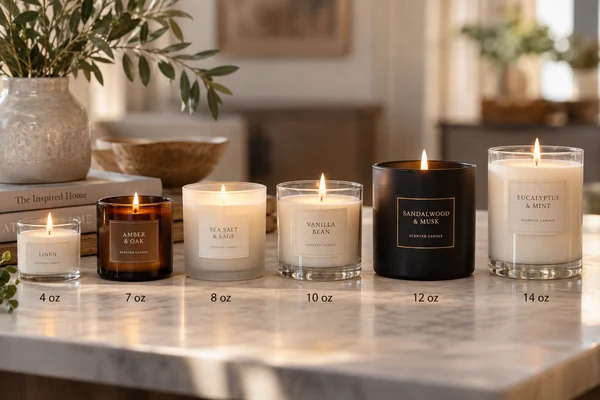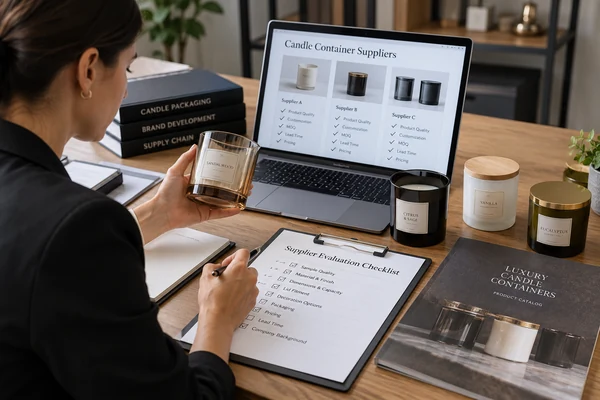

Struggling to find the right container for your new candle line? Many brands invest heavily in premium waxes and oils but then choose a generic jar to save a few cents, creating a huge risk. The question of what jars are safe for candles1 is one you can't afford to get wrong, as a single failure can lead to property damage and destroy your brand's reputation. The solution is to adopt an industrial-grade standard for vessel selection and testing, viewing safety as a complete system.
The safety of a candle jar is determined not by its material alone, but by a combination of its design, manufacturing quality, and suitability for the specific candle system (wax, wick, fragrance). Truly safe jars are those that have been properly annealed to remove internal stress2, feature uniform wall thickness, and are validated through testing with the final candle configuration3 to withstand thermal shock.
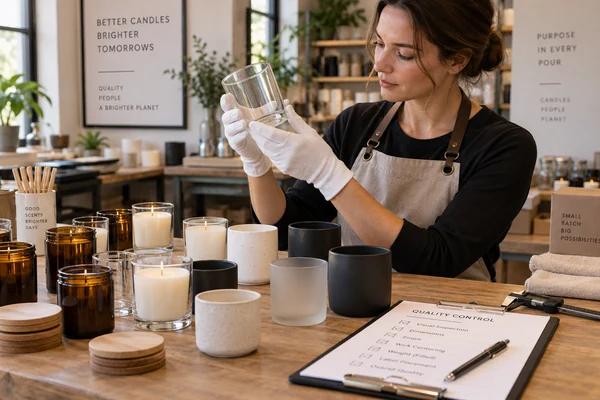
Understanding this definition is the first step. Now, let's move beyond simple appearances and explore the technical criteria that separate a decorative piece of glass from a genuinely safe and reliable candle vessel. This is how professional brands build safety into their products from the ground up.
Why Material Alone Is Not Enough?
Does seeing "glass" or "ceramic" on a product description mean it's ready for a candle? This is a dangerous assumption. Many procurement managers start their search for safe candle containers by focusing only on material, but this approach misses the most critical variables.
To properly evaluate a vessel, you must first define the entire project's context. A container that is perfectly safe for a small, single-wick soy candle might be completely unsuitable for a large, multi-wick paraffin blend. True suitability is a function of the complete system, not just the empty jar.
Dive Deeper: Defining Your Project for a Proper Assessment
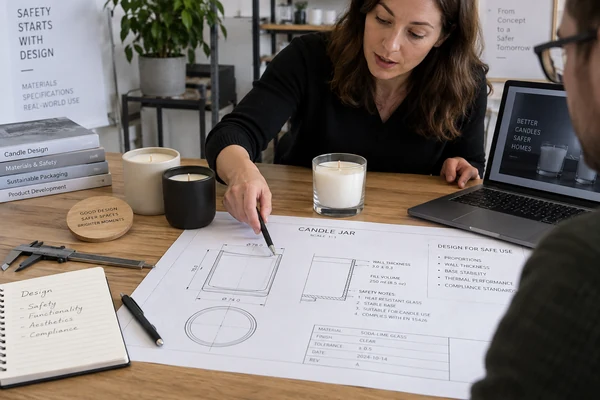
Before you can even begin to ask what jars are safe for candles, you need a clear specification for your candle project. Without this, any supplier recommendation is just a guess. The container is one component in a complex thermal system. Its performance depends entirely on the stresses you place upon it.
Here are the inputs you must define before evaluating any vessel:
- Vessel and Design: What are the target dimensions, capacity, shape, and opening diameter? A narrow opening, for example, can trap heat and create dangerous hot spots on the glass walls. Straight-sided, cylindrical jars generally offer more predictable and even heat distribution.
- Material & Decoration: While we often start with common materials like soda-lime glass, borosilicate glass, or ceramic, any post-manufacturing decorations are critical. Will the vessel be sprayed, electroplated, or have a decal applied? Each of these finishes can alter the surface's heat tolerance and must be part of the evaluation.
- Wax and Fragrance Formula: Different waxes (soy, paraffin, coconut) have different melting points and heat-retention properties. Fragrance oil load can also affect the burn characteristics.
- Wick Configuration: This is arguably the most important factor. The number of wicks, their size (e.g., CDN, HTP), and their material directly dictate the flame height and total heat output. A vessel that's safe with a CDN 4 wick could easily fail with three CDN 8 wicks4.
- Intended Use Conditions: Where and how will the end consumer use this candle? Will it be burned for long four-hour stretches or short one-hour periods? This affects the total heat buildup within the container.
Only by outlining these factors can you begin a meaningful conversation with a supplier about finding a truly safe and appropriate container.
How Do You Inspect Vessel Design and Supplier Documents?
You've found a potential vessel and the supplier claims it's perfect for candles. How do you verify this? Relying on verbal assurances is not a quality control strategy. You need to systematically inspect the physical sample and request specific documentation.
Your goal is to gather objective evidence. When you inquire about heat safe containers for candles5 your job is to ask for the data that backs up that claim. This separates professional suppliers from mere traders.
Dive Deeper: A Checklist for Sample and Document Review
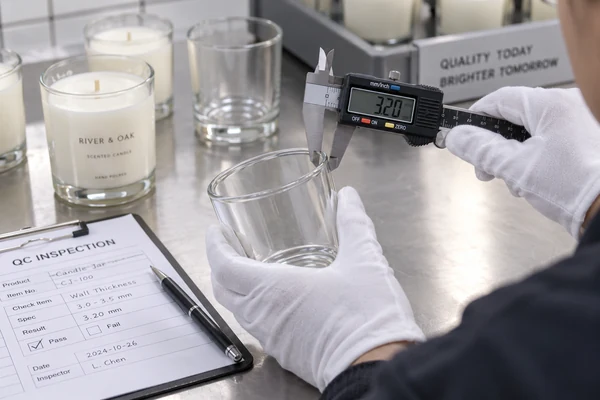
A proper assessment involves both a physical inspection of the sample and a review of the supplier's technical files. In my experience, many hidden risks are revealed during this stage. For instance, a jar might look beautiful, but if it was produced with a shortened annealing time to speed up production, it's a ticking time bomb.
Use this table as a guide to structure your evaluation and conversations with potential suppliers.
| Evaluation Item | What to Check (Sample/Doc) | Key Questions to Ask Your Supplier |
|---|---|---|
| Geometry & Dimensions | Physical sample, technical drawing (CAD file) | Does the height-to-diameter ratio allow for stable burning? Is the opening wide enough for proper oxygen flow and heat dissipation? Is the base thick enough to insulate the surface below? |
| Wall Thickness Uniformity | Physical sample (visual/caliper check), QC reports | Is the wall thickness consistent from top to bottom and all the way around? Can you provide data from your infrared or caliper inspections showing the tolerance range? |
| Material Specification | Material Safety Data Sheet (MSDS), supplier spec sheet | What is the exact material composition (e.g., high-white soda-lime glass, borosilicate)? Are there any heavy metals or restricted substances present? |
| Annealing Process | Production process documentation, QC records | Can you describe your annealing process? What is the duration and temperature curve for this specific vessel? How do you verify that internal stress has been properly relieved? |
| Thermal Shock Resistance | Internal test reports, third-party lab reports | Has this vessel undergone thermal shock testing? If so, what were the parameters (e.g., temperature differential, duration) and what were the results? |
| Surface & Decoration | Physical sample, decoration spec sheet | For coated or decorated jars, what is the heat resistance of the coating? Has the decorated vessel been tested for adhesion and safety after prolonged heat exposure? |
When reviewing documents, always check that the report corresponds to the exact vessel model and production batch you are evaluating. A test report for a different jar is irrelevant to your project. This methodical approach is the foundation for building a safe and reliable product.
How Do You Evaluate the Complete Candle System?
Securing a well-made vessel is only half the battle. As we've established, the ultimate safety of a candle depends on the interaction between the jar, wax, fragrance, and wick. Therefore, the final and most crucial step is to test the complete candle system.
The vessel supplier can provide a safe component, but only you, the brand, can validate the safety of the final product. This responsibility cannot be outsourced. A structured burn test is not optional—it's a fundamental part of product development and liability management.
Dive Deeper: Documenting Your Validation Process
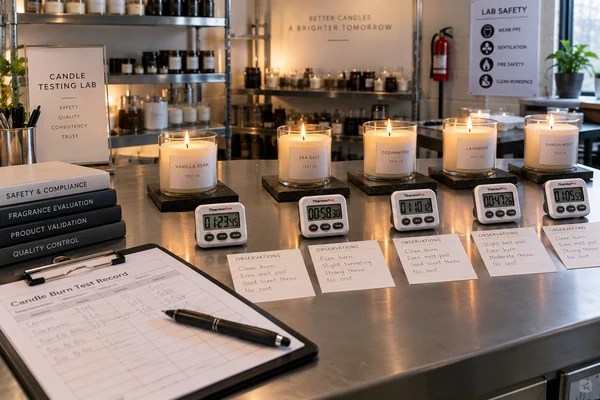
The goal of a burn test is to simulate both normal and foreseeable misuse scenarios to ensure the candle performs safely and consistently. This isn't just about lighting a wick and watching it; it's about collecting data in a structured way.
At Bright Glassware, while we provide robust, pre-tested vessels, we always advise our clients to conduct their own end-product validation. Your internal records are your proof of due diligence.
Here is a basic template for a validation record you can adapt:
| Record Field | Example Entry / Information to Include |
|---|---|
| Product SKU / Name | "Midnight Jasmine" Luxury Candle / SKU 789-MJ |
| Vessel Information | Supplier: Bright Glassware, Model: BGC8090, Material: Heavy-Base Soda-Lime Glass |
| Wax & Fragrance | Wax: Golden Brands 464 Soy Wax6, Fragrance: "Jasmine Noir" @ 8% load |
| Wick Configuration | Wick: CDN 18, centered, set with wick sticker |
| Fill & Production | Fill Volume: 220g, Poured at 165°F, Cured for 7 days |
| Test Protocol | Based on ASTM F24177 (Standard Specification for Fire Safety for Candles) |
| Test Cycles | 5 cycles of 4-hour burns, observing flame height, container temp, and end-of-life behavior. |
| Results & Observations | Max flame height: 2.5". Max container temp: 155°F at top edge. No cracking, sooting, or instability. Vessel remained intact at end-of-life. |
| Status & Reviewer | Passed. Reviewed by: [Product Manager Name], Date: [Date] |
This record connects the vessel you procured to the final product you're selling. It confirms that the wick you chose doesn't create excessive heat, that the glass doesn't crack under sustained temperatures, and that the entire system is stable from the first light to the final flicker. Without this documented link, your safety claims are unsupported.
When Does a Vessel Need Further Assessment?
While a structured sourcing process is ideal, sometimes you'll encounter situations that fall outside the standard workflow. Knowing the red flags that demand extra scrutiny is key to avoiding costly mistakes and ensuring you know what jars are safe for candles in every scenario.
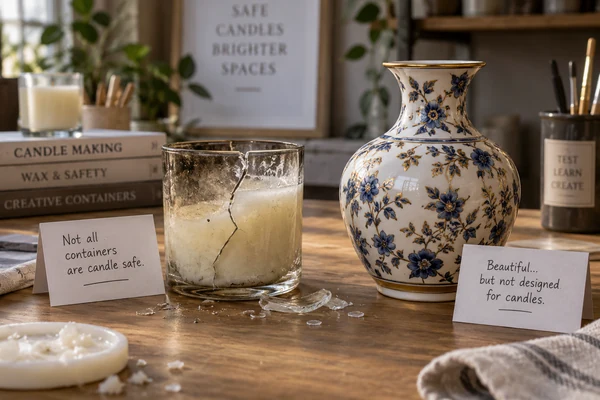
A common misstep is repurposing containers intended for other uses, like food storage. Just because a Mason jar can handle boiling water doesn't mean it's been annealed to withstand the focused, prolonged heat from a candle flame. These situations require a full stop and reassessment.
Dive Deeper: Red Flags That Require a Deeper Look
If you encounter any of the following situations, do not approve the vessel for production without gathering more information and likely conducting a full validation test from scratch.
- Repurposed Containers: Jars originally designed for food, beverages, or storage have not been engineered or tested for candle safety. Their thermal properties are unknown.
- Missing Info: Annealing records, thermal shock data8.
- Next Step: Avoid for commercial production. If for personal use, test with extreme caution.
- Vessels with Unknown History: Sourcing from liquidation sales or using vintage/second-hand glass is extremely risky. You have no idea about the manufacturing process or whether the glass has sustained micro-fractures.
- Missing Info: All manufacturing and QC data.
- Next Step: Reject for any commercial application.
- Visible Damage or Defects: Even small chips, scratches, or "wavy" inconsistencies in the glass can create stress points. During heating, these can easily develop into full-blown fractures.
- Missing Info: The structural integrity of the vessel is compromised.
- Next Step: Immediately quarantine and reject the affected units.
- Post-Purchase Modifications: If you apply your own coating, paint, or decals to a plain jar, you have fundamentally changed its properties. The new surface may not be heat-resistant and could release toxic fumes.
- Missing Info: Safety and heat resistance of the modified vessel.
- Next Step: Conduct a full burn test on the modified vessel as if it were a new product.
- Refill Scenarios: If you plan to offer a candle refill service9, you must account for the fact that the original vessel may have been weakened by its first use cycle.
- Missing Info: The cumulative thermal stress on the container.
- Next Step: Develop a strict inspection protocol for returned jars and communicate clearly to customers that only undamaged vessels can be refilled.
When approaching a supplier for a new project, providing a clear brief helps them help you. Be ready to share: your target vessel style, capacity, decoration needs, and—most importantly—your intended wax and wick configuration. This enables a professional supplier to recommend a vessel that is not just beautiful, but fundamentally safe.
Frequently Asked Questions
Can any glass jar be used for a candle?
No. Only glass vessels specifically designed, manufactured, and tested for candle use should be considered. Factors like glass composition, wall thickness uniformity, and proper annealing are critical for safety. Using a random glass jar, such as one for food storage, poses a significant risk of cracking or shattering from thermal stress.
Does thicker glass guarantee better performance?
Not necessarily. While a thick, heavy base is excellent for insulating the surface underneath the candle, overall safety is more dependent on uniform wall thickness and the annealing process. A jar with uneven walls—thin in one spot and thick in another—is far more likely to crack from uneven heat expansion than a thinner but perfectly uniform one.
Can the vessel supplier approve my final wick and formula?
No. A reputable vessel supplier can provide extensive data, test reports, and recommendations for their containers based on common use cases. However, they can only approve their component. The final approval of the complete candle system—the specific combination of your chosen jar, wax, fragrance, and wick—is the responsibility of the candle brand after conducting thorough end-product burn tests.
Conclusion
Determining what jars are safe for candles requires moving beyond aesthetics and adopting a systematic, evidence-based approach. Safety is not a feature of a single material but the outcome of a well-designed system. It begins with selecting a vessel manufactured with strict process controls, like proper annealing and uniform wall thickness. It continues with verifying supplier documents and, most critically, concludes with rigorous testing of the final, complete candle. Don't let your brand's reputation rest on an untested, generic container. Safety is the ultimate passport to earning customer trust and building a premium brand.
If you are ready to build your next candle or home fragrance line on a foundation of proven safety and industrial-grade quality, our team is here to help. Contact Bright Glassware today to discuss your project specifications, and let us provide you with a vessel solution that is engineered to perform.
"Open Flame / Candle Guide", https://umdearborn.edu/environmental-health-and-safety/fire-and-life-safety/fire-safety-guides/open-flame-candle-guide. Glass safety for candle containers is influenced by factors such as annealing, wall thickness uniformity, and thermal shock resistance, as outlined in educational resources on material engineering and product safety standards. Evidence role: general_support; source type: education. Supports: The importance of design, manufacturing quality, and system suitability in determining candle jar safety.. Scope note: Specific application to candle jars may require additional industry-specific testing. ↩
"Analysis of Glass Mold to Enhance Rate of Heat Transfer", https://digitalcommons.usf.edu/etd/1293/. Annealing is a critical process in glass manufacturing that reduces internal stress, improving the material's ability to withstand thermal and mechanical loads, as detailed in material science research. Evidence role: mechanism; source type: research. Supports: The role of annealing in removing internal stress from glass containers.. Scope note: The research may not specifically address candle jars but applies broadly to glass products. ↩
"A Practical Petition | Stories | Notre Dame Magazine", https://magazine.nd.edu/stories/a-practical-petition/. Testing protocols, such as those outlined in ASTM F2417, emphasize the importance of validating candle jars under realistic use conditions to ensure thermal shock resistance. Evidence role: case_reference; source type: institution. Supports: The necessity of testing candle jars with the final configuration to ensure safety.. Scope note: Specific results may vary depending on the exact testing parameters and materials used. ↩
"HEAT AND MASS TRANSPORT INSIDE A CANDLE WICK", https://etd.ohiolink.edu/acprod/odb_etd/ws/send_file/send?accession=case1157564736&disposition=inline. Studies on candle performance show that larger or multiple wicks increase flame height and heat output, which can affect container safety, as detailed in combustion research. Evidence role: mechanism; source type: research. Supports: The relationship between wick size, number, and heat output in candles.. Scope note: Specific wick types and configurations may require individual testing. ↩
"Candle Making Manual Daily", https://discover.hastings.edu/assets/default/wEP765uqkD1e/Making_Manual_Daily. Industry guidelines recommend that suppliers provide detailed documentation, including thermal shock resistance and annealing records, to verify the safety of candle containers. Evidence role: expert_consensus; source type: institution. Supports: The need for suppliers to provide data supporting the safety of candle containers.. Scope note: Documentation quality may vary between suppliers. ↩
"REQUEST FOR PROPOSAL BID SOLICITATION ...", https://uapb.edu/wp-content/uploads/2024/05/UAPB-A183-Campus-Food-Service-with-Management.pdf. Golden Brands 464 Soy Wax is widely used in candle production and supports fragrance loads up to 10%, as documented in product testing reports. Evidence role: case_reference; source type: research. Supports: The suitability of Golden Brands 464 Soy Wax for candle production with specific fragrance loads.. Scope note: Performance may vary based on specific fragrance formulations and wick configurations. ↩
"Candles Business Guidance", https://www.cpsc.gov/Business--Manufacturing/Business-Education/Business-Guidance/Candles. ASTM F2417 outlines fire safety specifications for candles, including testing protocols for flame height, container temperature, and end-of-life behavior. Evidence role: case_reference; source type: government. Supports: The relevance of ASTM F2417 as a standard for fire safety in candles.. Scope note: The standard provides general guidelines but may require adaptation for specific products. ↩
"A Practical Petition | Stories | Notre Dame Magazine", https://magazine.nd.edu/stories/a-practical-petition/. Educational resources emphasize that repurposed containers often lack the necessary manufacturing and testing data to ensure safety under candle use conditions. Evidence role: expert_consensus; source type: education. Supports: The importance of annealing and thermal shock testing for glass containers used in candles.. Scope note: Specific risks may vary depending on the original use and material of the container. ↩
"Fact Sheet: Glassware Handling | PennEHRS", https://ehrs.upenn.edu/health-safety/lab-safety/chemical-hygiene-plan/fact-sheets/fact-sheet-glassware-handling. Studies on material fatigue suggest that repeated thermal cycles can weaken glass containers, increasing the risk of failure during subsequent uses. Evidence role: mechanism; source type: research. Supports: The potential weakening of glass containers due to repeated thermal stress from candle use.. Scope note: Specific effects depend on the glass type and use conditions. ↩
Keep Reading