
Finding the right partner for your brand can feel overwhelming, especially when every vendor claims to offer "premium quality." You're looking for the best luxury candle container suppliers, but you're met with inconsistent samples and vague promises that could jeopardize your brand's reputation. Choosing the wrong supplier can lead to cracked glass, ill-fitting lids, and flawed finishes that cheapen your product and erode customer trust.1 The solution lies in a systematic evaluation process that moves beyond a simple price list to a deep analysis of capabilities, quality, and partnership potential.
To properly evaluate the best luxury candle container suppliers, you must move beyond marketing claims and superficial price comparisons. The most effective method involves comparing candidates against a unified project specification, rigorously verifying physical samples and quality control records, analyzing their complete commercial and delivery terms, and using a structured evaluation worksheet to make an informed, evidence-based decision.
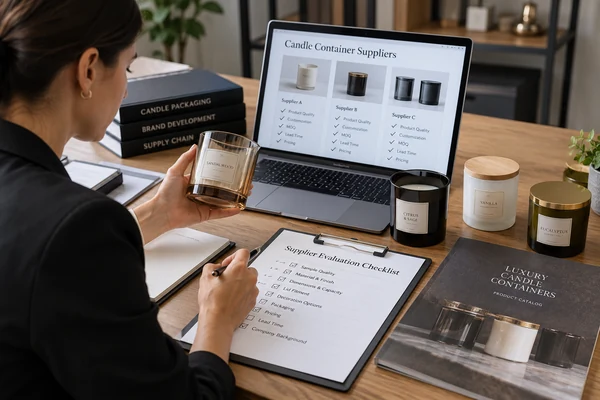
A beautiful catalog photo or a low unit price tells you very little about a supplier's ability to deliver tens of thousands of flawless units on time. The real assessment begins long before you ask for a quote. It starts with defining exactly what you need, so you can compare potential partners on a level playing field. Let's explore the steps to do this right.
Define the Comparison Specification
You've sent out inquiries and now have three quotes on your desk, but the prices are wildly different. How can this be? It's likely because each supplier is quoting for a slightly different product. To compare apples to apples, you must first create a document that defines the apple in meticulous detail.
Before you even contact potential suppliers, you should create a detailed comparison specification. This document serves as your project's blueprint, outlining your exact requirements for material, dimensions, capacity, lids, decoration, packaging, quantity, and delivery. This ensures every quote you receive is based on the exact same criteria, making your comparison meaningful.
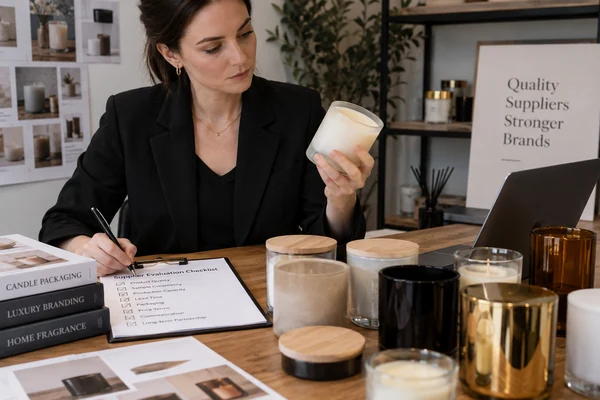
A specification sheet translates your brand's vision into a set of verifiable technical requirements that a factory can actually produce.2 Instead of asking for a "heavy, high-end feel," you specify a glass weight of 450g +/- 10g and a wall thickness of 3mm. This removes ambiguity and forms the foundation of a successful manufacturing partnership.
From Vision to Verifiable Specs
A truly luxurious product is defined by its attention to detail. Your specification sheet must capture these nuances. For example, when evaluating glass, the first test for a luxury supplier isn't the shape, but the "optical flatness" of the glass itself. After years of producing for high-end brands, I've learned a simple insider trick: hold an empty jar against a strong light. Inferior molding and drawing processes create a subtle, wavy distortion on the inner wall.3 This "waviness" can make expensive, clean-burning soy wax look like cheap, mottled paraffin. A top-tier supplier's high-white glass must be optically flat, with zero tolerance for visible seam lines, scratches, or bubbles over 1mm.
Your specification document should clearly outline the following:
- Vessel Material & Style: Specify the glass type (e.g., standard flint, high-white, borosilicate for heat resistance) and reference a style code from the supplier’s catalog or your own design.
- Dimensions & Capacity: Provide exact measurements for height, inner/outer diameter, and define the capacity you need (e.g., 8 oz / 240g wax fill volume).
- Lid & Fitment: Detail the lid material (e.g., zamac, wood, bamboo), the desired fit (friction fit, screw-on), and any gasket or seal requirements for fragrance preservation.
- Decoration & Finish: Provide Pantone codes for any spray colors. Specify the type of decoration (e.g., silk-screen printing, hot stamping, decal) and the finish (e.g., matte, glossy, frosted).
- Packaging Requirements: Describe your ideal retail and transit packaging, such as an individual retail box, a 12-pack inner carton, and a heavy-duty master carton for export.
- Order Quantity: State your estimated order volume, and ask for pricing at different tiers if applicable.
- Logistics: Define the final destination port or address and your preferred Incoterms (e.g., FOB, DDP) to ensure you are comparing total landed costs.
Verify Samples, Capabilities and Quality Records
A supplier's website shows stunning product photos, and the first sample they sent is beautiful. But can they replicate that quality across an order of 50,000 units? A single "golden sample" is a marketing tool, not a guarantee of production capability. True verification requires digging deeper.
To properly vet a candle container supplier, you must verify their claims by requesting and inspecting physical production samples, reviewing their quality control documentation, and getting tangible evidence of their customization capabilities. This step is non-negotiable for confirming that their mass-produced goods will consistently match the quality of the sample you approved.
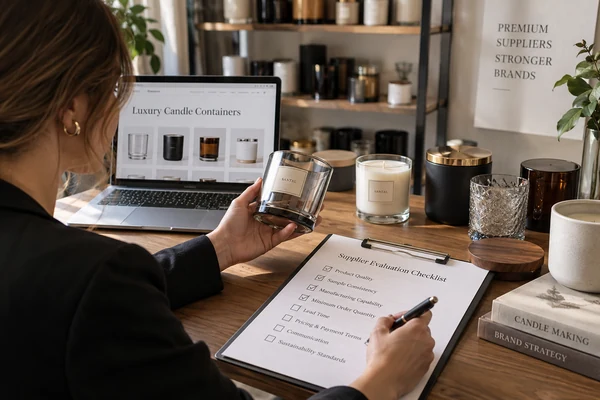
This is where you separate the true manufacturing partners from the mere traders. A professional supplier will welcome this scrutiny and readily provide the necessary documentation and samples. A hesitant or evasive response is a significant red flag.
Micro-Millimeter Tolerances
Luxury is often a game of millimeters.4 A premium candle paired with a heavy zamac or solid wood lid creates a powerful sensory experience. But if the glass jar's mouth opening has a tolerance deviation of just 0.5mm, that lid will either be too tight to open or feel loose and cheap. Your brand's perceived value can collapse in that single moment of interaction. When we produce for discerning brands, we rely on automated infrared inspection and caliper checks to ensure extreme consistency in diameter, height, and wall thickness. Ask potential suppliers for their standard dimensional tolerance specifications.
The Environment for Decoration
A raw glass jar is a blank canvas; the decoration gives it a designer soul. Many buyers are impressed by a beautiful decorated sample, only to receive a bulk order where the spray paint is dotted with dust particles or the hot-stamped logo scratches off with a fingernail. This is often a result of a poor processing environment. When evaluating a supplier, ask to see their decoration workshop. The finishing for luxury candle jars and perfume bottles must happen in a controlled, near-dust-free environment to ensure batch-to-batch color consistency and decoration durability that passes adhesion tests.
Respect for Thermal Dynamics
A luxury candle that shatters on a customer's mahogany table is a brand-ending disaster. You must assess if your supplier understands the science of heat. Ask them about their annealing process—the controlled cooling of the glass to remove internal stresses. A longer, more gradual annealing process is critical for candle safety.5 For large, multi-wick candles that generate significant heat, ask if they can produce with borosilicate glass, which is designed to withstand extreme thermal shock. A professional supplier will also provide guidance on safe design geometry, steering you toward stable shapes that promote a perfect full melt pool and prevent dangerous tunneling or cracking.6
Use this checklist to guide your verification process:
| Evaluation Item | What to Request from Suppliers | What to Confirm and Verify |
|---|---|---|
| Glass & Material Quality | Pre-production samples from a real batch. | Optical clarity (no "waviness"), zero visible scratches or prominent seam lines, minimal bubbles. |
| Dimensional Accuracy | The product's technical drawing with tolerances. | Consistent mouth diameter for a perfect lid fit, stable base, uniform wall thickness. |
| Decoration & Finish | Samples featuring your specific color and logo. | Color matches your Pantone standard, logo adhesion passes a cross-hatch test, finish is uniform. |
| Quality Control System | Examples of their internal QC checklists/reports. | What specific defects do they check for? What is their acceptance threshold? How do they ensure consistency? |
| Certifications & Testing | Copies of any claimed certificates (e.g., ISO 9001). | Check that the certificate is valid and its scope applies to the products you are buying. |
Compare Commercial and Delivery Terms
Supplier A's unit price is 10% lower than Supplier B's. This seems like an easy decision, right? But what if Supplier A's quote excludes lids and packaging, has double the minimum order quantity, and quotes "ex-works" pricing? The lowest unit price is rarely the lowest total cost.7
A true cost comparison requires you to analyze the supplier's complete commercial offer, not just the per-piece price of the glass. You must diligently evaluate the Minimum Order Quantity (MOQ), production lead times, payment terms, and exactly what is included in the quote to understand the total cost of ownership.
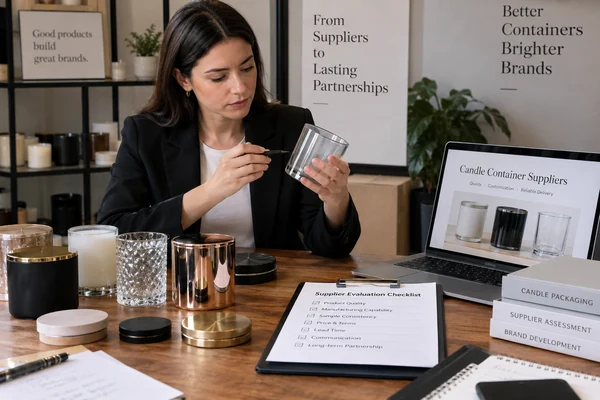
To accurately compare offers, you need to normalize them. If one supplier quotes FOB (Free On Board) and another quotes DDP (Delivered Duty Paid), the prices are not directly comparable. You must add the costs of ocean freight, insurance, customs clearance, and duties to the FOB price to get a true "landed cost" equivalent.
The Final Mile: Retail-Ready Packaging
The luxury experience begins the moment your shipment arrives. If a supplier sends your expensive glass jars loosely wrapped in bubble film on a disorganized pallet, they are not a luxury-tier partner. Breakage during transit eats into your profits and delays your launch.8 A top-tier supplier thinks beyond the factory gate and provides a complete packaging system.9 For our clients, we often design a matrix structure—such as 12 jars per inner box, with multiple inner boxes in a reinforced master carton. This not only achieves near-zero breakage during international transit but also creates a "retail-ready" system that allows distributors to stock shelves directly from the case. This protects your logistics budget and ensures a pristine unboxing experience.
When reviewing quotes, ensure you have clear answers to these questions:
- Price Inclusions: Does the unit price cover the glass jar, the lid, all decoration processes, and the individual retail box?
- Tooling & Sampling Fees: Are there one-time mold fees for custom shapes or setup charges for printing plates? How are pre-production samples costed?
- Minimum Order Quantity (MOQ): Is the MOQ applied per order, per SKU, or per color/finish? Does this align with your sales forecast and inventory strategy?
- Production Lead Time: When does the lead time officially begin—after deposit payment or after final sample approval? This can impact your timeline by weeks.
- Payment Terms: What is the required deposit percentage? When is the final balance due (e.g., before shipping, upon bill of lading)?
- Shipping & Incoterms: Does the quote specify the shipping terms (e.g., FOB, CIF, DDP)? This determines who is responsible for cost and risk during transit.
Use a Supplier Evaluation Worksheet
You've gathered technical specifications, inspected samples, and analyzed commercial quotes. Now your desk is overflowing with notes, emails, and spreadsheets. How do you consolidate all of this disparate information to make a clear, confident, and defensible sourcing decision?
The most effective way to finalize your choice is to consolidate all your findings into a supplier evaluation worksheet. This simple but powerful tool allows you to score and compare your top candidates side-by-side across all the critical criteria you've established, from technical compliance to total landed cost. This transforms a complex decision into a logical, objective process.
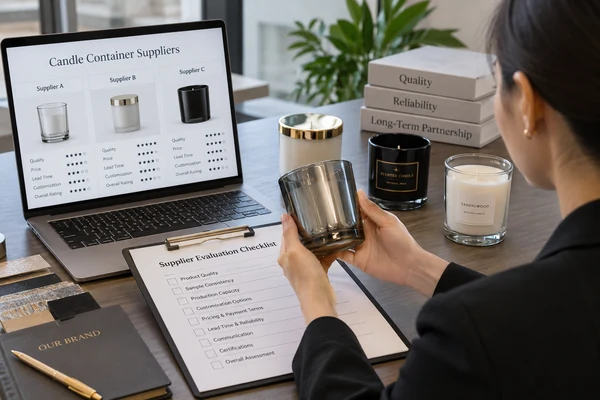
This worksheet serves as your decision-making dashboard. It helps you move past gut feelings and focus on the data you've painstakingly collected. It also becomes an invaluable internal document for justifying your sourcing choice to other stakeholders in your company.
Here is a template you can adapt for your own evaluation process:
| Evaluation Criteria | Candidate A | Candidate B | Candidate C |
|---|---|---|---|
| Specification Compliance | |||
| Sample Quality (Glass Clarity) | |||
| Sample Quality (Lid Fit & Finish) | |||
| Decoration Capability & Proof | |||
| QC Records & Process | |||
| Total Landed Cost per Unit | |||
| Minimum Order Quantity (MOQ) | |||
| Production Lead Time | |||
| Packaging Solution Quality | |||
| Communication & Responsiveness | |||
| Key Issues / Unanswered Questions | |||
| Next Step (e.g., Order, Re-sample) |
Preparing Your Initial Inquiry
To get the quality information needed to fill out this worksheet, your initial inquiry to suppliers must be clear and comprehensive. A well-crafted inquiry signals that you are a serious, professional buyer.10 Be sure to include:
- Project Overview: A brief description of your brand and project.
- Vessel of Interest: A reference photo, drawing, or style number.
- Key Specifications: Desired capacity, critical dimensions, and material.
- Lid & Accessories: Details on the required lid and any other components.
- Decoration & Branding: Your desired color (Pantone), finish, and logo application.
- Packaging: Your requirements for both retail and transit packaging.
- Estimated Quantity: Your target order volume.
- Destination: Your final delivery city and country for shipping cost estimation.
Frequently Asked Questions
What should be compared beyond unit price?
Beyond unit price, you must compare the total landed cost, which includes all components (jar, lid, box), decoration, sampling fees, tooling, packaging, shipping, insurance, and duties. Equally important are non-monetary factors like MOQ, lead time, documented quality control processes, packaging integrity, and the supplier's responsiveness and ability to solve problems.
Does a US-related search require a US-based factory?
Not necessarily. While sourcing from a US-based factory or distributor can sometimes offer faster shipping for in-stock items, many US brands work directly with experienced international manufacturers. This often provides access to a much wider range of customization options, proprietary mold development, and competitive pricing. The key is to clarify delivery terms (like DDP - Delivered Duty Paid), which means the overseas supplier handles everything, delivering the goods directly to your door at a fixed landed cost.
How can a supplier claim be checked?
Verify all claims by requesting tangible evidence. Instead of accepting vague terms like "premium quality," request physical samples from a production run to inspect and test yourself. If a supplier claims they are "certified," ask for a copy of the certificate and verify its authenticity, scope, and expiration date. For claims of "advanced capabilities," ask to see samples of past projects that used the specific decoration technique or material you require.
Conclusion
Selecting the right manufacturing partner is one of the most critical decisions you will make for your candle brand.11 The process of finding the best luxury candle container suppliers is not about finding the cheapest price or the most polished sales pitch. It is a methodical process of due diligence. By first defining a clear specification, rigorously verifying samples and capabilities, comparing complete commercial terms, and using a structured worksheet, you can move from ambiguity to clarity. This empowers you to choose a true partner—one who can consistently deliver the quality your brand deserves and help you scale with confidence.
Ready to begin the evaluation process with a supplier who understands the nuances of luxury packaging? Review our extensive collection of vessel options or submit your project requirements to our team today. We can help you build a comprehensive specification and discuss the sampling and customization process for your next signature collection.
"Glass Candles: 5 Common Errors and Misconceptions", https://himalayantradingpost.com/glass-candles-5-common-errors-and-misconceptions/?srsltid=AU7gw4Vpc_Wce0wd_juaCmgtrUxkULXIZXJsqxfYCc1wZbmbvKTYL0e1. A study on manufacturing defects in glass products highlights common issues such as cracking and dimensional inconsistencies caused by inadequate quality control processes during production. Evidence role: general_support; source type: research. Supports: Poor supplier selection can result in product defects such as cracked glass and flawed finishes.. Scope note: The study may not specifically address candle containers but provides general insights into glass manufacturing defects. ↩
"Specification (technical standard)", https://en.wikipedia.org/wiki/Specification_(technical_standard). Educational resources on product design emphasize the role of detailed specification sheets in reducing production errors and ensuring consistency. Evidence role: expert_consensus; source type: education. Supports: Specification sheets are critical for ensuring manufacturing aligns with design and technical requirements.. Scope note: The source may focus on general manufacturing rather than luxury candle containers specifically. ↩
"thermomechanical modeling and analysis of precision glass", https://ninercommons.charlotte.edu/record/2596/files/Bobba_uncc_0694D_13553.pdf. Research on glass manufacturing identifies uneven cooling and improper molding techniques as common causes of distortions in glass products. Evidence role: mechanism; source type: research. Supports: Wavy distortions in glass can result from suboptimal molding and drawing processes.. Scope note: The findings may apply broadly to glass products and not specifically to candle containers. ↩
"An Overview of the Luxury Fashion Industry - PMC", https://pmc.ncbi.nlm.nih.gov/articles/PMC7355146/. Industry guidelines for luxury goods emphasize the importance of tight tolerances to ensure product consistency and customer satisfaction. Evidence role: general_support; source type: institution. Supports: Precision in manufacturing is critical for maintaining the quality and perception of luxury products.. Scope note: The guidelines may not specifically address candle containers but apply broadly to luxury manufacturing. ↩
"Candles Business Guidance", https://www.cpsc.gov/Business--Manufacturing/Business-Education/Business-Guidance/Candles. Studies on glass annealing show that extended cooling periods improve material stability and reduce the risk of cracking under thermal stress. Evidence role: mechanism; source type: research. Supports: Gradual annealing reduces internal stresses in glass, enhancing its safety for applications like candle containers.. Scope note: The studies may not specifically address candle containers but provide general insights into glass safety. ↩
"Candle Jars Complete Guide: Materials, Sizes, Safety & ...", https://fhpkg.com/blogs/news/candle-jars-complete-guide?srsltid=AU7gw4XYDY5FpBcolv1tQYsPF3f8t39jOGbRdz8Rpd-a9i0sRIKPzL2z. Educational resources on candle design highlight the importance of container shape in achieving a full melt pool and preventing tunneling. Evidence role: expert_consensus; source type: education. Supports: Proper design geometry is essential for safe and effective candle performance.. Scope note: The resources may focus on general candle design rather than supplier-specific practices. ↩
"The Hidden Value in Procurement Terms - Wharton Magazine", https://magazine.wharton.upenn.edu/digital/the-hidden-value-in-procurement-terms/. Educational resources on procurement highlight that unit price often excludes additional costs like shipping, packaging, and duties, which contribute to the total cost. Evidence role: general_support; source type: education. Supports: Total cost analysis is necessary to understand the true financial impact of sourcing decisions.. Scope note: The resources may focus on general procurement rather than luxury candle containers specifically. ↩
"Glass Shipment Damage: How to Prevent $4.7B Annual ...", https://impactograph.com/the-true-cost-of-glass-shipment-damage-a-4-7-billion-problem-with-a-data-driven-solution/. Studies on logistics and packaging report that inadequate packaging is a leading cause of product damage during transit, particularly for fragile items like glass. Evidence role: statistic; source type: research. Supports: Transit breakage is a common issue that can lead to financial losses and delays.. Scope note: The studies may not specifically address candle containers but provide general insights into transit breakage. ↩
"Glass Packaging Solutions, LLC: Wholesale Glass Bottles and ...", https://glaspak.com/. Industry standards for luxury goods emphasize the role of robust packaging systems in minimizing transit damage and ensuring a premium unboxing experience. Evidence role: general_support; source type: institution. Supports: Comprehensive packaging systems are essential for protecting products during transit and enhancing presentation.. Scope note: The standards may apply broadly to luxury goods and not specifically to candle containers. ↩
"Managing Relationships with Suppliers and Vendors You Use", https://www.apu.apus.edu/area-of-study/business-and-management/resources/managing-relationships-with-suppliers-and-vendors-you-use/. Procurement guides emphasize that clear and comprehensive inquiries improve supplier responsiveness and establish buyer credibility. Evidence role: expert_consensus; source type: education. Supports: Detailed inquiries demonstrate professionalism and help build trust with suppliers.. Scope note: The guides may focus on general procurement practices rather than luxury candle container sourcing. ↩
"The power of partnerships: how companies grow faster ...", https://www.ienyc.edu/the-blueprint/power-of-partnerships/. Case studies from industry reports show that successful brands often attribute their growth to reliable and high-quality manufacturing partners. Evidence role: case_reference; source type: institution. Supports: Strong manufacturing partnerships are essential for ensuring product quality and brand reputation.. Scope note: The case studies may focus on general manufacturing partnerships rather than candle brands specifically. ↩
Keep Reading