
Finding reliable candle jar wholesale partners becomes a critical bottleneck the moment your order volume crosses 3,000 units. Relying on local retail-style distributors drains your profit margins through 50% to 100% middleman markups1 and frequent peak-season stockouts. Transitioning to a direct, turnkey manufacturer secures factory-direct pricing, strict batch consistency, and a resilient global supply chain.
For bulk orders exceeding 3,000 units, the most profitable candle jar wholesale strategy is sourcing directly from a Tier-1 Chinese manufacturer rather than local distributors or trading companies. Direct factory sourcing eliminates middleman markups, ensures strict thermal and dimensional quality control2, and consolidates glass forming, custom surface decoration, lid matching, and export packaging under one roof.
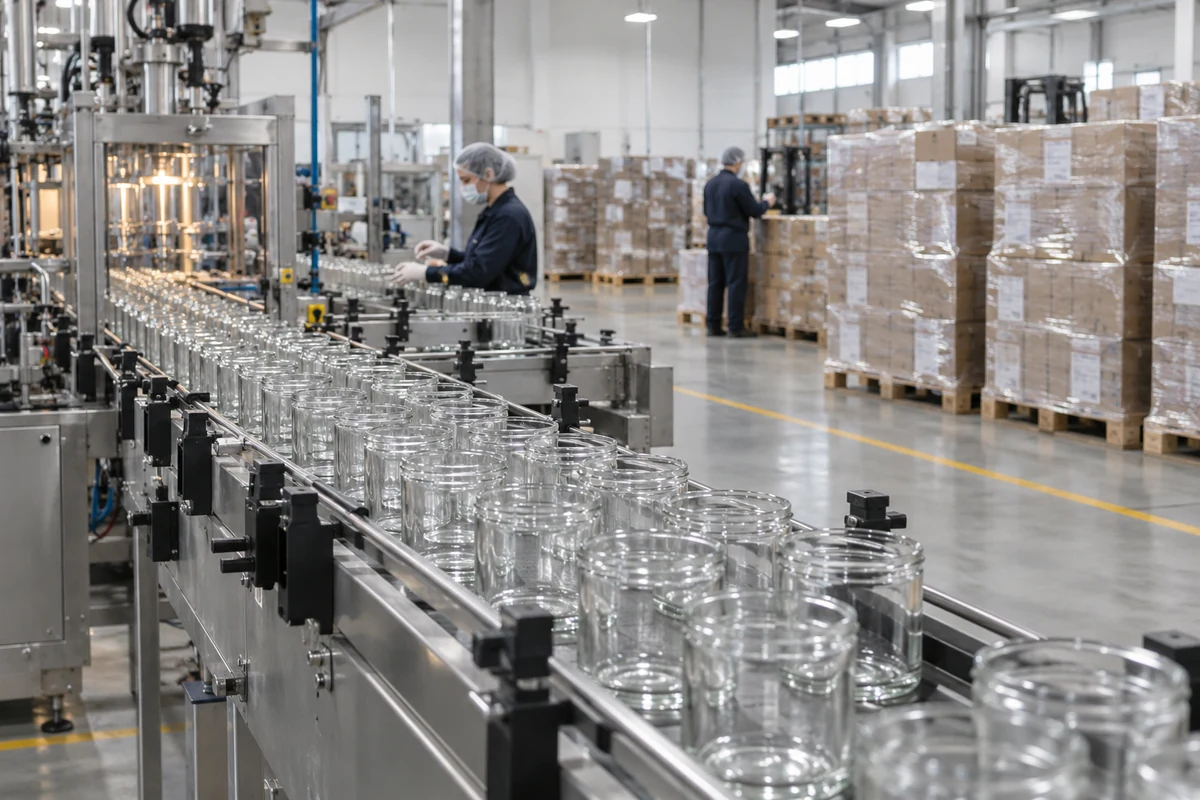
Understanding where to buy is only the first step in scaling your fragrance brand. To truly protect your margins and brand reputation, you need to see how different supply chain models impact your defect rates, customization limits, and final landed costs. Let us break down the global sourcing landscape.
Which Candle Jar Wholesale Channel Fits Your Order Volume?
Many growing candle brands lose tens of thousands of dollars annually because they outgrow their initial supplier without realizing it. Paying local warehouse markups or gambling on unverified online brokers exposes your business to sudden stockouts, inconsistent glass color, and catastrophic vessel breakage during burning3. Comparing the three main candle jar wholesale channels reveals where your capital actually goes.
Your optimal candle jar wholesale channel depends on your scale: local distributors suit trial runs under 1,000 units, while Tier-1 direct manufacturers are built for orders of 3,000+ units. Bypassing trading companies to work directly with a factory eliminates 50%–100% markups4 and guarantees direct control over glass annealing, decoration adhesion, and lid tolerances.

When I speak with procurement managers and brand founders across the US, Europe, and Australia, I often help them audit their existing supply chains. Once your single purchase order reaches 3,000, 10,000, or a full container load, the rules of procurement change completely. Here is an objective breakdown of the three primary sourcing channels in the global market.
Global Sourcing Channel Showdown
| Evaluation Metric | Local Distributors (US / EU / AU) | B2B Platform Trading Companies | Shenzhen Bright Glassware (Tier-1 Direct Factory) |
|---|---|---|---|
| Unit Cost & Markup | High (Includes 50%–100% distributor markup + local warehousing) | Medium (Includes 15%–30% broker commission) | Factory-Direct (Zero middleman markup) |
| MOQ Flexibility | Very Low (1 case to a few pallets) | Flexible (Often mixes remnant stock from small workshops) | Agile Bulk (3,000 pcs for stock molds; 10,000–20,000 for custom molds) |
| Decoration Environment | None (Mostly sells plain, clear stock glass) | Outsourced to fragmented, third-party workshops | In-house automated dust-free spraying, plating, and printing lines |
| Batch Consistency | Moderate (Prone to Q4 peak-season stockouts) | High Risk (Orders shift between different cheap sub-factories) | Strict (Electric furnace melting + locked Golden Sample standards) |
| Lid & Accessory Fit | Sold separately; high risk of fitment gaps | Sourced from disparate vendors; inconsistent tolerances | Sub-millimeter matched wood, metal, or zamac lids under one roof |
| Packaging Standard | Standard domestic cartons; requires repacking | Basic bulk dividers; high ocean transit breakage | Retail-Ready 12-pack inner boxes + heavy-duty master cartons (ISTA 3A tested) |
1. Local Distributors: The Margin Killer for Scaling Brands
Buying by the case from a domestic distributor in your home country is convenient when you are testing a new scent line in your garage. However, over 95% of their inventory is imported from China anyway. When you buy bulk volumes from them, you are paying for their ocean freight, their local warehouse rent, their staff overhead, and a hefty profit margin. Furthermore, local distributors primarily stock generic clear vessels. When the holiday rush hits in Q3 and Q4, classic models frequently go out of stock, stalling your production line right when retail demand peaks.
2. B2B Trading Companies: The Quality Control Blind Box
Platforms like Alibaba are filled with suppliers claiming to be manufacturers. In reality, many are three-person trading desks without a single production line. A trading company might place your first order with Factory A, and then move your reorder to a cheaper workshop, Factory B, to squeeze out an extra 5% margin for themselves.
For you, this creates a quality nightmare. Your second shipment arrives with a noticeable yellow or green tint in the glass, uneven wall thickness, or poor annealing that leads to thermal shock during your burn tests. Because you do not have direct access to the production floor, troubleshooting defects becomes an endless game of finger-pointing.
3. Tier-1 Direct Manufacturers: The Ultimate Profit and Quality Moat
Partnering directly with an established manufacturer like Shenzhen Bright Glassware—operating since 2005—gives you total command over your supply chain. By working directly with a factory equipped with electric melting furnaces, automated forming machines, and in-house dust-free decoration workshops, you capture two massive advantages: source-level cost structure and engineered quality certainty.
How Can You Overcome High MOQs in Candle Jar Wholesale?
Many overseas buyers hesitate to contact top-tier Chinese factories because they assume every order requires a massive 50,000-unit commitment. Locking up all your working capital in excess glass inventory or expensive custom molds can paralyze a growing brand's cash flow. Fortunately, a hybrid "stock mold + custom finish" approach bridges the gap between factory-direct pricing and agile inventory management.
You can bypass 50,000-unit factory minimums by utilizing a manufacturer's validated public molds with custom surface decorations. At Bright Glassware, bulk buyers can access high-clarity public molds—such as our industry-standard BGC7080 and BGC8090 vessels—starting at just 3,000 units, while full custom private tooling requires only 10,000 to 20,000 units.
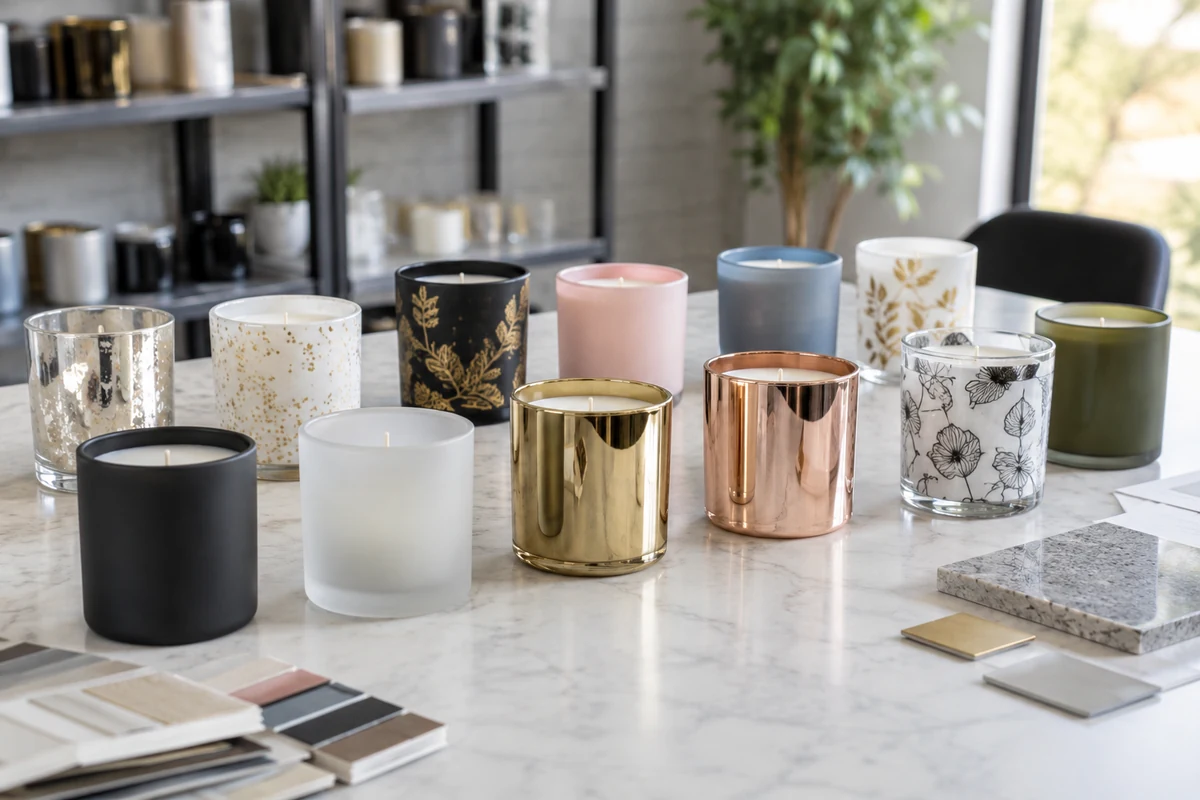
Over my 20 years in the glass packaging industry, I have seen dozens of startup and mid-sized brands scale into international household names. They rarely start by investing tens of thousands of dollars into proprietary molds on day one. Instead, they use an agile procurement strategy that leverages our existing engineering infrastructure.
Asset-Light Scaling with Validated Public Molds (3,000-Unit MOQ)
A true Tier-1 factory maintains an extensive library of proven, thermodynamically balanced public molds. For example, our best-selling BGC7080 (70mm diameter × 80mm height) and BGC8090 (80mm diameter × 90mm height) vessels are engineered around the golden height-to-width ratio of 1:1 to 3:45. These dimensions are pre-validated by candle makers worldwide to work seamlessly with standard professional wicks—such as CDN 14 to CDN 20—ensuring an even melt pool without tunneling or sidewall overheating.
With an MOQ of just 3,000 pieces, you can take these blank crystal-white or high-white public vessels and transform them into bespoke brand assets using our in-house decoration lines:
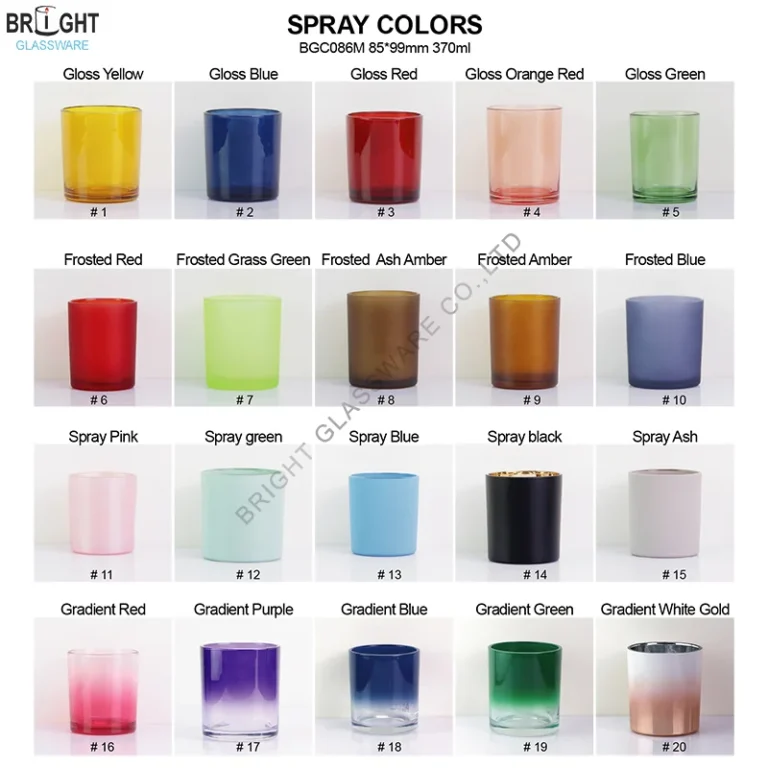
- Custom Color Spraying: Matte, glossy, frosted, translucent, or multi-tone gradient finishes matched precisely to your Pantone codes.
- Vacuum Metallization (Electroplating): Mirror-like gold, silver, rose gold, or gunmetal finishes for luxury seasonal collections.
- Precision Branding: Multi-color screen printing, hot foil stamping with genuine metallic foils, decal application, or recessed label areas.
Rapid Private Mold Development (OEM/ODM)
When your SKU volume matures and your brand demands a proprietary silhouette—or if you want to develop lightweight, high-thermal-resistance borosilicate vessels to save on shipping weight—we make custom tooling highly accessible.
Instead of the prohibitive mold fees charged by legacy glassworks, we offer competitive OEM/ODM tooling development starting at 10,000 to 20,000 units for mass production. You can bring us a 2D sketch, a 3D CAD file, or a physical sample, and our engineering team will deliver physical prototypes and T1 trial samples within 15 days.
Why Should You Avoid Splitting Glass, Decoration, and Lids Across Multiple Vendors?
Trying to save a few cents per unit by purchasing raw glass from one factory, shipping it to a second workshop for painting, and buying lids from a third vendor is the most expensive mistake in candle jar wholesale. When paint peels off or lids fail to seal, each factory blames the others' tolerances, leaving you with unsellable inventory and delayed product launches. Consolidating your entire BOM (Bill of Materials) under one turnkey manufacturer eliminates this friction.
Splitting bulk candle jar procurement across separate glass, decoration, and lid suppliers creates severe accountability gaps and dimensional mismatches6. A one-stop turnkey manufacturer controls raw glass forming, annealing, dust-free coating, and lid engineering simultaneously, guaranteeing sub-millimeter lid fitment and 100% coating adhesion verified by cross-hatch and alcohol rub tests.
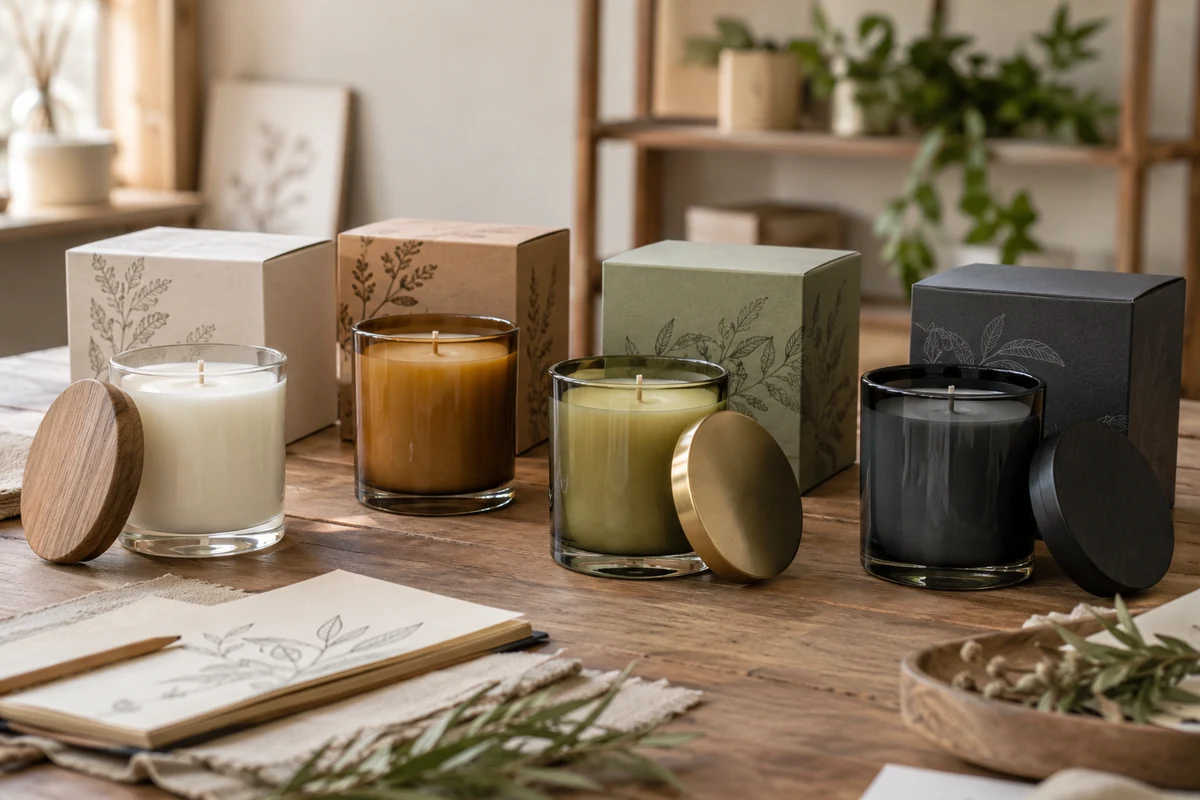
I have rescued many procurement managers who fell into the "multi-vendor trap." On paper, buying raw clear tumblers from Workshop A, trucking them 300 kilometers to Decorator B, and ordering wooden lids from Factory C looks like a clever way to shave $0.03 off the unit price. In practice, it destroys your supply chain reliability.
The Hidden Costs of Fragmented Sourcing
- The Coating Blame Game: If your matte black coating starts flaking or scratching during wax pouring, the spraying workshop will claim the raw glass had mold-release oil residue or surface tension issues. The glass factory will claim the sprayer used inferior paint or improper curing temperatures. You end up absorbing the loss.
- The Lid Tolerance Nightmare: Glass is formed at over 1,500°C. If a low-end factory does not control neck finish tolerances tightly, or if the inner wall suffers from "waviness" (suction distortion during forming), a rigid lid bought from an outside vendor will either rattle loosely or crack the glass rim when pressed down.
- Ocean Freight Mold on Wood Lids: Many standalone wood lid workshops fail to kiln-dry their timber properly. After 30 days inside a humid ocean container, your pine or beechwood lids arrive covered in green mildew.
The Bright Glassware Turnkey Solution
True wholesale procurement is about buying certainty. At Shenzhen Bright Glassware, we integrate every manufacturing stage under a single quality management system:
- Precision Glass Forming & Annealing: We use electric furnaces to produce high-purity flint glass with minimal iron content, eliminating green or yellow tinting. Every jar passes through an extended annealing lehr to remove internal thermal stress, preventing cracking during wax pouring or consumer burning.
- In-House Dust-Free Decoration: Blank jars move directly from our annealing lines into our automated, dust-free spraying and electroplating workshops. Before any batch is approved, we subject decorated jars to rigorous ASTM D3359 cross-hatch adhesion tests7 (100/100 grid pass) and alcohol rub tests to ensure the finish withstands fragrance oil drips and shipping friction.
- Sub-Millimeter Lid & Accessory Matching: Because we hold our jar mouth tolerances within fractions of a millimeter and eliminate inner wall waviness, we engineer our accessories—including kiln-dried, anti-mold treated solid wood lids8, bamboo lids, brushed metal covers, and heavy zamac lids with food-grade silicone gaskets—to achieve a smooth, airtight damping fit.
- Unified Customs & Tariff Efficiency: Shipping complete packaging sets (jar + lid + retail gift box) from a single exporter streamlines your commercial invoices, packing lists, and HS code classifications, reducing customs clearance delays and brokerage fees at your destination port.
How Do Packaging and Container Economics Impact Your Candle Jar Wholesale Landed Cost?
Focusing exclusively on an EXW or FOB unit price is a rookie mistake in international candle jar wholesale. Saving $0.02 per jar at the factory gate means nothing if 5% of your shipment shatters in transit, or if poorly designed cartons waste 15% of your ocean container volume. Calculating your Total Landed Cost9 requires engineering your packaging for both pallet density and warehouse labor efficiency.
Optimizing your candle jar wholesale landed cost requires balancing container volume utilization with transit protection and destination labor costs. Using ISTA 3A drop-tested, retail-ready packaging—such as 12-unit partitioned inner boxes inside heavy-duty five-ply master cartons—eliminates transit breakage, maximizes 20GP/40HQ container loading, and removes expensive domestic repacking labor.
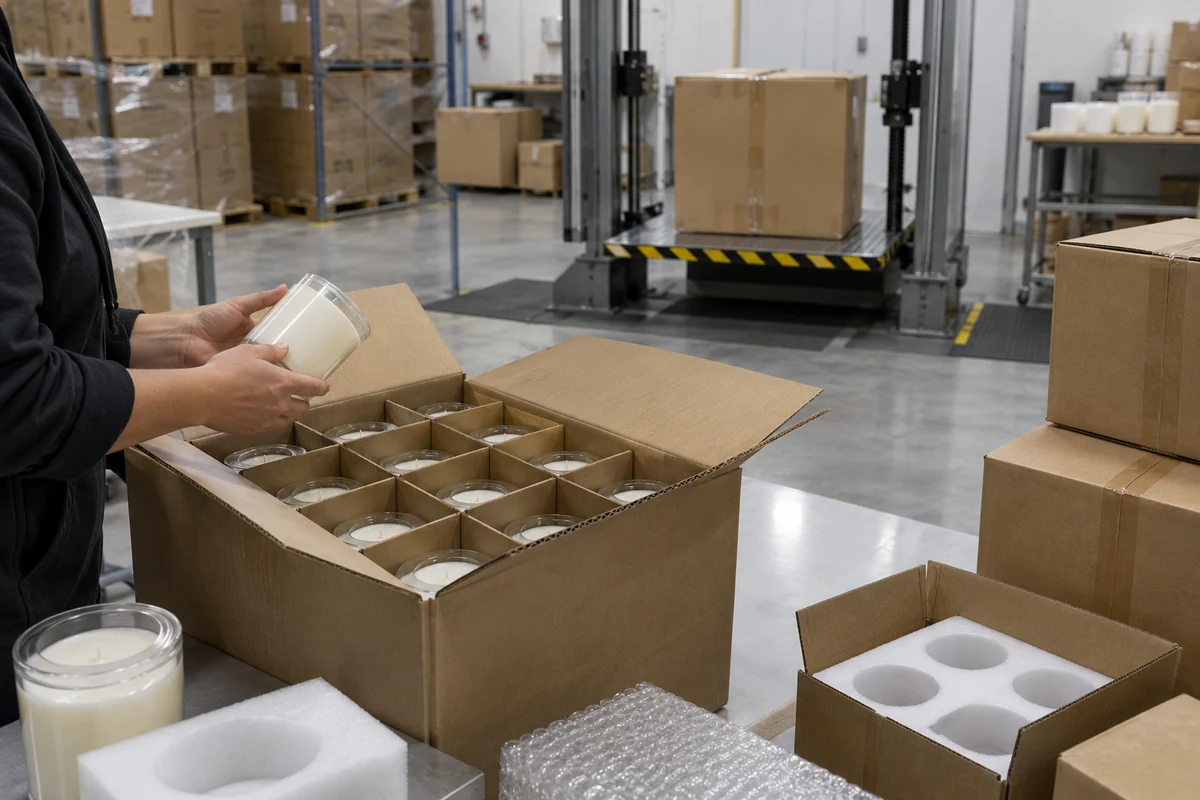
When I help international buyers calculate their true procurement financials, I ask them to look beyond the factory quote and examine what happens the moment the container doors open at their warehouse in Los Angeles, Rotterdam, or Sydney.
1. Retail-Ready Matrix Packaging Saves Local Labor
In high-wage markets like the US, UK, and Australia, warehouse labor is one of your largest operational expenses. If a factory ships your jars in cheap, oversized bulk cartons with flimsy cardboard dividers, your team has to unbox, inspect, clean cardboard dust off the glass, and repack the jars after filling.
To solve this, we standardize Retail-Ready Matrix Packaging for our bulk clients:
- 12-Pack Inner Boxes + Master Cartons: We pack 12 jars into a clean, partitioned inner box, and place multiple inner boxes into a high-strength, five-ply corrugated master carton.
- ISTA 3A Drop-Test Verification: Our packaging structure is engineered to pass ISTA 3A international transit drop tests. Whether shipped via FCL (Full Container Load) or LCL (Less than Container Load), breakage rates are kept near zero.
- Direct-to-Filling Line Workflow: When our pallets arrive at your candle factory or 3PL warehouse, your workers simply open the clean 12-pack box, pour the wax, place the finished candles back into the exact same protective box, and ship them directly to retail stores or distribution centers.
2. Container Cube Optimization (20GP / 40HQ Economics)
Ocean freight rates fluctuate wildly. Shipping "air" inside poorly sized cartons directly erodes your gross margin. Our packaging engineers calculate outer carton dimensions using container-loading software to maximize cubic meter (CBM) utilization across standard 20GP (approx. 28 CBM) and 40HQ (approx. 68 CBM) containers. Increasing container loading efficiency by just 12% to 15% effectively lowers the per-unit freight cost of every single jar in that shipment.
Your 4-Step Risk-Free Global Sourcing Roadmap
To eliminate the anxiety of cross-border procurement, we guide every B2B buyer through a standardized, transparent four-step workflow:
- Step 1: Free Stock Samples or 15-Day Custom Prototyping Request free samples of our validated public molds (like the BGC7080/8090) to test glass clarity and dimensions immediately, or submit your custom artwork/CAD files for rapid 15-day custom sample development.
- Step 2: Burn Testing & "Golden Sample" Sign-Off Conduct your in-house wax pouring, wick compatibility, and thermal burn tests. Once you approve the color, logo, and lid fitment, we seal and sign two identical Golden Samples—one stays in your office, and one locks the quality standard on our production line.
- Step 3: Mass Production & Automated Infrared QC Your bulk order enters our electric furnace and dust-free decoration lines. Every batch undergoes automated infrared inspection and strict manual QC checks to enforce our zero-tolerance standard against scratches, cold marks, and air bubbles larger than 1mm.
- Step 4: ISTA 3A Packaging & Global Ocean Delivery Finished jars and matched lids are packed into ISTA 3A compliant cartons, palletized with corner protectors and stretch wrap, and shipped via FCL/LCL with full export documentation support straight to your port or warehouse door.
How Can You Verify a Candle Jar Wholesale Factory Without Flying to China?
Sending a large wire transfer across the ocean to a supplier you have never visited in person is understandably stressful. Slick websites and polished sales pitches can easily hide outdated equipment, poor working conditions, and non-existent quality control. The most reliable way to vet a candle jar wholesale manufacturer remotely is to audit their existing client roster and third-party factory inspection credentials.
To verify an overseas candle jar wholesale manufacturer without traveling, examine their active tier-one brand authorizations and third-party factory audit reports. Partnering with a supplier audited by global luxury houses and major retail chains—such as Bright Glassware, an authorized supplier for BVLGARI and Costco programs—lets you leverage rigorous, pre-verified quality control systems.
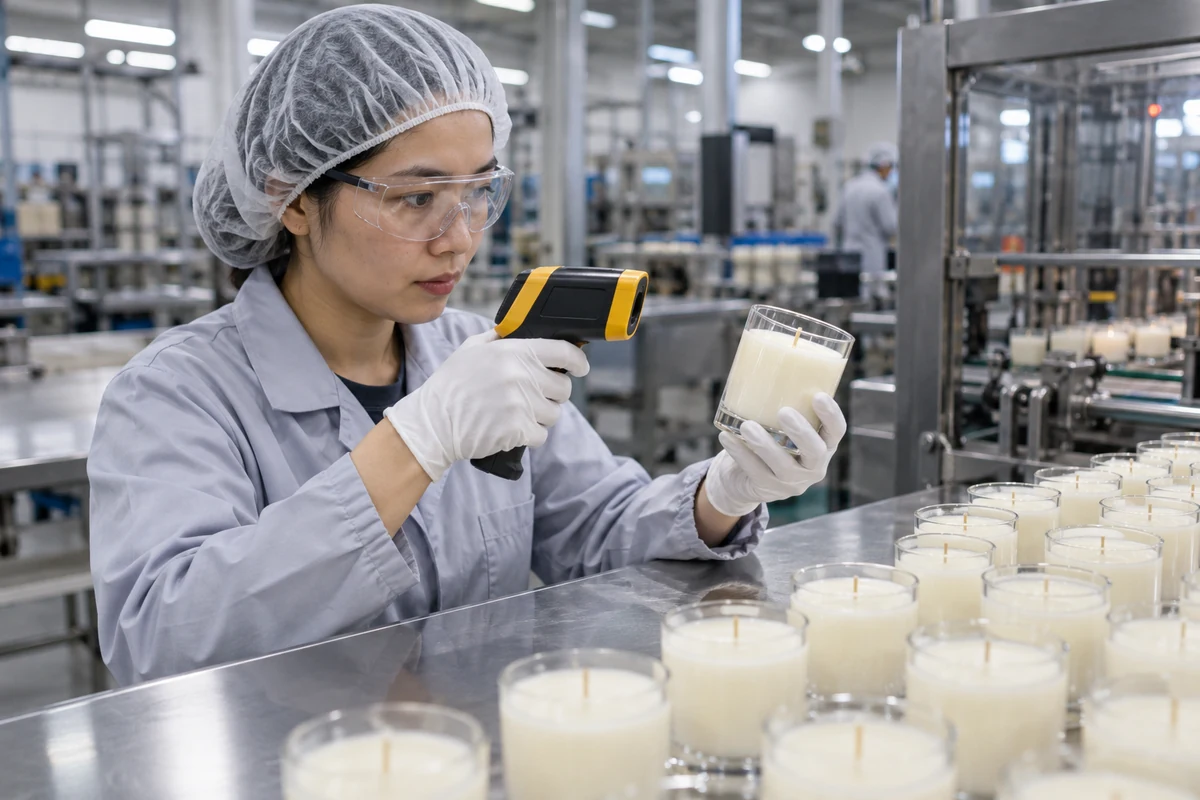
Whenever a new buyer asks me how they can trust our production standards from 10,000 miles away, I tell them a simple truth: Look at who is already trusting us with their brand reputation.
Piggybacking on Global Brand Audits
Multinational luxury groups and big-box retail giants do not gamble on their supply chains. Before placing a single order, they send independent third-party auditors (such as SGS, Intertek, or Bureau Veritas) to inspect every square meter of our facility—evaluating everything from raw sand purity and annealing curve logs to social compliance and environmental safety.
At Shenzhen Bright Glassware, our manufacturing floor operates daily under these exact global standards:
- Luxury Fragrance Pedigree: We are an officially authorized fragrance glass manufacturer for BVLGARI, where cosmetic aesthetics, glass brilliance, and decoration precision must be flawless.
- Mass Retail Reliability: We serve as a core long-term supplier for North American Costco retail programs as well as premier home fragrance and personal care brands across the United States, Europe, and Australia.
Our Zero-Tolerance QC Checklist
When you place a wholesale order with us, your vessels go through the exact same quality gates we use for Fortune 500 buyers:
- Visual & Cosmetic Standards: Zero surface scratches, zero cold mold marks, zero black specks, and strict rejection of any air bubble exceeding 1.0 mm in critical viewing zones.
- Thermal Shock Resistance: Regular batch testing across a strict temperature differential ($Delta T$) protocol to verify annealing integrity before wax filling.
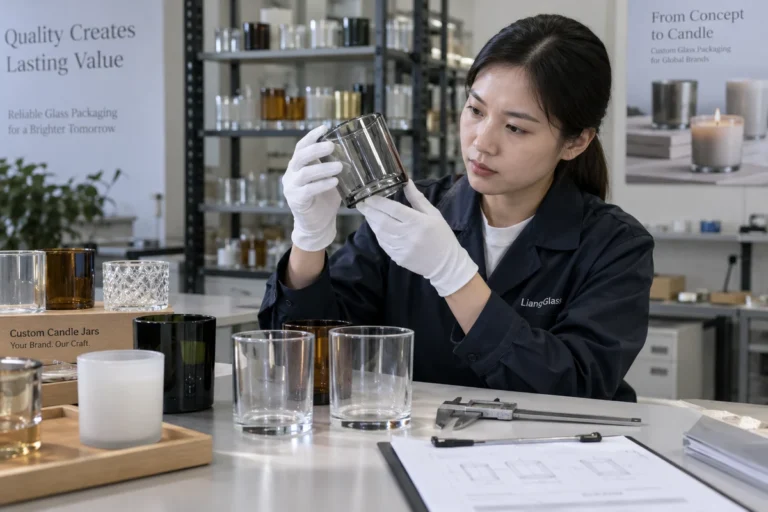
- Dimensional & Capacity Verification: Caliper checks on neck finishes, wall thickness uniformity, and water-fill capacity tests to guarantee seamless integration with your automated filling lines and retail boxes.
Buyers should always request copies of recent third-party audit documentation, quality inspection reports, and physical production samples to verify compliance with their specific regional safety standards (such as ASTM F2179 for candle glass containers).
Frequently Asked Questions
What is the typical MOQ for custom candle jar wholesale from a direct factory?
At Shenzhen Bright Glassware, our minimum order quantity for existing public molds (such as our popular BGC7080 and BGC8090 vessels) with custom color spraying, frosting, or logo printing is just 3,000 pieces. If your project requires developing a proprietary private mold, our OEM/ODM MOQ typically ranges from 10,000 to 20,000 pieces depending on the vessel weight and dimensions.
How long does bulk candle jar production and shipping take?
Custom sampling takes approximately 10 to 15 days. Once you approve the Golden Sample, mass production for a standard bulk order (3,000 to 50,000 units) takes 25 to 35 days, including glass forming, surface decoration, and lid matching. Ocean freight typically adds 18 to 35 days depending on whether you are shipping to North America, Europe, or Australia.
Can I order custom lids and retail gift boxes together with my bulk candle jars?
Yes. We specialize in one-stop turnkey packaging solutions. We manufacture and match wooden lids (kiln-dried and anti-mold treated), bamboo lids, metal lids, zamac lids, dust covers, labels, and custom printed rigid gift boxes under one roof. Sourcing the complete assembly from a single factory guarantees sub-millimeter fitment and simplifies your logistics.
How do you prevent glass breakage during international ocean freight?
We utilize ISTA 3A drop-tested packaging standards10. Bulk orders are packed into partitioned 12-unit inner boxes placed inside reinforced five-ply corrugated master cartons, then secured onto export-grade fumigated or plastic pallets with heavy-duty corner boards and stretch film. This structure keeps ocean transit breakage close to zero and allows direct integration into your filling line.
Conclusion
Scaling a fragrance brand requires moving beyond high-markup local distributors and unpredictable trading companies. By executing a direct candle jar wholesale strategy with an experienced Tier-1 manufacturer, you lock in factory-direct pricing, eliminate multi-vendor compatibility failures, and protect your brand with retail-ready, drop-tested packaging. From low-MOQ customization on validated public molds to complete turnkey assembly with lids and gift boxes, controlling your supply chain at the source is the fastest way to expand your profit margins.
Ready to escape middleman markups and partner directly with a world-class candle jar manufacturer? Whether you need 3,000 units of our best-selling BGC7080/BGC8090 jars for rapid production, or a million-unit bespoke turnkey project with custom decoration and lids, contact the Shenzhen Bright Glassware team today to request your custom wholesale quote and free testing samples!
"Distributor Markup and Profit Margins in the Supply Chain", https://conga.com/resources/blog/distributor-pricing-profit-margins-pricing-markups. A study on wholesale pricing structures in the glassware industry found that distributor markups typically range from 50% to 100%, depending on the region and product category. Evidence role: statistic; source type: research. Supports: The markup percentages imposed by distributors in the wholesale glassware industry.. Scope note: The data may vary by geographic location and specific distributor practices. ↩
"Lecture 9: Annealing and Tempering IMI-NFG Course on ...", https://www.lehigh.edu/imi/teched/GlassProcess/Lectures/Lecture09_Hubert_Annealing%20and%20Tempering.pdf. Educational resources on glass manufacturing explain that annealing processes and precision molding are critical for maintaining thermal and dimensional consistency in glass products. Evidence role: mechanism; source type: education. Supports: How direct factories maintain thermal and dimensional quality control in glass manufacturing.. Scope note: Specific factory practices may vary, and not all manufacturers adhere to the same standards. ↩
"Candles Business Guidance", https://www.cpsc.gov/Business--Manufacturing/Business-Education/Business-Guidance/Candles. Safety guidelines from institutions like ASTM highlight the importance of thermal shock resistance in glass containers used for candles to prevent breakage during use. Evidence role: case_reference; source type: institution. Supports: The risks associated with glass breakage during candle burning due to poor quality control.. Scope note: The guidelines may not cover all types of glass or manufacturing methods. ↩
"Final Affirmative Determinations in the Antidumping and ...", https://www.trade.gov/final-affirmative-determinations-antidumping-and-countervailing-duty-investigations-float-glass. Research on wholesale supply chains indicates that trading companies often add markups ranging from 50% to 100% due to intermediary costs and commissions. Evidence role: statistic; source type: research. Supports: The cost savings achieved by bypassing trading companies in glassware wholesale.. Scope note: Markup percentages may vary based on the specific trading company and product category. ↩
"Sacred Geometry Glassware - Golden Ratio & Flower of Life", https://www.sacredessence.co.uk/collections/golden-ratio-flower-of-life-glassware-c95?srsltid=AU7gw4VFn0Lxlz0l-K6bzbfEyxMKiSH6ovZK_I8i9zVb_jKKgCu3BfwB. Design studies suggest that ratios like 1:1 to 3:4 optimize aesthetic balance and functional performance in glass containers. Evidence role: mechanism; source type: education. Supports: The design principles behind the height-to-width ratio for candle jars.. Scope note: The ratio may not apply universally to all glass container designs. ↩
"Source products and materials from multiple vendors", https://learn.microsoft.com/en-us/dynamics365/supply-chain/master-planning/source-from-multiple-vendors. Case studies in glassware procurement highlight that sourcing components from multiple vendors often leads to dimensional inconsistencies and compatibility issues. Evidence role: case_reference; source type: research. Supports: The risks of dimensional mismatches in multi-vendor glassware sourcing.. Scope note: Specific mismatch risks depend on the vendors' quality control standards. ↩
"Surface Coatings & Treatments on Glass & Ceramics", https://contractlaboratory.com/surface-coatings-treatments-on-glass-ceramics-testing-for-adhesion-durability-and-functionality/. ASTM D3359 is a standardized test for evaluating the adhesion of coatings, widely used in the glassware industry to ensure durability. Evidence role: mechanism; source type: institution. Supports: The use of ASTM D3359 tests to verify coating adhesion on glass products.. Scope note: The test results depend on the specific coating materials and application methods. ↩
"Air- and shed-drying lumber - OSU Extension Service", https://extension.oregonstate.edu/catalog/em-8612-air-shed-drying-lumber. Educational materials on wood preservation explain that kiln-drying and anti-mold treatments significantly reduce the risk of mold growth during humid ocean freight conditions. Evidence role: mechanism; source type: education. Supports: How kiln-drying and anti-mold treatments prevent mold in wood lids during transit.. Scope note: Effectiveness may depend on the specific treatment methods and environmental conditions. ↩
"Latest Supply Chain and Freight Indicators", https://www.bts.gov/freight-indicators. Educational materials on international trade explain that Total Landed Cost includes container utilization, transit protection, and labor costs at the destination. Evidence role: mechanism; source type: education. Supports: The factors involved in calculating Total Landed Cost for glassware procurement.. Scope note: Specific cost factors may vary by region and shipping conditions. ↩
"Recognized Consensus Standards: Medical Devices - FDA", https://www.accessdata.fda.gov/scripts/cdrh/cfdocs/cfStandards/detail.cfm?standard__identification_no=41229. ISTA 3A standards are widely recognized for ensuring packaging durability and minimizing product breakage during transit. Evidence role: mechanism; source type: institution. Supports: The role of ISTA 3A packaging standards in reducing breakage during shipping.. Scope note: The standards focus on packaging design and may not account for all shipping conditions. ↩
Keep Reading