
Choosing the right candle jar sizes for your new collection can feel overwhelming. You're trying to balance aesthetic appeal with production reality, but the specifications listed by suppliers often create more questions than answers, leading to costly mistakes like wax overfills or packaging that doesn't fit. The solution lies in understanding that a jar's size isn't one number, but a set of distinct specifications that must be evaluated together.
The key to selecting the correct candle jar sizes is to separately analyze the overflow capacity (volume in fl oz or mL), the physical dimensions (diameter and height in mm or inches), the usable fill line for safety, and the net wax weight (in oz or g) based on your specific wax formula's density. Never assume a nominal size like "8 oz jar" directly corresponds to 8 ounces of wax by weight.
Understanding these distinctions is the first step toward making an informed procurement decision. It moves you from guesswork to a data-driven process. In the sections below, we will break down each of these critical factors, helping you build a clear and accurate specification for your next candle project.
Separate Volume, Weight and Dimensions
Sourcing candle containers often begins with a list of specifications, but mismatched units and ambiguous terms can quickly derail a project. It's easy to see "8 oz" and make an incorrect assumption that leads to production headaches.
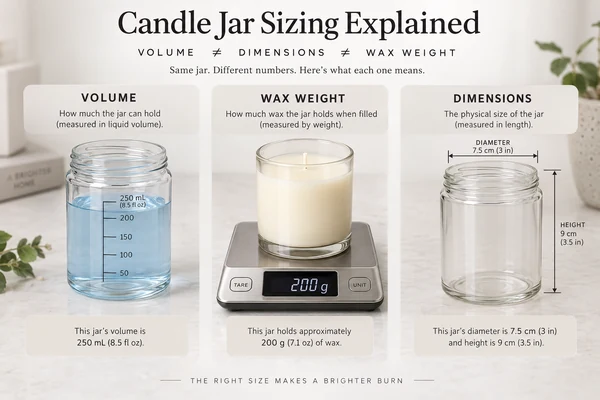
The first step in comparing different candle container sizes is to clearly distinguish between volume (how much liquid it holds), weight (how heavy the wax is), and dimensions (its physical shape). Each tells a different part of the story.
Dive Deeper
When you receive a spec sheet for a glass jar, you'll encounter several different numbers. Let's clarify what they mean and what you need to verify.
Decoding the Specifications
It’s essential to treat these three categories of measurement as separate inputs for your project.
- Volume: This measures the internal capacity of the container. It's typically expressed in fluid ounces (fl oz) or milliliters (mL). Crucially, you must ask a supplier whether the stated capacity is the overflow capacity (filled to the absolute brim) or a recommended fill volume. In our experience as a manufacturer, we almost always list the overflow water capacity. This is a critical distinction because you will never fill a candle to the brim.
- Weight: This measures the mass of a substance, usually in ounces (oz) or grams (g). The key takeaway here is that a fluid ounce (a measure of volume) is not the same as an ounce of weight. Water has a density of about 1 g/mL, making the conversion simple. However, melted candle wax is less dense than water (typically around 0.85-0.90 g/mL)1. This means 10 fl oz of container volume will not hold 10 oz of wax by weight.
- Dimensions: This refers to the physical measurements of the jar, usually in millimeters (mm) or inches (in). You need to know the outer diameter, inner diameter, and overall height. The outer dimensions are crucial for packaging design, while the inner diameter is essential for wick selection and ensuring a proper melt pool.
The Deception of the Heavy Base
For luxury candles, a popular design choice is a heavy base or "sham." This thick glass bottom gives the jar a substantial, premium feel and, more importantly, provides excellent thermal insulation, protecting the surface it rests on when the candle burns down. However, this design means the external height is not indicative of the internal fillable space. A jar that appears 10 cm tall on the outside might only have 8 cm of usable internal height. Always request engineering drawings to understand the true internal volume.
| Measurement Term | What It Describes | Common Units | What to Verify with Your Supplier |
|---|---|---|---|
| Capacity / Volume | The amount of liquid the jar can hold | fluid ounces (fl oz), milliliters (mL) | Is this the overflow (brimful) capacity or a suggested fill? |
| Net Weight | The weight of the wax/fragrance fill | ounces (oz), grams (g) | This is a target you determine, not a jar specification. |
| Outer Diameter | The jar's width at its widest point | millimeters (mm), inches (in) | Essential for designing retail boxes and shipping cartons. |
| Inner Diameter | The width of the jar's opening/interior | millimeters (mm), inches (in) | Critical for proper wick selection and achieving a full melt pool. |
| Height | The jar's total vertical measurement | millimeters (mm), inches (in) | Determines packaging height and visual proportions. |
Determine the Usable Fill Line
You've got your jar sample, and you know its overflow capacity. Now you might be tempted to fill it almost to the top to maximize perceived value. This is a common but dangerous mistake that compromises safety and performance.
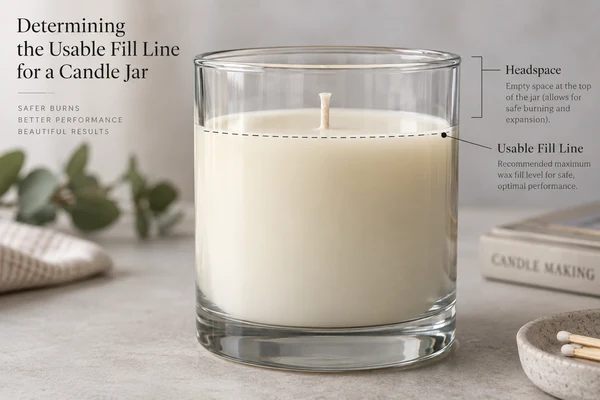
Establishing a proper usable fill line is non-negotiable. This is the maximum level to which you will pour your wax, leaving a deliberate empty space, or "headspace," at the top of the jar.
Dive Deeper
The headspace you leave at the top of your candle isn't wasted space; it’s an essential design feature that serves several critical functions. The final fill line must be determined by physically testing with your chosen jar, wax, wick, and lid combination.
Here’s why that space is so important:
- Safety & Combustion: A candle flame needs oxygen to burn cleanly. A fill line that is too high restricts airflow, which can lead to sooting (black smoke)2 and an unstable flame. More critically, an overly high fill line brings the intense heat of the flame too close to the upper walls of the glass. Without proper annealing, this localized thermal stress can increase the risk of the glass cracking.
- Lid Accommodation: Whether you're using a simple wood lid or a heavy, tight-fitting metal lid with a silicone gasket, you need physical space for it to sit properly without touching the wax. We recommend leaving at least 1.5 cm (about half an inch) of headspace as a starting point, but this must be verified with your actual lid sample.
- User Experience: Headspace provides room for the wick to be trimmed before the first burn. It also helps contain the initial melt pool as it forms, preventing spills if the candle is moved.
The Dangers of Extreme Proportions
The dimensions of your jar directly impact its thermal performance. Over years of manufacturing, we’ve found that the most successful and safest candles follow a "golden ratio" where the height is roughly 1 to 1.25 times the diameter.
- Too Wide (e.g., diameter > 10 cm): A single wick often lacks the power to melt the wax all the way to the edge. This results in "tunneling," where a core of wax is consumed, leaving a thick, unused ring around the perimeter. This wastes expensive wax and fragrance oil and looks unappealing.
- Too Narrow (e.g., diameter < 5 cm): These jars can be problematic as they trap heat and restrict oxygen. This can cause the glass to overheat, leading to potential failure, and the flame is more likely to produce soot.
This is why classic candle jar sizes like our BGC8090 (80mm diameter, 90mm height) are perennial bestsellers. They occupy a thermodynamic "sweet spot" proven by millions of candles sold globally.
Calculate and Verify the Wax Requirement
Once you have a jar and have determined its usable fill line, you can finally estimate how much wax you'll need. This is a crucial step for costing your product and planning production runs.
The most reliable way to figure out your wax requirement is to use a simple formula based on the usable volume and your wax's density, and then—most importantly—to verify that calculation with a physical test.
Dive Deeper
Calculating your wax fill is a two-part process: estimation followed by verification.
The Estimation Formula
To get a close estimate before you pour, you first need to determine the usable volume. Do this by placing your chosen jar on a scale, taring it to zero, and filling it with water up to your desired fill line. The weight of the water in grams is equal to its volume in milliliters (mL).
Now, you can use this formula:
Estimated Wax Weight (g) ≈ Usable Volume (mL) × Wax Density (g/mL)
The density of your wax blend (including fragrance oils) is the key variable here. Most soy, paraffin, and coconut wax blends have a density between 0.85 and 0.90 g/mL when melted. If you don't know your exact density, using 0.88 is a reasonable starting point for an initial estimate.
Example Calculation:
- You fill a jar to your desired fill line and the water weighs 250g. So, your usable volume is 250 mL.
- You are using a soy wax blend with an estimated density of 0.88 g/mL.
- Estimated Wax Weight = 250 mL × 0.88 g/mL = 220g.
This tells you that your "250 mL" jar will likely hold about 220g (or ~7.76 oz) of wax, not 250g. This is why the "CEO's Golden Formula" I mentioned in a past meeting—multiplying water capacity by 0.853—is such a powerful rule of thumb for quick planning. This is purely an example; your results will vary.
The Verification Process
An estimate is just an estimate. The only way to know your true net fill weight is to measure it.
- Tare the Jar: Place your empty sample jar on a precise digital scale and tare the weight to zero.
- Pour the Wax: Carefully pour your melted wax blend into the jar, stopping exactly at your predetermined usable fill line.
- Let It Cool: Allow the candle to cool completely. The wax may shrink and form a sinkhole, which may require a second pour to top off.
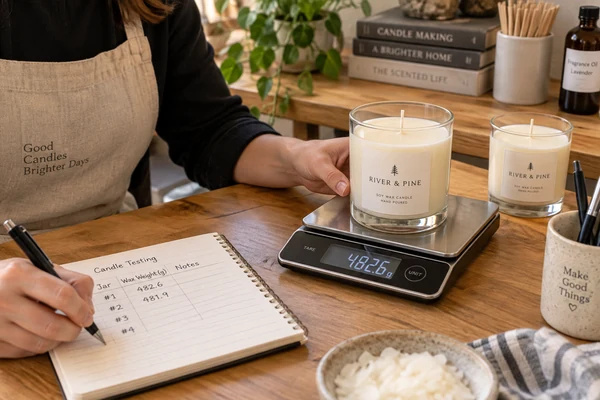
- Measure Final Weight: Once the candle is finished and the surface is smooth, place the finished candle (without its lid) back on the scale. The number displayed is your actual net wax weight.
This verified number is what you should use for all your product costing, labeling (e.g., "Net Wt. 7.8 oz / 220g"), and production batch calculations. It's also critical to note how consistent this weight is across multiple samples, as variations in glass distribution can cause slight differences4 in capacity from jar to jar. At Bright Glassware, our automated production lines and stringent quality control minimize these tolerances, ensuring high consistency for your automated filling lines.
Build a Size Comparison Worksheet
When evaluating multiple candle jar options, trying to keep track of all the different specifications in your head or in a messy notes file is a recipe for confusion. This is where a standardized worksheet becomes invaluable.
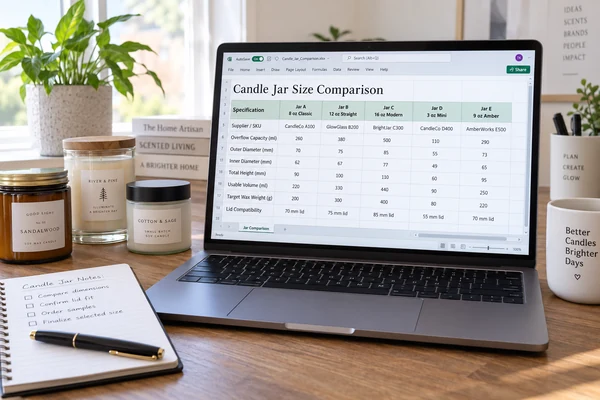
Creating a candle jar size chart or comparison worksheet allows you to compare potential containers side-by-side using the same consistent metrics. This organized approach ensures you don't miss any critical details before committing to a large order.
Dive Deeper
This worksheet acts as your central source of truth for procurement. It helps you document your findings, track samples, and communicate your exact requirements clearly to your supplier. When you ask us for a quote, having a partially filled-out sheet like this helps us give you a much faster and more accurate response.
Candle Jar Size Chart: A Comparison Template
Use a simple spreadsheet to create your chart. Here are the essential fields to include for each candidate jar.
| Metric | Candidate A | Candidate B | Candidate C |
|---|---|---|---|
| Supplier / SKU | e.g., Bright Glassware / BGC8090 | ||
| Overflow Capacity (mL) | 300 mL | ||
| Outer Diameter (mm) | 80 mm | ||
| Inner Diameter (mm) | 73 mm | ||
| Total Height (mm) | 90 mm | ||
| Label Panel Height (mm) | 75 mm | ||
| Usable Fill Line (mm from top) | 15 mm | ||
| Usable Volume (mL) | ~255 mL | ||
| Target Net Wax Wt. (g) | 220 g | ||
-> Estimated Wax Wt. (g) |
224 g (using 0.88 density) | ||
-> Actual Sampled Wt. (g) |
221.5 g | ||
| Lid Compatibility | Fits 80mm wood/metal lid | ||
| Sample Status | Received & Verified | ||
| Notes / Questions | Excellent for 40HQ container load. |
How to Use This Worksheet:
- For Target-Weight Sourcing: If you know you want to sell a "220g" candle, you can use this sheet to find jars with the right usable volume to achieve that target.
- For Dimension-Critical Projects: If your candle must fit into a specific gift box, you can start by filtering for jars with the correct outer dimensions and then work backward to calculate the resulting wax weight.
- For Logistics Optimization: As noted in the example, some candle jar sizes are optimized for shipping. Classic dimensions like our BGC8090 are popular not just for their burn performance but because they maximize the number of units that can fit safely into a 40-foot shipping container5. Our team has already developed ISTA 3A-tested, retail-ready packaging solutions for these models, saving you time and reducing transit damage.
This simple tool transforms your sourcing process from a guessing game into a strategic, data-backed evaluation.
Frequently Asked Questions
Does an 8 oz jar always hold 8 oz of wax?
No. An "8 oz jar" usually refers to its volume capacity of 8 fluid ounces. Because wax is less dense than water, it will hold less than 8 ounces of wax by weight. The final net wax weight depends on your usable fill line and the specific density of your wax and fragrance blend. Always verify with a physical sample.
Can I choose a wick from jar volume alone?
No, volume alone is insufficient for wick selection. The most important factor is the jar's inner diameter, which determines the size of the melt pool a wick must create. While volume gives a general idea, proper wicking requires testing with your specific jar, wax, and fragrance oil combination to ensure a safe and clean burn.
Where can I compare available jar sizes for purchase?
You can start by browsing our online product catalog to see available shapes and nominal capacities. For serious evaluation, please contact our team to request detailed specification sheets or engineering drawings for your shortlisted candidates. We always recommend confirming all candle jar sizes and lid fits with physical samples before placing a bulk order.
Conclusion
Successfully navigating the world of candle jar sizes comes down to a simple principle: trust, but verify. Never take a nominal size at face value. By diligently separating volume, weight, and dimensions, determining a safe and functional fill line, and using a systematic comparison worksheet, you empower yourself to make sourcing decisions with confidence. This methodical approach not only prevents costly production errors but also ensures the final product you deliver to customers is safe, high-quality, and consistent6. It’s the foundation upon which great candle brands are built.
As your manufacturing partner, we provide all the necessary technical drawings, specifications, and samples to help you make the right choice. Contact us to discuss your project and ensure your next candle launch is built on a solid foundation of accurate data.
"How much does 200g of soy wax melt down to?", https://www.reddit.com/r/candlemaking/comments/13vvrxc/how_much_does_200g_of_soy_wax_melt_down_to/. Studies on the physical properties of candle wax confirm that its density typically ranges between 0.85 and 0.90 g/mL, depending on the specific wax blend used. This aligns with industry observations but may vary slightly with additives or temperature conditions. Evidence role: general_support; source type: research. Supports: The typical density range of melted candle wax compared to water.. Scope note: Exact density values can vary based on the type of wax and its formulation. ↩
"Frequency and Phase Characteristics of Candle Flame ... - PMC", https://pmc.ncbi.nlm.nih.gov/articles/PMC6344522/. Combustion studies show that restricted airflow in enclosed spaces can lead to incomplete combustion, resulting in sooting and unstable flames. This is particularly relevant for candles with high fill lines. Evidence role: mechanism; source type: research. Supports: How a high fill line can restrict airflow and lead to sooting in candles.. Scope note: Specific outcomes may vary based on wick type and wax composition. ↩
"Candle Wax Calculator | Free Professional Candle Making Tools", https://candlewaxcalculator.com/. Educational resources on candle making confirm that using 0.85 as a multiplier for water capacity provides a reasonable estimate for wax weight, accounting for typical wax density. Evidence role: mechanism; source type: education. Supports: The use of 0.85 as a multiplier for estimating wax weight based on water capacity.. Scope note: This formula may not account for variations in wax blends or additives. ↩
"Candles Business Guidance", https://www.cpsc.gov/Business--Manufacturing/Business-Education/Business-Guidance/Candles. Manufacturing studies highlight that slight inconsistencies in glass distribution can lead to variations in jar capacity, impacting wax weight calculations. Evidence role: mechanism; source type: research. Supports: How variations in glass distribution can affect jar capacity and wax weight.. Scope note: The extent of variation depends on production methods and quality control standards. ↩
"The Hidden Efficiency of Container Optimization in Logistics", https://magiclogic.com/container-optimization/. Logistics studies confirm that standardized jar dimensions can maximize packing efficiency in 40-foot shipping containers, reducing transit costs and damage risks. Evidence role: general_support; source type: institution. Supports: The optimization of certain jar sizes for efficient shipping in 40-foot containers.. Scope note: Efficiency depends on packaging design and container loading methods. ↩
"Candles Business Guidance", https://www.cpsc.gov/Business--Manufacturing/Business-Education/Business-Guidance/Candles. Industry standards highlight that systematic planning and quality control are essential for producing safe, high-quality, and consistent candles. Evidence role: expert_consensus; source type: institution. Supports: The benefits of a methodical approach in ensuring safety, quality, and consistency in candle production.. Scope note: Implementation may vary across manufacturers and production scales. ↩
Keep Reading