
Struggling to find a candle jar that is both beautiful and safe? Many brands underestimate the engineering involved, thinking any glass container will do. This is a dangerous oversight; a poorly made jar holding a live flame is a significant liability1. Learning how to make candle jars correctly is a matter of precision engineering, where thermodynamics and aesthetics meet to create a product you can trust.
Making candle jars is a multi-stage industrial process that transforms raw materials into finished, quality-controlled vessels. It begins with a detailed technical specification2, followed by molding the molten glass, a critical annealing step to ensure thermal stability, optional surface decoration and branding, and finally, rigorous inspection before packaging for shipment.
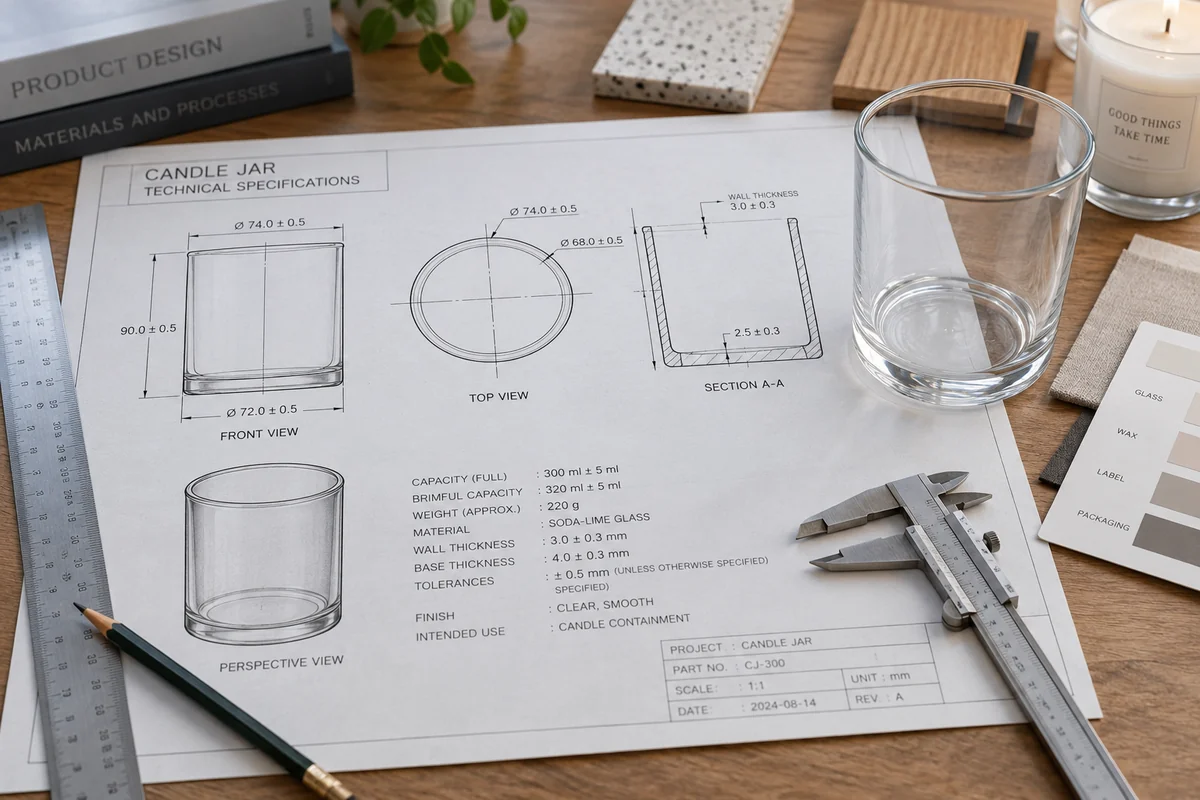
Now that you have the high-level overview, let's explore each stage. Understanding these details is what separates a reliable manufacturing partner from a risky gamble. Every step, from the initial drawing to the final box, is crucial for delivering a safe, premium product.
Begin with a Container Specification?
Starting a project with just a visual concept is common, but it's fraught with risk. Without a solid technical blueprint, you invite production delays, inconsistent quality, and potential safety failures. The foundation of exceptional manufacturing is always a rigorous engineering specification, established long before the first grain of sand is melted.
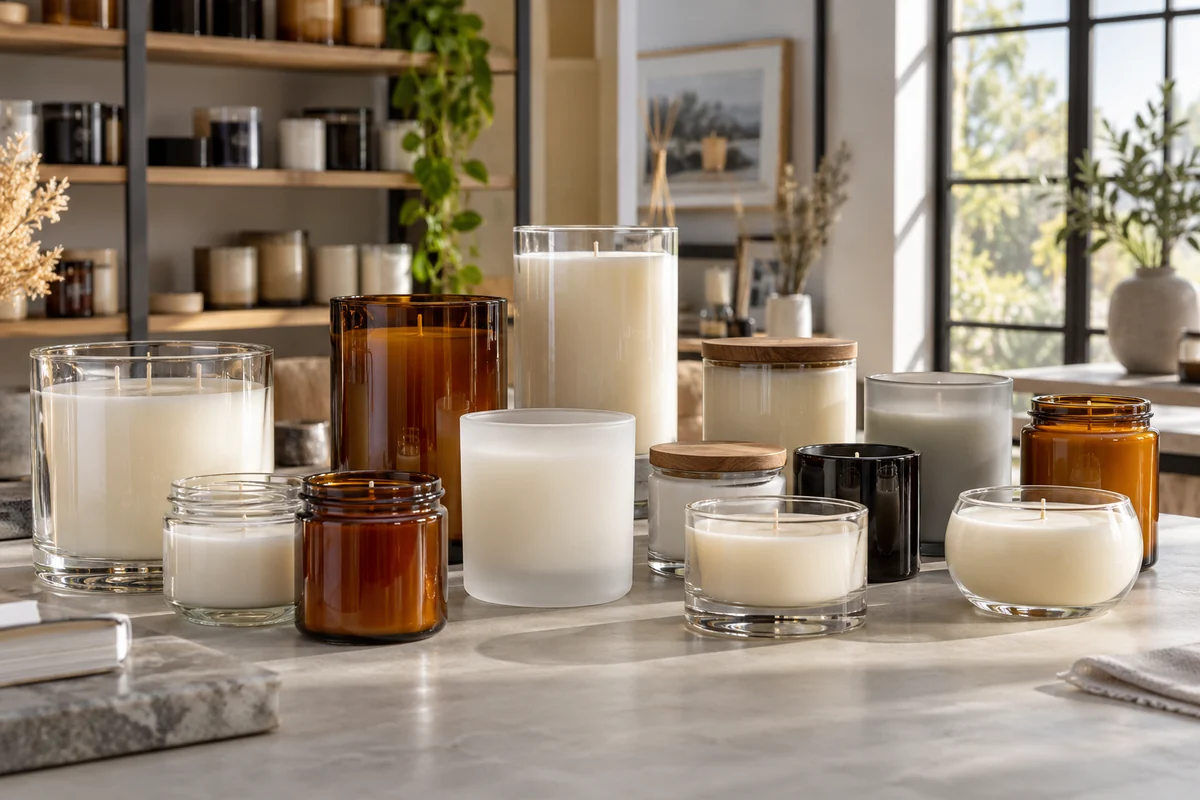
A container specification is a detailed technical drawing that defines every critical parameter of the jar. This includes the material, precise dimensions, weight, volume capacity, and, most importantly, the acceptable tolerances for each measurement.
The Blueprint for Success
As a manufacturer, I can tell you that the most successful projects are won on paper first. A detailed specification acts as the universal language between your design intent and our production reality.
Material Selection is Foundational
The first decision is choosing the right "engine" for your jar. This choice impacts clarity, durability, and cost.
- Standard Soda-Lime Glass3: The workhorse of the industry, suitable for most candle applications. It offers good clarity and is cost-effective for mass production.
- High-Clarity (Crystal Flint) Glass4: For luxury brands, we often use a higher purity silica mix melted in electric furnaces. This produces exceptional brilliance and is perfect for thick, heavy-base designs that signal premium quality.
- High Borosilicate Glass5: If your design is large, multi-wick, or requires superior thermal shock resistance, borosilicate glass is the superior choice. It can handle rapid temperature changes far better than standard soda-lime glass.
Defining Thermodynamic 'Sweet Spots'
The shape of your jar isn't just about looks; it's about performance. We guide our clients toward dimensions that promote a clean, even burn. An ideal aspect ratio of diameter-to-height often falls between 1:1 and 3:4. Jars that are too tall and narrow are prone to "tunneling6," where the wax only melts in the center, wasting fuel and creating an unsightly appearance. A proper specification helps engineer a shape that works in harmony with common wick sizes to ensure optimal heat distribution.
The Anatomy of a Technical Drawing
A professional specification sheet is non-negotiable. It should clearly define:
- Overall Height and Outer Diameter (OD): The basic footprint of the jar.
- Inner Diameter (ID) and Mouth Opening: Critical for lid fitment and automated filling lines.
- Wall Thickness and Base Thickness: Key factors for durability, weight, and heat safety.
- Net Weight: Determines material cost and shipping logistics.
- Overflow Capacity (ml/oz): The total volume if filled to the brim.
- Recommended Fill Line: The suggested wax fill height for safe operation.
- Tolerances: The acceptable range of variation (e.g., +/- 0.5mm) for each dimension.
Separate the Manufacturing Routes?
You have a perfect specification, but how does it become a physical object? The manufacturing method chosen has a massive impact on the final jar's quality, tooling cost, and minimum order quantity (MOQ). Selecting the wrong route can lead to a product that doesn't match your vision or budget.
The two primary industrial routes for making glass candle jars are machine-press7 and machine-blow manufacturing. Each is suited for different types of designs, and a good supplier will guide you to the most appropriate one for your specific project.
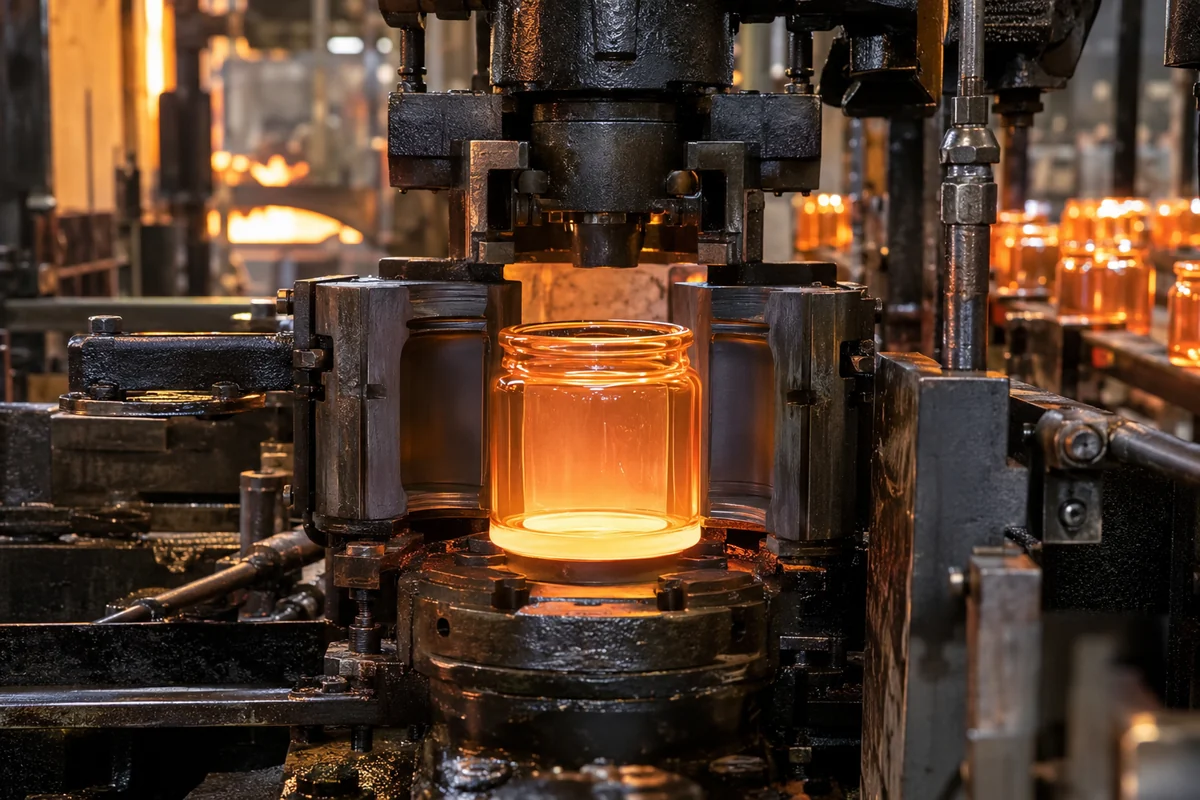
From Molten Glass to Solid Form8
At temperatures around 1500°C (2732°F), glass behaves like a thick liquid. Our job is to shape it with precision and then cool it in a way that guarantees its structural integrity.
Machine-Press Manufacturing
This is the most common method for classic, thick-walled candle jars.
- A "gob" of molten glass is dropped into a female mold.
- A metal plunger presses down, forcing the glass to fill the mold cavity.
- The formed jar is removed and transferred to the annealing lehr9.
This process is highly efficient, has relatively low tooling costs, and is ideal for producing sturdy, heavy-base jars with consistent wall thickness. It's the go-to method for high-volume production of cylindrical and square vessels.
Machine-Blow Manufacturing
For more complex or lightweight shapes, we use automated blow-and-blow or press-and-blow machines (known as IS machines).
- A smaller gob of glass is formed into a preliminary shape called a parison.
- The parison is transferred to the final blow mold.
- Compressed air is injected, expanding the glass to conform to the mold's final shape.
This method offers greater design flexibility but requires sophisticated process control to ensure even wall distribution and avoid "waviness"—a visual distortion you see in lower-quality glass.
The Critical Annealing Process
This is the single most important step for candle jar safety. As a glass jar cools after molding, internal stresses build up. If not properly relieved, this "thermal stress" creates a ticking time bomb that can cause the jar to fracture or shatter when heated by a candle flame.
Every jar we produce travels through a long, temperature-controlled tunnel called an annealing lehr. Inside, the jars are slowly and uniformly cooled over a carefully calculated period. This process allows the glass molecules to settle into a stable, stress-free state. A properly annealed jar is dramatically stronger and safer, which is why we consider this step non-negotiable.
Decoration, Component Matching and Inspection?
A plain glass jar is a blank canvas; it lacks brand identity. But applying decorations is a delicate process where mistakes can ruin your product's premium feel. Poorly executed printing can chip or fade, and incorrect lid fitment can frustrate customers. This is where a professional post-processing workflow truly shines.
After the jars are formed and annealed, they move to the finishing stages. This involves applying surface decorations, matching them with components like lids or pumps, and conducting a final, exhaustive inspection to ensure they meet all aesthetic and functional requirements.
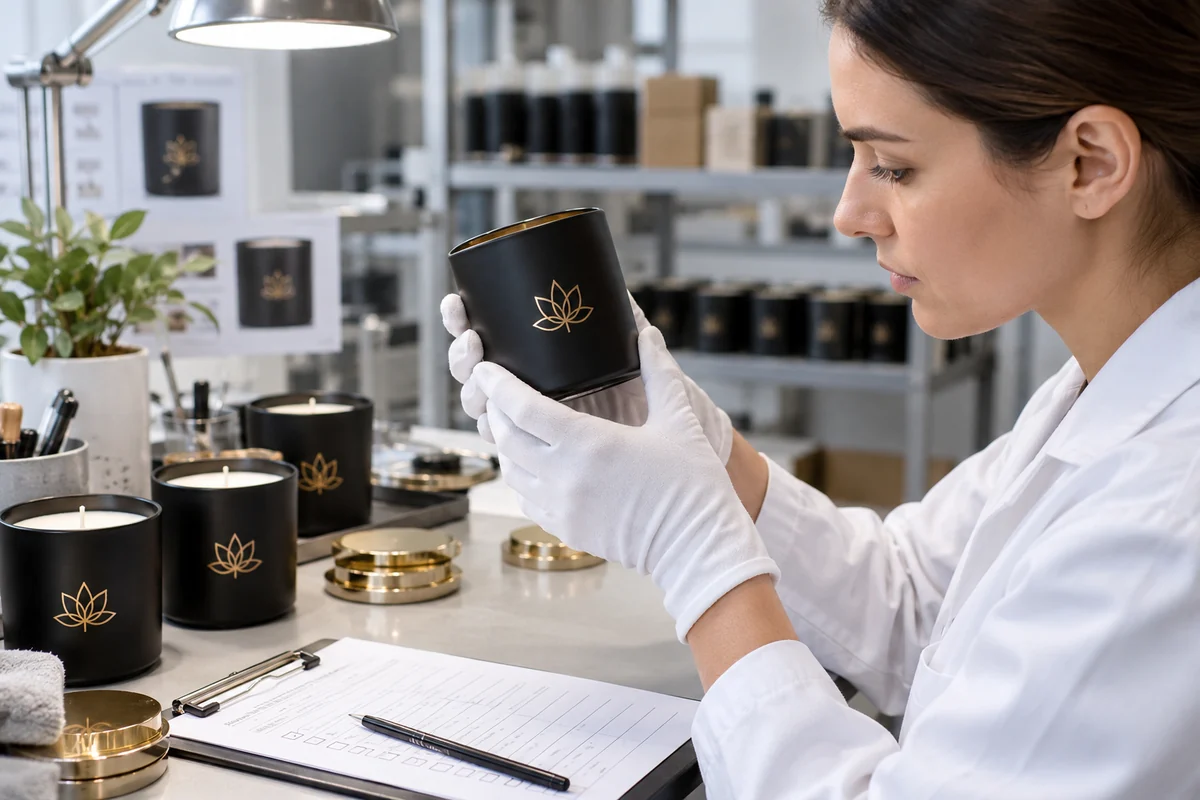
Adding the Soul of Your Brand
This is where a simple container is transformed into your unique product. Our deep processing capabilities are handled in specialized workshops, often in dust-free environments to ensure a flawless finish.
Surface Decoration Techniques
We offer a wide range of options to bring your brand vision to life:
- Color Spraying: Applying opaque, translucent, matte, or glossy colors. This is often done on an automated line in a cleanroom environment to prevent any dust or particles from marring the finish.
- Electroplating: Creates a shiny, metallic finish in gold, silver, rose gold, or other metallic shades for a truly luxurious look.
- Silk-Screen Printing: A method for applying solid-color logos or designs. We use high-temperature cured inks to ensure durability.
- Hot Stamping: Used to apply metallic foil logos (e.g., shiny gold or silver). A properly stamped logo should be crisp and strongly bonded to the glass.
- Decal Application: For intricate, multi-color designs, a water-slide decal is applied and then fired at a high temperature to permanently fuse it to the glass.
For every decorated batch, we perform adhesion tests, such as the cross-cut test10 and alcohol rub test, to ensure the branding will withstand handling and use without peeling or scratching off.
The Art of Component Matching
A candle jar is often part of a package. The fit and feel of the lid are just as important as the jar itself. We work with an extensive network of component suppliers to source and match:
- Lids: Wood, bamboo, metal, or plastic lids that provide the right seal and aesthetic.
- Pumps & Sprayers: For diffuser and perfume bottles, ensuring a leak-proof fit and consistent spray pattern.
- Accessories: Such as stoppers, reeds, or custom packaging inserts.
We manage the entire sourcing and matching process to ensure a perfect fit, saving you the headache of coordinating multiple suppliers and risking incompatibility.
What Buyers Should Request?
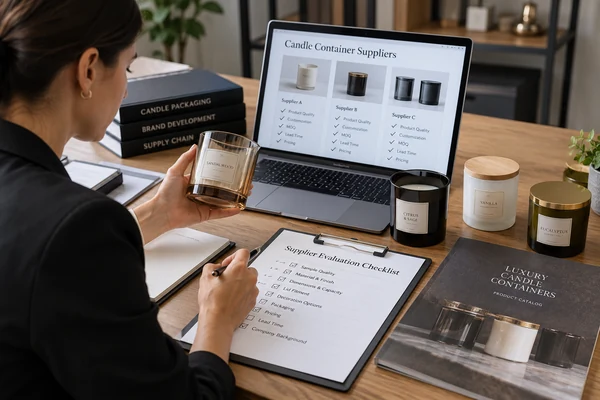
You're ready to engage a supplier, but how do you verify their capabilities and ensure the final product will meet your standards? Asking for the right documentation and samples is the most effective way to vet a potential partner and mitigate risk.
At a minimum, a professional buyer should request technical drawings for approval, pre-production samples for physical evaluation, and access to quality control reports for mass production batches. These items provide clear checkpoints to ensure alignment throughout the project.
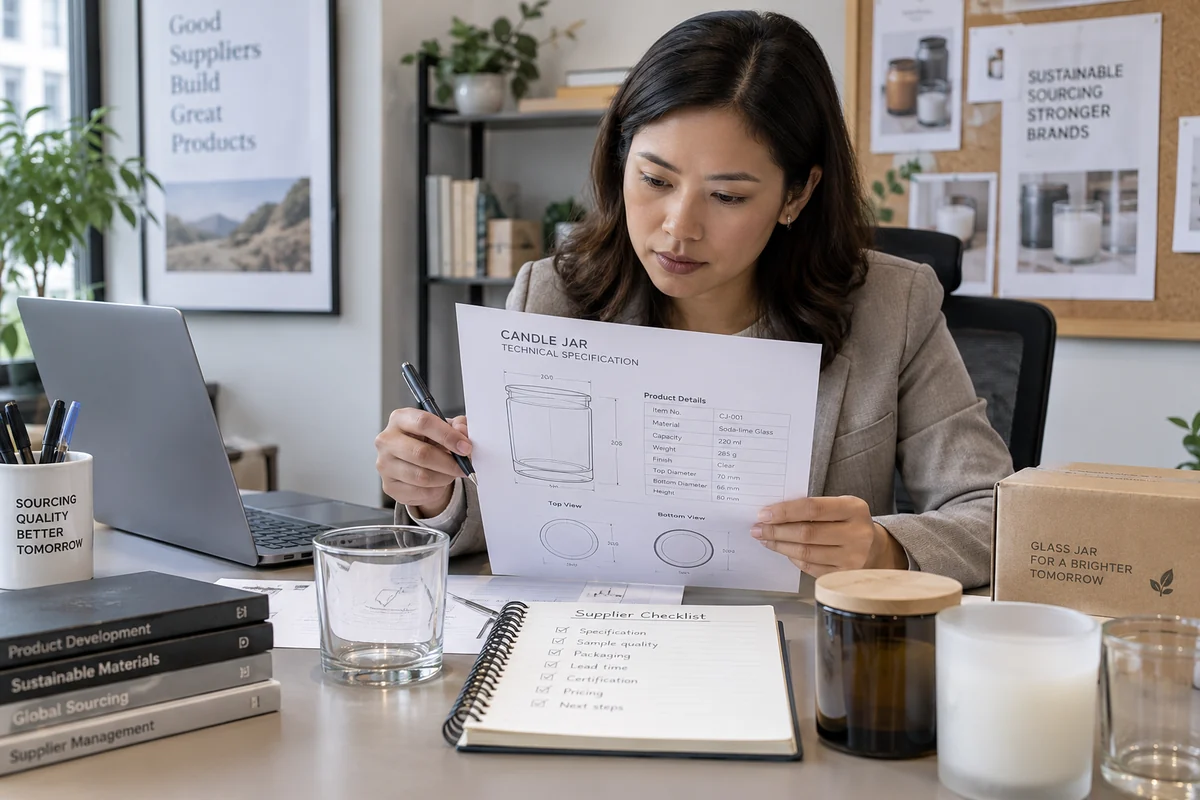
Your Due Diligence Checklist
Treating procurement as a partnership built on transparency is the key to success. Here is what we recommend every buyer request before committing to a large order.
Pre-Production Documentation
- Technical Drawing / Specification Sheet: Before any tooling is made, you must receive and sign off on a detailed drawing. This is your contract for the physical product. Do not proceed without it.
- Mold Design (for custom projects): For a new mold, reviewing the design can provide insight into the engineering behind your product.
Essential Samples to Validate
Never approve mass production based on photos alone. Physical samples are essential.
- Blank Samples: Request undecorated samples first to assess the core glass quality, clarity, weight, and smoothness.
- Decorated Pre-Production Samples (PPS): Once the blank is approved, request samples with your color, logo, and finish. Check for color accuracy (against a Pantone code), logo placement, and finish quality.
- Component Fit Samples: Get samples of the jar with its intended lid or accessories. Test the fit. Is it too tight? Too loose? Does it feel secure?
In-Production and Post-Production Verification
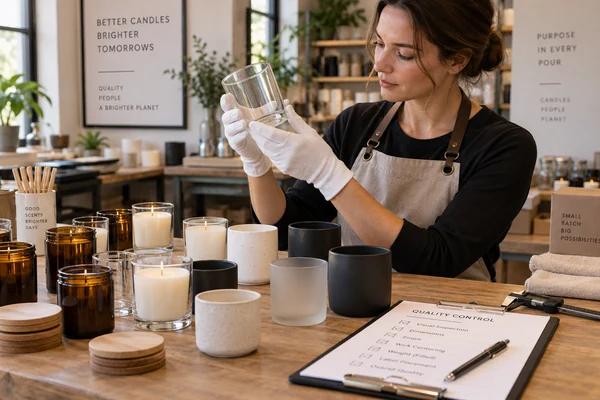
- Quality Control Reports: Ask your supplier for their internal QC reports from the production line. This shows they are actively monitoring for defects.
- Third-Party Inspection: For large or high-value orders, consider hiring an independent inspection service to audit the goods before shipment. This provides an unbiased assessment of quality.
- Material & Safety Compliance: Request safety data sheets for any coatings, inks, or materials to ensure they are non-toxic and compliant with your target market's regulations (e.g., California Prop 65).
- Packaging Test Reports: For fragile items, a supplier should be able to provide evidence that their packaging can withstand the rigors of shipping, such as an ISTA-3A drop test report11.
Frequently Asked Questions
What is the difference between making candle jars and making candles?
Making candle jars is an industrial glass manufacturing process focused on creating the empty vessel. It involves high temperatures, heavy machinery, and engineering for safety and consistency. Making candles is the process of filling those jars with wax, wicks, and fragrance, which can be done at an industrial scale or as a craft. We specialize in the former.
Does a new candle jar design always require a new mold?
Not necessarily. If your design can be based on one of our hundreds of existing stock molds, you can achieve uniqueness through custom colors, finishes, and printing without the cost of a new mold. However, if you require a completely unique shape or size, a new custom mold is necessary, which involves an upfront tooling investment.
What production documents should a buyer verify?
The most critical documents are the technical specification sheet (for sign-off before production), pre-production sample approval reports, and in-process quality control checklists. For decorated items, you should also verify material safety data sheets (MSDS) for the inks and coatings, as well as any adhesion test reports (like the cross-cut test).
Conclusion
Understanding how to make candle jars is about recognizing it as a discipline of precision engineering, not simply glass blowing. From the initial specification that governs every millimeter to the critical annealing process that ensures safety, every step matters. A robust quality control system isn't a cost—it's an investment in your brand's reputation and your customers' safety. This meticulous, multi-stage process is what separates a world-class, reliable container from a potential liability.
Don't risk your brand on inconsistent quality and unverified processes. If you have a specification ready or an idea you'd like to develop into a premium product, contact our team at Bright Glassware. Let us walk you through a manufacturing process built on transparency, engineering, and a true commitment to quality control.
"The unknown risks of scented candles! what science has to say", https://pmc.ncbi.nlm.nih.gov/articles/PMC10783381/. Research has shown that poorly manufactured glass containers used for candles can pose safety risks, including cracking or shattering due to thermal stress when exposed to high temperatures.[1] Evidence role: general_support; source type: research. Supports: Poorly made candle jars can pose safety risks, such as breaking or shattering when exposed to heat.. Scope note: The source may not address all potential risks or specific cases of poorly made jars. ↩
"Technical Glass: A Key Component in Modern Technology", https://pegglass.com/technical-glass/. Technical specifications serve as a blueprint for ensuring consistent quality and safety in the manufacturing of glass products.[3] Evidence role: general_support; source type: education. Supports: Technical specifications are critical for ensuring consistent quality and safety in glass manufacturing.. Scope note: The source may not focus exclusively on candle jars but on glass products in general. ↩
"Soda–lime glass", https://en.wikipedia.org/wiki/Soda%E2%80%93lime_glass. Soda-lime glass is the most commonly used type of glass for various applications, including containers, due to its affordability and optical clarity.[4] Evidence role: general_support; source type: encyclopedia. Supports: Soda-lime glass is widely used for candle jars due to its cost-effectiveness and clarity.. Scope note: The source may not specifically address its use in candle jars. ↩
"Flint glass", https://en.wikipedia.org/wiki/Flint_glass. Crystal flint glass is manufactured using high-purity silica and electric furnaces, which enhance its clarity and brilliance.[10] Evidence role: mechanism; source type: research. Supports: High-clarity glass is produced using a high-purity silica mix melted in electric furnaces, resulting in exceptional brilliance.. ↩
"Borosilicate glass", https://en.wikipedia.org/wiki/Borosilicate_glass. Borosilicate glass is known for its high thermal shock resistance, making it suitable for applications involving rapid temperature changes.[5] Evidence role: mechanism; source type: research. Supports: High borosilicate glass is suitable for applications requiring superior thermal shock resistance, such as large, multi-wick candle jars.. Scope note: The source may not specifically discuss its use in candle jars. ↩
"Why is this candle tunneling??", https://www.reddit.com/r/Candles/comments/18sfm19/why_is_this_candle_tunneling/. Candle tunneling occurs when the wax around the edges of a candle remains unmelted, often due to improper wick size or jar shape.[6] Evidence role: definition; source type: encyclopedia. Supports: Tunneling is a phenomenon where a candle burns unevenly, leaving unmelted wax around the edges.. ↩
"Recommended Jars and Lids", https://nchfp.uga.edu/how/can/general-information/recommended-jars-and-lids/. Machine-press manufacturing is a common method for producing thick-walled glass containers due to its efficiency and consistency.[11] Evidence role: general_support; source type: research. Supports: Machine-press manufacturing is widely used for producing thick-walled glass containers, including candle jars.. Scope note: The source may discuss glass containers in general, not specifically candle jars. ↩
"Physical Properties of Glass 1. Properties of Glass Melts 2. ...", https://www.lehigh.edu/imi/teched/GlassProp/Slides/GlassProp_Lecture7_Brow_Part2.pdf. Glass becomes malleable and behaves like a thick liquid at temperatures around 1500°C, enabling it to be shaped into desired forms.[12] Evidence role: mechanism; source type: education. Supports: Glass behaves like a thick liquid at high temperatures, allowing it to be shaped into various forms.. ↩
"Lehr (glassmaking)", https://en.wikipedia.org/wiki/Lehr_(glassmaking). An annealing lehr is a temperature-controlled tunnel that gradually cools glass to relieve internal stresses and improve durability.[7] Evidence role: mechanism; source type: education. Supports: An annealing lehr is used to relieve thermal stress in glass products by cooling them uniformly.. ↩
"How to do a cross-cut test according to ISO and ASTM",
The cross-cut test is a standard method used to evaluate the adhesion of coatings by making a lattice pattern and assessing the adhesion of the coating to the substrate.[8] Evidence role: mechanism; source type: education. Supports: The cross-cut test is a method for evaluating the adhesion of coatings or decorations on surfaces like glass.. ↩"3A 2", https://www.ista.org/docs/3Aoverview.pdf. The ISTA-3A drop test is a standardized procedure to assess the ability of packaging to protect its contents during the shipping process.[9] Evidence role: general_support; source type: institution. Supports: The ISTA-3A drop test evaluates the durability of packaging during shipping.. ↩
Keep Reading