
Struggling to find the perfect container for your new candle line? Many brand founders believe a unique fragrance is half the battle, but the wrong vessel can undermine even the most exquisite scent, leading to poor performance or safety issues1. The search for the best candle jars can feel overwhelming, with endless choices in material, shape, and size.
The best candle jars are those that safely contain your specific wax and wick combination, align with your brand's aesthetic, meet production and packaging requirements, and can be sourced reliably from a qualified supplier. The ideal choice balances material science, thermal performance, and supply chain logistics, not just price or appearance.
Now that you have the short answer, how do you apply it to your project? This guide will walk you through the essential engineering, manufacturing, and supply chain criteria you need to evaluate containers like a seasoned product developer. Let's build your selection framework.
Define Your Candle Jar Requirements
Jumping into supplier catalogs without a clear brief is a recipe for confusion. You end up wasting hours on unsuitable options and find it impossible to compare quotes effectively. To avoid this, you must first define your project's core parameters before you even look at a single jar.
Start by outlining your project goals. This includes your target wax fill, ideal customer profile, primary sales channels, design direction, lid and packaging needs, and your budget. This brief becomes the foundation for your entire sourcing process.
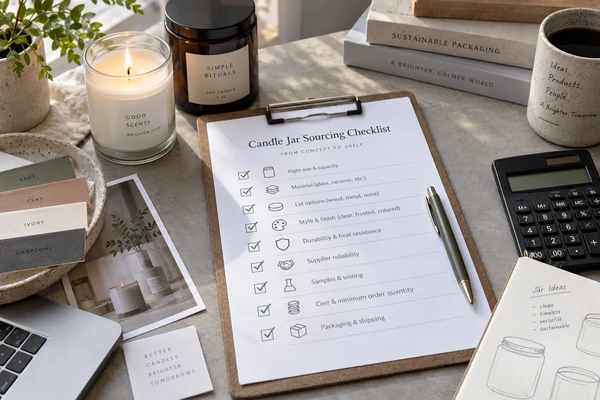
Dive Deeper: Your Candle Jar Requirement Checklist
Use the following checklist to create a concise brief for your project. Having clear answers to these questions will allow you to quickly filter out inappropriate options and communicate effectively with potential suppliers.
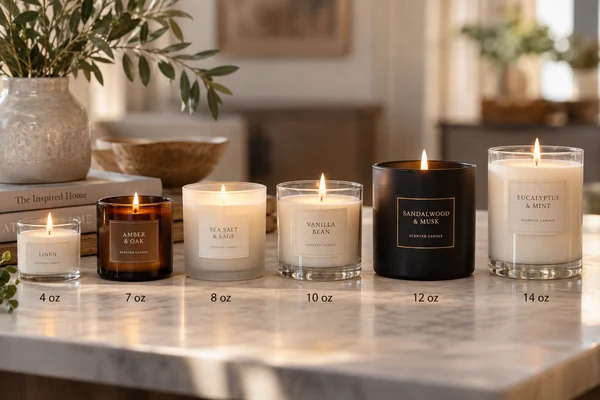
- Target Net Wax Weight: What is the final wax weight (e.g., 8 oz / 227g) you want to advertise to customers? This determines the necessary internal volume of the jar.
- Brand Positioning & Price Point: Is this a luxury, mid-market, or budget-friendly product? A heavy-base glass jar conveys a premium feel that a simple tin might not.
- Primary Sales Channels: Will you sell primarily online (requiring robust, shippable packaging), in physical retail stores (requiring shelf-ready packaging), or through wholesale distributors?
- Brand Aesthetic: What is your visual identity? Minimalist, modern, rustic, or ornate? Your jar is a key physical expression of your brand.
- Lid Requirements: Do you need a simple dust cover or a functional lid with a silicone seal? What material do you prefer (wood, metal, bamboo)?
- Retail Packaging: Will the candle be sold in a retail box? This box must be designed in tandem with the jar and lid to ensure a proper fit.
- Customization Needs: Do you require specific colors, finishes, or a printed logo?
- Estimated Order Quantity: Your initial and future order volume will influence supplier options, pricing, and the feasibility of custom molds.
- Project Timeline: When do you need to have the finished product ready for market?
This checklist will serve as your guide throughout the selection process, ensuring every decision aligns with your strategic goals.
Compare Candle Jar Types: Glass, Ceramic and Concrete
You see them everywhere: sleek glass, rustic ceramic, and industrial concrete. But choosing a material based on a trend or a competitor's design can lead to unexpected production challenges and safety risks. Each material has unique properties that affect performance, branding, and cost.
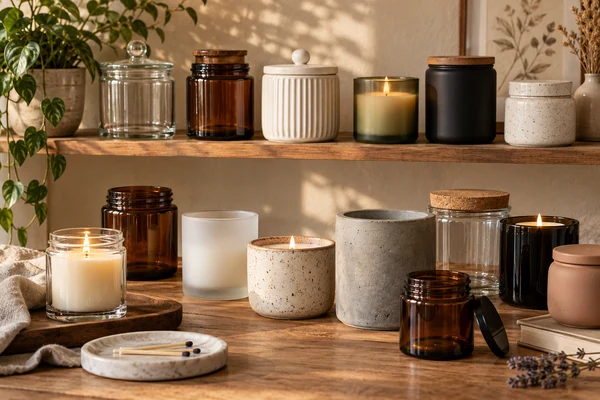
The right choice among different candle jar types depends on your brand's aesthetic, thermal management needs, customization goals, and budget. Glass offers transparency and versatility, ceramic provides an artisan feel, and concrete delivers a modern, textured look.
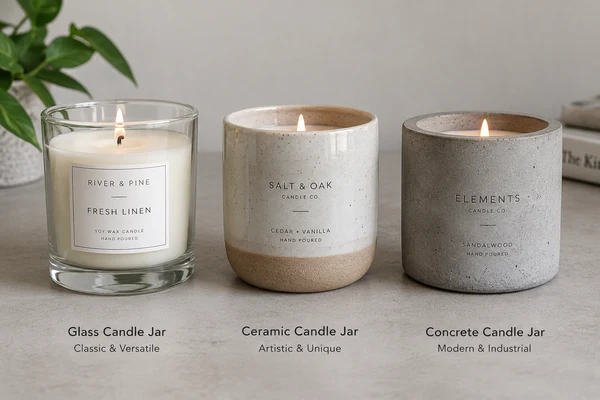
Dive Deeper: A Practical Comparison of Materials
Instead of just focusing on looks, let's analyze these materials from a manufacturing and sourcing perspective. As a buyer, you need to know what questions to ask and what potential issues to look for during sampling.
| Feature | Glass Jars | Ceramic Jars | Concrete / Cement Jars |
|---|---|---|---|
| Visual Appeal | Transparent or colored, high-end finish, shows flame & melt pool. | Opaque, artisan feel, wide range of colors and glazes. | Industrial, rustic, minimalist, textured. |
| Brand Fit | Highly versatile, from mass-market to ultra-luxury. | Best for boutique, spa, wellness, and handcrafted brands. | Ideal for modern, minimalist, and industrial-chic brands. |
| Verification Focus | Annealing process, wall thickness consistency, thermal shock resistance. | Firing consistency, glaze quality, porosity, and sealant integrity. | Curing process, quality of internal sealant, potential for hairline cracks. |
| Sample Checks | Look for waviness, air bubbles, and mold marks. Test with your final wax/wick. | Check for pinholes in the glaze, lid fit, and color consistency between samples. | Inspect for even sealing (to prevent wax bleed), texture uniformity, and weight. |
: Glass: The Versatile Industry Standard
Glass is the dominant material for scented candles for a reason2. It is non-porous, offers a premium appearance, and allows the beauty of the flame and melt pool to be visible.
- Soda-Lime Glass: This is the workhorse of the industry. For luxury brands, I always recommend heavy-base soda-lime glass. The substantial weight feels premium in a customer's hand, and the thick base acts as a crucial heat insulator, protecting furniture surfaces when the candle burns down. When sourcing, demand glass with "no waviness" and near-zero visible mold lines for optical purity.
- Borosilicate Glass: If your plans include large-format, multi-wick candles or you're aiming for a minimalist, lab-glass aesthetic, borosilicate is an excellent choice. Its extremely low coefficient of thermal expansion makes it highly resistant to thermal stress, meaning it won't crack even with significant temperature fluctuations. It is also remarkably lightweight, which can lead to significant savings on shipping costs for direct-to-consumer brands.
: Ceramic: The Artisan's Choice
Ceramic vessels offer a warm, handcrafted feel that resonates with artisan and wellness brands3. The opaque nature allows for a vast world of colors and glazed finishes. However, quality control is paramount. The primary concern with ceramic is porosity. Ensure your supplier uses a high-quality, fully sealed glaze on the interior to prevent wax from "bleeding" into the material, which is both a cosmetic and a safety issue.
: Concrete: The Modern Statement
Concrete and cement jars have gained popularity for their raw, industrial, and minimalist appeal4. Like ceramic, concrete is porous. It is absolutely critical that the jar has a high-quality internal sealant applied. Without a proper seal, the wax will seep into the concrete, creating an unsightly appearance and potentially compromising the vessel's integrity. When sampling, pay close attention to the quality and coverage of this internal coating.
Choose the Right Dimensions and Usable Wax Fill
You found a jar listed as "10 oz," but does that mean it holds 10 ounces of your wax? This is a common and costly misconception. Assuming a container's stated volume directly translates to the weight of wax it can hold will lead to inaccurate labeling and inconsistent products.
To avoid this, always distinguish between a jar's overflow capacity (the total liquid volume) and its usable wax fill (the actual net weight of wax it can safely hold). Request key internal dimensions from your supplier and conduct your own tests to determine the correct fill level for your specific wax blend.
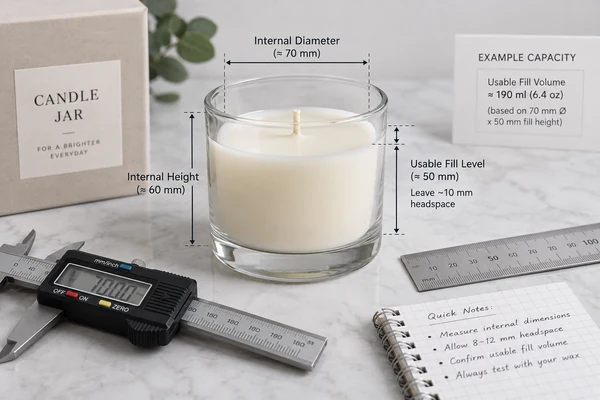
Dive Deeper: From Volume to Weight
Understanding vessel specifications is a technical but essential step in choosing the best candle jars.
- Overflow Capacity (or Nominal Capacity): This is the total volume the container can hold if filled to the very brim. It's typically measured in milliliters (ml) or fluid ounces (fl oz). This is a measure of volume, not weight.
- Net Wax Weight: This is the actual weight of the wax (in grams or ounces) that you pour into the jar. This is the weight you will state on your product label.
- Usable Fill: The usable fill is the volume occupied by your net wax weight, which must be less than the overflow capacity to leave a safe amount of headspace (typically 1/2 inch or 12mm) at the top.
The reason you cannot use the overflow capacity directly is twofold. First, wax is less dense than water, so 10 fl oz of volume will not hold 10 oz by weight of wax. Second, you must leave headspace for safety and to allow for a lid.
To properly assess a jar, ask your supplier for these three key specifications:
- Internal Diameter (ID): This is the most critical dimension for selecting the right wick.
- Internal Height: This helps you calculate the potential fill volume.
- Recommended Max Fill Line: Experienced suppliers can often provide a guideline for the safe fill height.
From my experience manufacturing millions of jars, the most successful candle designs often adhere to a thermodynamic sweet spot. Jars with a diameter-to-height ratio between roughly 1:1 and 3:4 (e.g., 80mm diameter and 90mm height) tend to promote an even, efficient burn and a full melt pool, preventing tunneling and sooting.
Select Candle Jar Shapes, Colors and Finishes
A unique shape seems like a great way to stand out on a crowded shelf. However, complex or unconventional candle jar shapes can complicate production, increase packaging costs, and even impact the candle's burn performance. The key is to balance a distinctive aesthetic with practical, real-world considerations.
When selecting candle jar shapes and finishes, prioritize designs that provide a suitable surface for labeling, are compatible with available lids, and align with automated production. Finishes like spraying, electroplating, or printing should be rigorously tested for adhesion and durability.
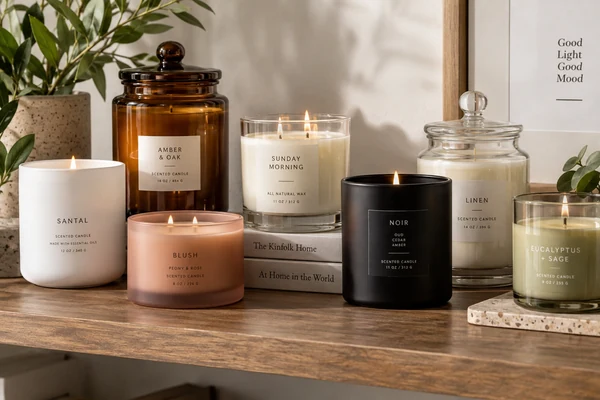
Dive Deeper: Balancing Form and Function
The visual appeal of your candle is paramount, but it cannot come at the expense of functionality.
The Power of Classic Shapes
At our facility, the undisputed bestseller year after year is the straight-sided round jar. This isn't a coincidence. This shape offers profound supply chain advantages:
- Production Efficiency: Their uniform surface is perfect for high-speed automated filling and machine-applied labeling, reducing labor costs and increasing throughput.
- Logistical Excellence: Their simple geometry maximizes packing density. You can fit more units into a carton and more cartons into a shipping container, which directly reduces your per-unit freight cost.
While classic, these jars are a blank canvas. They can be transformed into unique products through color, finishes, and labeling.
Evaluating Other Common Shapes
- Square Jars: These offer a modern, geometric look but can be challenging to wick correctly. The corners are further from the flame and can be "cold spots," leading to unmelted wax.
- Tapered Jars (V-shaped): An elegant and popular choice, but ensure your label design works with the angled surface. Also, verify their stability, especially if they are tall and narrow.
- Custom Shapes: A proprietary shape offers the ultimate brand differentiation but comes with significant investment5. This requires a custom mold, higher MOQs, and fully custom packaging, which adds to both cost and lead times.
Leveraging Colors and Surface Decorations
This is where you can truly make a standard jar your own. High-quality surface treatments can elevate your brand perception. Common options include:
- Spraying: Opaque, translucent, glossy, matte, or gradient color finishes.
- Electroplating: Creates a shiny, reflective metallic finish.
- Frosting: A classic, soft-touch finish that diffuses light beautifully.
- Screen Printing & Hot Stamping: For applying logos and designs directly onto the glass.
A critical question for your supplier: Are your decoration processes performed in a cleanroom environment? For premium finishes, especially gradient sprays and real gold hot stamping, a dust-free environment is essential to prevent imperfections that can ruin the final product.
Plan Compatible Lids and Retail Packaging
You've finally selected the perfect jar. Now you just need to find a lid and a box, right? This piecemeal approach is a common mistake. An ill-fitting lid cheapens the user experience, while inadequate packaging can lead to costly breakage during shipping.
The jar, lid, and packaging must be sourced and designed as a single, cohesive system. Always verify the fit and function of the lid with your chosen jar, and co-design retail packaging that protects the final product while enhancing your brand's unboxing experience.
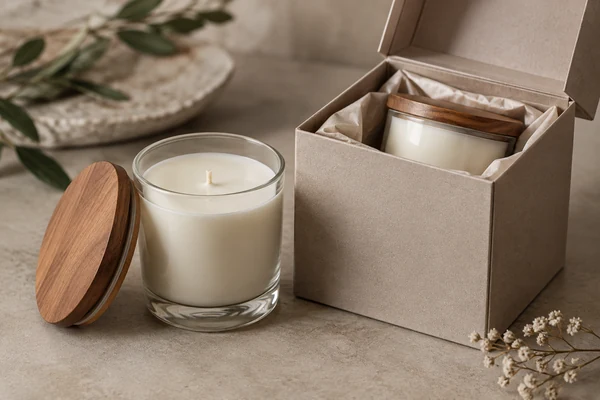
Dive Deeper: Building a Complete Packaging System
Thinking about the total package from day one will save you immense time and money.
Lid Compatibility is Non-Negotiable
A lid is more than just a cover; it's a key tactile interaction point for your customer6.
- Lid Types: Lids can be simple dust covers that sit on top or functional sealing lids, often fitted with a silicone gasket to help preserve fragrance.
- Materials: Common options include wood (acacia, pine), bamboo, metal (aluminum, tin), and glass.
- The Importance of Tolerance: This is where your supplier's manufacturing precision becomes critical. You need to ask about their tolerance control for the jar's rim diameter. If there is too much variation from jar to jar, a portion of your lids simply won't fit, leading to waste and frustration. Always test lid fit across multiple sample jars, not just one.
Designing for the Unboxing Experience
For many brands, especially in e-commerce, the packaging is the storefront.
- Retail Box: This is your customer's first physical interaction with your brand. The quality of the paper stock, printing, and construction all communicate a message.
- Inner Insert: An insert made of cardboard, foam, or molded pulp is essential for holding the candle securely within the box, preventing it from moving and breaking during transit.
The Hidden Value of Retail-Ready Packaging
If you sell to distributors or large retailers, ask your supplier if they can provide a retail-ready packaging system. This means the master shipping cartons are designed to be easily opened and placed directly onto a retail shelf. From our experience serving major brands in North America and Australia, providing a system tested to ISTA 3A drop test standards7 is a massive value-add. It eliminates the need for your distribution partners to unbox and repack products, saving them labor costs and ensuring your product reaches the customer safely.
Set Clear Sample Approval Criteria?
Your samples have finally arrived, and they look beautiful. It can be tempting to give immediate approval and rush into production. However, a simple visual check is not enough to qualify a container and can be a precursor to a large-scale production failure.
Your sample approval must be a systematic process that goes beyond aesthetics. It should include dimensional verification, lid fit testing, finish durability checks, and—most importantly—conducting your own burn tests with your final wax, fragrance, and wick formula in the actual vessel8.
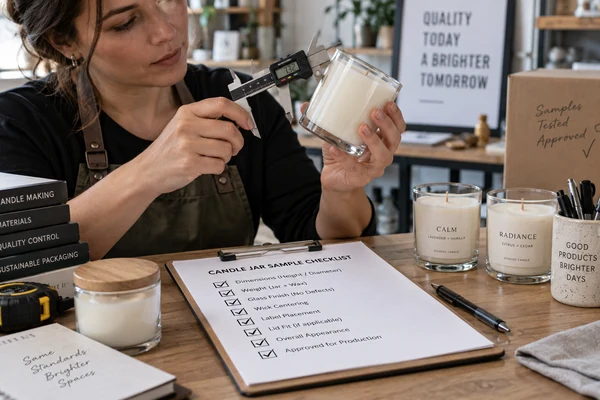
Dive Deeper: Your Pre-Production Quality Gate
Think of sample approval as your final quality gate before committing to a bulk order. A formal checklist ensures nothing is overlooked.
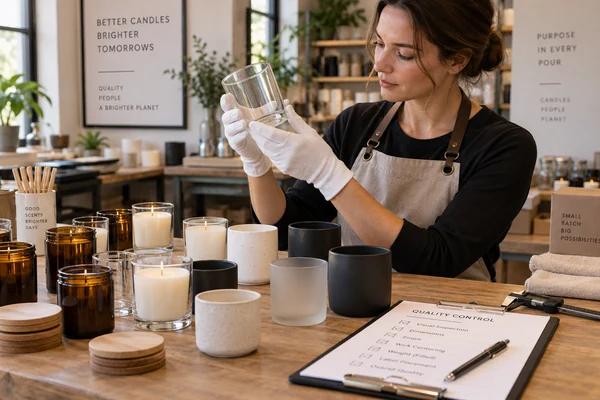
- Visual Inspection: Scrutinize the samples under good lighting. Look for unacceptable defects such as air bubbles, scratches, "waviness" in the glass, or inconsistent color application.
- Dimensional & Weight Verification: Use digital calipers to measure the height, outer diameter, and inner diameter. Compare these against the supplier's technical drawing. Weigh each sample jar; significant weight variation can indicate problems with wall thickness control.
- Lid Fit Test: Test the fit of your chosen lid on every single sample jar. Is the fit consistent? Is it too tight on one and too loose on another? This tests the supplier's rim tolerance control.
- Finish Durability Test: Perform simple adhesion tests. For a printed logo, try the "tape test" (apply and rip off strong adhesive tape). For a sprayed finish, gently scratch an inconspicuous area with a fingernail to check for chipping.
- Burn Testing (Your Responsibility): This is the most critical step. The supplier provides the vessel, but you must validate it for your specific application. Make several test candles in the sample jars using your final wax blend, fragrance oil load, and wick series. Conduct a full series of burn tests to ensure:
- A healthy, full melt pool is achieved.
- The container's external temperature remains within safe limits.
- The jar does not crack or show any signs of thermal stress.
It is always recommended that you have your final candle configuration evaluated by a qualified professional to ensure it meets all relevant safety standards for your target market.
Build Your Shortlist and Request Samples
After all this research, you've likely identified several promising jar options. But comparing them all can feel chaotic, making it difficult to land on a final decision. To move forward, you need to consolidate your findings and prepare a professional sample request.
Create a comparison table to objectively score your top 3-5 candidates9 for the best candle jars for your project. When you contact suppliers to request samples, provide them with your detailed project brief to get the most accurate feedback and relevant options.
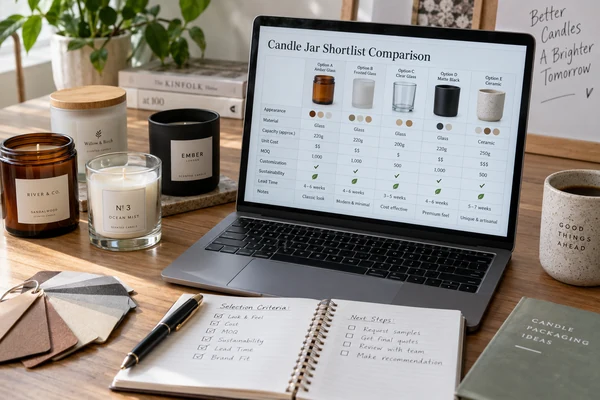
Dive Deeper: From Candidates to Samples
This structured approach transforms a confusing search into a clear decision-making process.
Creating Your Comparison Shortlist
Use a simple table to compare your top candidates side-by-side. This format makes it easy to spot the pros and cons of each option and identify any remaining questions for the supplier.
| Criteria | Candidate 1 | Candidate 2 | Candidate 3 |
|---|---|---|---|
| Supplier / SKU | |||
| Material | |||
| Dimensions (ID x H) | |||
| Est. Usable Wax Fill | |||
| Lid Option | |||
| Finish / Color | |||
| Packaging Details | |||
| Questions for Supplier | |||
| Sample Status | Requested / Received | Requested / Received | Requested / Received |
How to Request Samples Like a Pro
To get the best service and the most relevant samples, provide potential suppliers with a clear and concise request. A professional supplier will appreciate the detail, as it helps them serve you better. Include the following in your email or inquiry form:
- Your Project: Briefly introduce your brand and the product you're developing.
- Jar Requirements: Specify the SKU(s) you're interested in, your target net wax weight, and any critical dimensions.
- Customization: Detail any needs for color, finishing, or logo printing.
- Lid & Packaging: Mention that you require compatible lids and retail packaging solutions.
- Quantity & Timeline: Provide your estimated initial order quantity (EOQ) and your target launch date.
This level of detail signals that you are a serious buyer and enables a supplier like Bright Glassware to immediately assess whether our stock options are a good fit or if a custom development project is the better path forward.
Frequently Asked Questions About Choosing Candle Jars
What makes a jar a good choice for a candle brand?
A good jar is a combination of four key factors: it is verifiably safe for your specific candle system, it aligns with your brand's visual identity and price point, it is suitable for your manufacturing process (e.g., labeling and filling), and it comes from a reliable supplier who can ensure consistent quality and availability.
Should I select the jar or the wick first?
They must be selected and validated together. The jar's internal diameter is the primary factor that determines the necessary wick size range. However, the final wick selection can only be confirmed through rigorous burn testing conducted in the specific jar with your exact wax and fragrance oil formula.
Can appearance alone establish candle suitability?
Absolutely not. While appearance is critical for marketing and sales, the technical suitability of a jar is determined by material science and thermal performance. A beautiful jar that cracks from heat, has an inconsistent finish, or doesn't fit its lid is a liability, not an asset. Always back up aesthetic choices with thorough physical and burn testing.
Conclusion
Choosing the best candle jars for your brand is not about finding a single "perfect" container, but about executing a methodical evaluation process. By shifting your focus from pure aesthetics to a strategic framework that includes material science, dimensional analysis, and supply chain logistics, you transform a subjective search into a sound business decision. This diligent approach, which considers everything from the annealing process of the glass to the drop-test rating of the final shipping carton, ensures your product is not only beautiful but also safe, high-quality, and profitable. A truly great candle begins with a thoughtfully chosen vessel.
Ready to move from theory to production? Bring your candle concept to us. At Shenzhen Bright Glassware, we provide the end-to-end expertise to manufacture the best candle jars for your brand, from initial design and sampling to mass production and global delivery. Contact our team today to discuss your project and get started.
"Factors affecting candle performance in candle making", https://www.facebook.com/vacandlesupplies/posts/your-wax-wick-fragrance-load-vessel-size-cure-time-and-fragrance-oil-can-all-aff/1750903609411639/. Studies on candle performance have shown that vessel material and design can affect heat distribution, scent throw, and safety, particularly in terms of thermal stress and wax containment. Evidence role: general_support; source type: research. Supports: The claim that vessel choice can influence candle performance and safety.. Scope note: Specific findings may vary depending on the type of wax and wick used. ↩
"Explore the Global Candle Jar Market", https://www.futuremarketinsights.com/reports/candle-jar-market. Industry reports indicate that glass accounts for a significant portion of candle jar production due to its non-porous nature and aesthetic versatility. Evidence role: statistic; source type: institution. Supports: The claim that glass is the dominant material for scented candles.. Scope note: The dominance of glass may vary by region and market segment. ↩
"9 Essential Insights: How Ceramic vs Glass Candle Jars ...", https://circehome.com/blog/ceramic-vs-glass-candle-jars-shape-luxury-candle-brands/. Market analysis suggests that ceramic jars are often chosen by artisan and wellness brands for their handcrafted appearance and ability to support diverse finishes. Evidence role: general_support; source type: research. Supports: The claim that ceramic jars are favored by artisan and wellness brands.. Scope note: Preference for ceramic jars may depend on specific brand positioning and customer demographics. ↩
"Concrete & Hydrostone Candle Jars FAQ | Everything You ...",
. Recent design trends highlight the growing use of concrete and cement jars in modern candle collections, particularly for brands targeting minimalist aesthetics. Evidence role: general_support; source type: research. Supports: The claim that concrete and cement jars are popular for their industrial and minimalist appeal.. Scope note: Popularity may be limited to specific market segments or design trends. ↩"Package design as a branding tool in the cosmetic industry", https://pmc.ncbi.nlm.nih.gov/articles/PMC9123395/. Industry insights confirm that custom molds for proprietary jar shapes can elevate brand identity but involve higher upfront costs and MOQs. Evidence role: general_support; source type: institution. Supports: The claim that custom-shaped jars enhance brand differentiation but require significant investment.. Scope note: Cost-effectiveness depends on production volume and market positioning. ↩
"Eco-Friendly Amber Glass Candle Jars with Lids", https://farcandles.com/eco-friendly-amber-glass-candle-jars-with-lids-elevate-your-home-fragrance-experience/. Consumer research highlights that tactile elements like lids can influence perceived product quality and brand value. Evidence role: expert_consensus; source type: research. Supports: The claim that lids contribute significantly to customer experience.. Scope note: Impact may vary based on lid material and design. ↩
"3A 2", https://www.ista.org/docs/3Aoverview.pdf. ISTA 3A standards define procedures for testing packaging durability under simulated shipping conditions, including drop tests and vibration tests. Evidence role: definition; source type: institution. Supports: The claim that ISTA 3A standards ensure packaging durability.. Scope note: Standards apply broadly and may not address specific candle packaging needs. ↩
"Candles Business Guidance", https://www.cpsc.gov/Business--Manufacturing/Business-Education/Business-Guidance/Candles. Safety guidelines recommend burn testing to ensure proper melt pool formation, wick performance, and jar thermal stability. Evidence role: mechanism; source type: education. Supports: The claim that burn tests are critical for validating jar suitability.. Scope note: Results depend on specific wax and wick combinations used in testing. ↩
"Comparison Tables for Products, Services, and Features", https://www.nngroup.com/articles/comparison-tables/. Decision-making frameworks suggest that comparison tables improve clarity and objectivity in supplier evaluations. Evidence role: general_support; source type: education. Supports: The claim that comparison tables aid in evaluating candle jar options.. Scope note: Effectiveness depends on the criteria and data included in the table. ↩
Keep Reading