
Struggling to make your candle line stand out on a crowded shelf? A generic clear jar can feel uninspired, causing your unique fragrance to blend in with the competition. You know a custom color could elevate your brand, but you’re worried about the risks—peeling paint, toxic fumes, and a finish that looks cheap1, ultimately damaging your brand’s reputation. The solution lies in understanding the difference between simple decoration and industrial-grade coating, a process that ensures beauty, safety, and durability. Learning how to properly spray paint candle jars is the first step toward creating a truly premium product.
Yes, you can spray paint candle jars, but it requires specialized industrial processes, not DIY methods. For safety and quality, the coating must be an exterior-only, heat-resistant paint applied in a controlled environment2. The process must also include rigorous testing for adhesion and heat stability to ensure the paint doesn't chip, discolor, or release volatile organic compounds (VOCs)3 when the candle is burned.
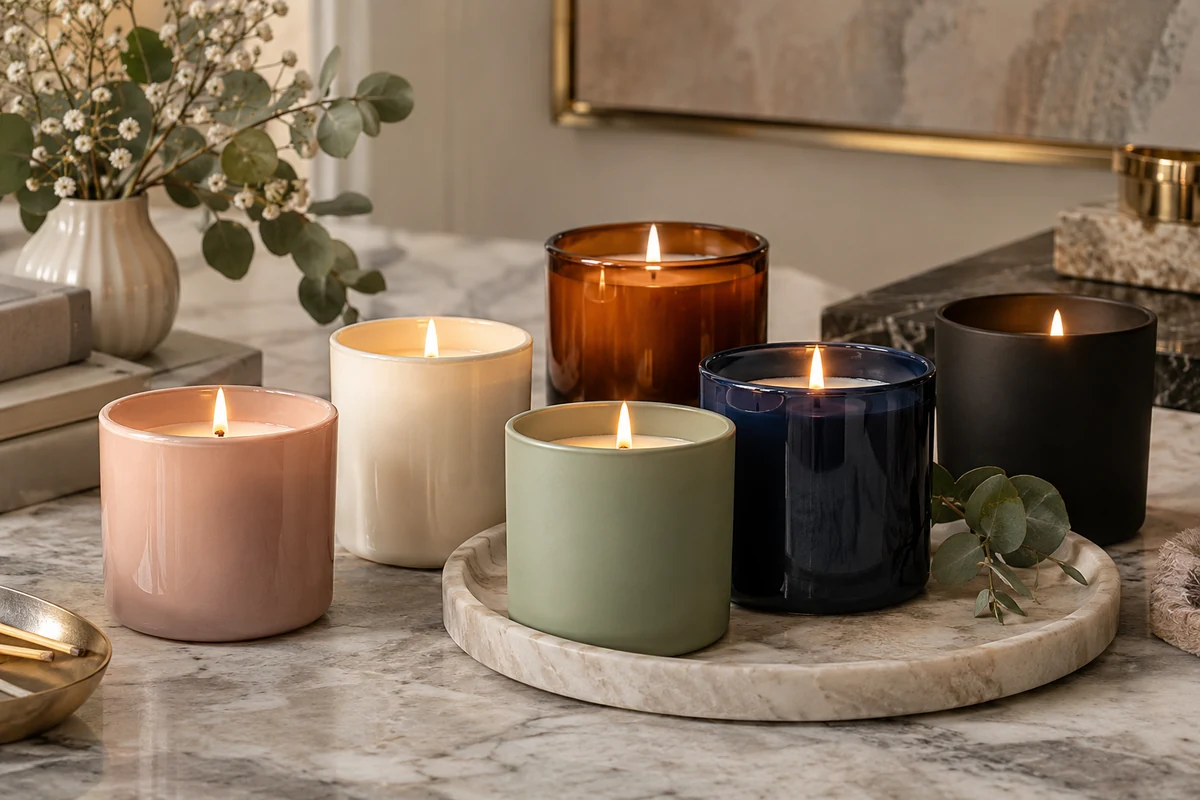
Now that you know it's possible, let's explore the critical quality checks you must perform. The difference between a stunning success and a costly failure lies in the details of the material, the process, and the testing protocols your manufacturing partner uses.
How Do You Distinguish Decoration from Suitability Approval?
You've found a supplier who can create a jar in your brand's signature color. It looks perfect, but what happens when a customer lights the wick? If the coating isn't designed for the heat of a burning candle, it can bubble, blacken, or even release a foul odor, ruining the scent experience.
The key is to separate aesthetic decoration from functional suitability. A decorative coating might look good, but a suitable coating is rigorously tested to perform safely under its intended use. For candle jars, this means ensuring the coating is only applied to the exterior and can withstand prolonged heat conducted through the glass without degrading.
The Heat & Toxicity Check
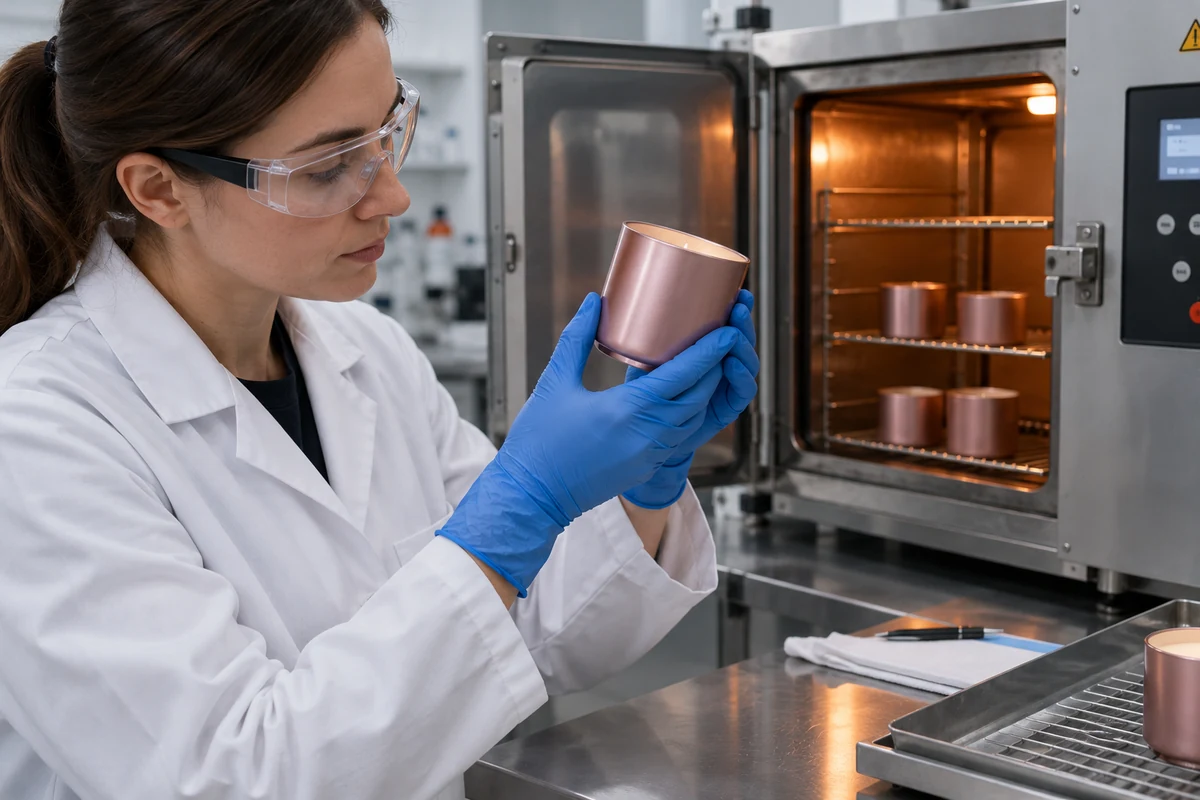
This is the most critical safety baseline when you spray paint candle jars. Standard decorative paints are not formulated to handle the sustained heat from a candle flame, which can reach high temperatures near the glass surface. When exposed to this heat, these coatings can blister, turn black, and—most dangerously—release toxic volatile organic compounds (VOCs). This not only creates a safety hazard but also contaminates the delicate fragrance you've worked so hard to perfect.
At Bright Glassware, this is a non-negotiable safety line. We specify industrial-grade coatings that undergo a high-temperature curing process in our production lines. This ensures the coating is fully hardened and chemically stable.
Even more importantly, we employ a technique called Precision Masking4. This process guarantees that not a single drop of paint ever touches the interior surface of the glass jar. The candle wax and flame should only ever come into contact with the pure, inert inner glass wall. The decorative coating remains safely on the exterior, protecting both the user and the integrity of your fragrance. This is the absolute safety standard we enforce for the top-tier home fragrance brands we partner with.
How Do You Review Material, Coating and Process Data?
That first sample arrives, and the color is perfect. But how can you be sure that the 10,000th jar in your bulk order will have the same quality? A small inconsistency in the manufacturing process can lead to widespread quality issues, like paint flaking off in your customer's hands.
To protect your investment, you must look beyond the initial sample. A professional supplier should be able to provide technical data sheets for their coatings and transparently explain their process controls. Insist on seeing evidence of their quality testing, because what you can't see is often what determines the final quality.
The "Cross-Cut" Adhesion Test
Many brands have faced the nightmare of receiving a shipment only to find the paint scratches or flakes off with minimal friction. This often happens when a supplier cuts corners on surface preparation or uses a low-quality coating.
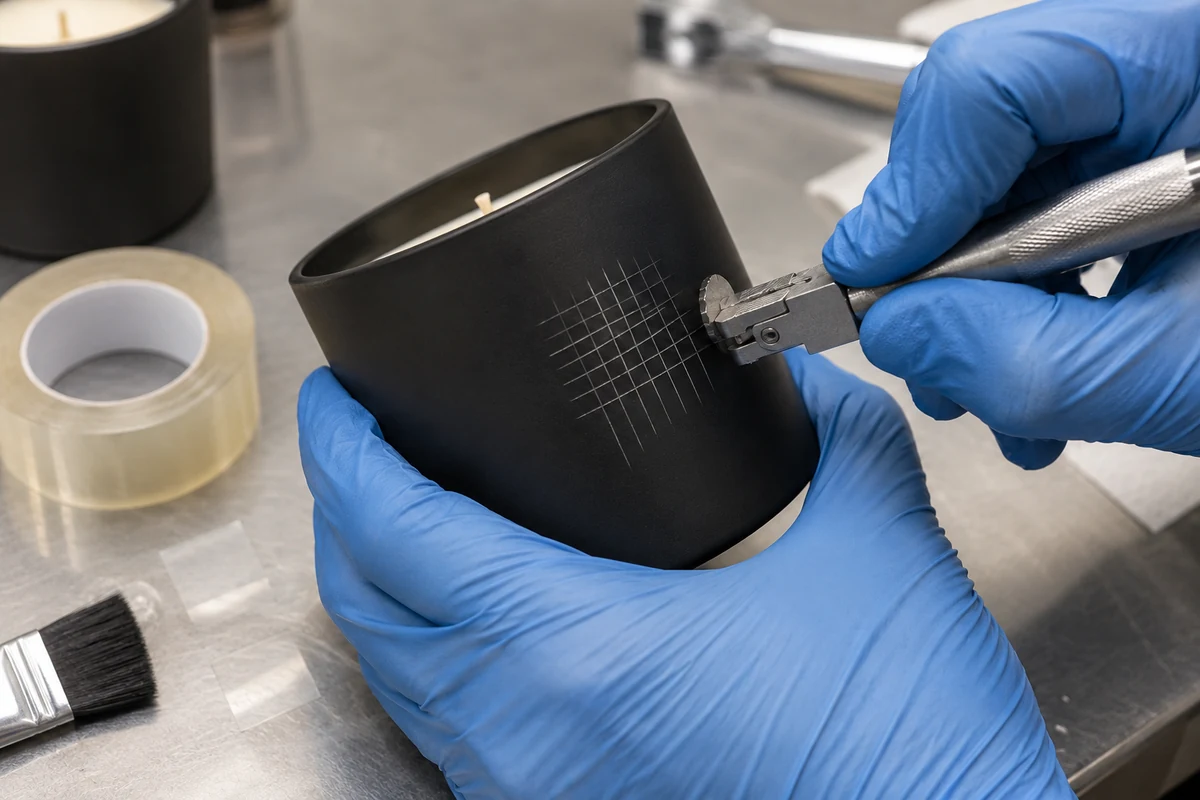
Don't just trust your eyes; insist on a test that uses a blade. During factory audits, I always show buyers our "mirror of truth" for paint adhesion: the Cross-Cut Adhesion Test (per ASTM D3359)5. In our finishing workshop, every batch of coated jars must pass this demanding test.
Here’s how it works:
- A technician uses a special multi-blade tool to scribe a grid of 100 small squares into the painted surface.
- A strip of high-tack industrial adhesive tape is firmly applied over the grid.
- The technician then rips the tape off in one swift motion.
Our standard is absolute. If even one small square of paint is pulled away, the entire batch is considered a failure and is rejected. Only coatings that pass this test, along with long-term alcohol immersion and friction tests, are deemed worthy of a premium home fragrance product.
The Cleanroom Check for a Flawless Finish
Have you ever seen a painted candle jar that just looked... cheap? Often, the culprit is invisible to the naked eye until it's too late. Tiny dust particles landing on the glass surface before or during the painting process get trapped under the coating, creating small, unsightly bumps. Under the focused lighting of a retail store or in a customer's home, these "pimples" become glaringly obvious and detract from the premium feel.
Low-cost workshops often spray paint in open-air environments where airborne dust is unavoidable. This is a shortcut we refuse to take. Our competitive advantage lies in our fully automated, dust-free cleanrooms6. We treat the finishing of your candle jars with the same precision as medical device manufacturing. By eliminating environmental contaminants, our automated spray guns can apply a perfectly smooth and uniform layer of paint. This is the secret behind our ability to produce flawless finishes, from ultra-fine matte black and velvety frosted white to perfectly clear and even gradient amber.
The Batch Consistency Check
Imagine your signature candle becomes a bestseller. Six months later, you place a reorder for 50,000 units. The new shipment arrives, but the "Morandi Pink" is two shades darker than the original batch. Suddenly, your customers are confused, and some may even suspect they've bought a counterfeit product. This inconsistency can severely damage brand trust.
Manual spraying, even by a skilled worker, can never fully eliminate color variation between batches. Our confidence comes from our world-leading automated spray coating line. The entire process is managed by data, not by hand.
From the moment a jar is loaded onto the line, it undergoes:
- Automated static elimination to ensure a clean surface.
- Computer-programmed robotic arms that control the spray path and speed, ensuring perfectly even film thickness.
- Infrared tunnels that provide consistent, controlled heat for curing.
This data-driven approach means that whether it's the 1,000th jar or the 100,000th, we can promise virtually zero color variation from batch to batch7.
How Should You Test the Finished Decoration and Packaging?
The coating itself seems perfect—it’s durable, smooth, and the color is consistent. But what about the glass vessel underneath? Applying a high-end coating to a low-quality jar is like putting a fine suit on a poorly made mannequin; it only serves to highlight the underlying flaws.
The final product's quality is an interplay between the glass and its decoration. Therefore, you must evaluate the finished sample as a complete unit. A superior coating can actually amplify imperfections in the glass, making a thorough inspection of the foundational vessel essential.

The Foundation: Glass Quality Matters
A common misconception is that an opaque spray coating can hide defects in the glass. The opposite is true. The smooth, uniform surface of the paint actually makes flaws like waviness, prominent seam lines, or internal bubbles more noticeable. If the glass has "waviness" (an uneven surface from the molding process), it will create a distorted, fun-house mirror effect on a glossy finish.
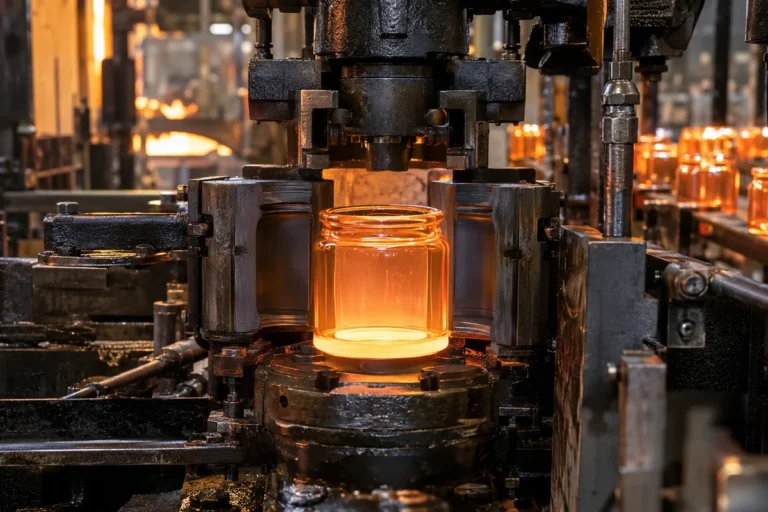
Our ability to deliver finishes that resemble works of art is built upon a superior "canvas." We start with exceptionally high-quality glass, whether it's our thick-bottom super flint glass or durable borosilicate glass. Our raw vessels are subject to strict quality control for:
- Optical Clarity8: Zero bubbles, stones, or other inclusions.
- Surface Flatness: A perfectly smooth surface free of waviness.
- Tight Tolerances: Consistent wall thickness and dimensions.
This commitment to the quality of the underlying glass is the essential prerequisite for any premium decoration process.
Assembling a Comprehensive Test Plan
Before signing off on a bulk order, you or a third-party inspector should have a clear test plan for the final production samples.
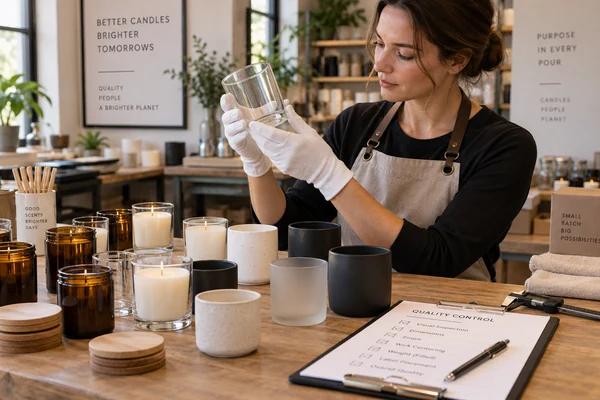
Here is a checklist we recommend to our clients:
- Visual Inspection: Examine the jar under bright, direct light. Look for any dust particles, drips, unevenness ("orange peel" texture), or color variations.
- Adhesion Test: Ask your supplier for their cross-cut adhesion test report for your specific batch. For your own peace of mind, you can perform a simple scratch test with a fingernail or coin in an inconspicuous area. It should not flake or chip easily.
- Chemical Resistance Test: Gently rub a small area with a cotton swab dipped in isopropyl alcohol. A quality cured coating should not soften, fade, or rub off.
- Controlled Burn Test9: This is crucial. Make a finished candle using your specific wax, fragrance, and wick. Burn it for a full cycle and observe the exterior. Check for any discoloration, blistering, bubbling, or odor coming from the coating.
- Packaging and Transit Test: A beautiful finish is useless if it gets damaged in transit. Ensure the supplier's master carton includes proper dividers (like cardboard grids) to prevent jars from rubbing against each other. Shake the box to simulate shipping stress and inspect for scuff marks.
How Do You Prepare a Decoration Request for Spray Painted Candle Jars?
You're now equipped with the knowledge to identify high-quality finishing. The next step is to communicate your requirements clearly to your supplier. A vague request can lead to inaccurate quotes, incorrect samples, and frustrating delays.
To ensure everyone is on the same page, prepare a detailed decoration brief or Request for Quotation (RFQ). This document serves as the blueprint for your project and is the most effective way to communicate your vision for your custom spray painted candle jars.

Use the following checklist to build your decoration request:
| Specification Element | What to Include |
|---|---|
| Base Item | Provide the model number of the glass jar, a technical drawing, or a physical sample. |
| Decoration Type | Be specific: Opaque spray, translucent spray, gradient/fade effect, matte finish, gloss finish, etc. |
| Color Specification | Provide an official Pantone Matching System (PMS) code10. This is the universal language for color and eliminates guesswork. |
| Coating Area | Specify exactly which parts of the jar to coat. Examples: "Full exterior coverage," "Exterior only, leaving bottom clear," or "Gradient starting from the base." |
| Secondary Decorations | Mention if you plan to add a logo (silkscreen print, hot stamping) on top of the coating, as this may require a different formulation. |
| Accessory Fitment | Name the specific lid or cap you will be using. The supplier must account for paint thickness to ensure a perfect fit. |
| Required Quality Tests | State your standards clearly. For example: "Coating must pass ASTM D3359 cross-cut adhesion test." |
| Packaging Needs | Specify your requirements, such as "Each jar to be individually wrapped in a foam pouch" or "Must use corrugated dividers." |
A detailed brief like this empowers a professional supplier to provide an accurate quote and a first sample that truly matches your expectations.
Frequently Asked Questions
Is acrylic paint safe for candle jars?
Standard craft-store acrylic paint is not safe for candle jars. It is not formulated to withstand heat and can release harmful fumes. However, industrial coating systems used by manufacturers may be acrylic-based, but these are specialty formulations that are professionally applied and heat-cured to be durable and stable.
What's the difference between painting the inside vs. the outside of a candle jar?
Painting the exterior is the industry-standard method for safety. This isolates the coating from direct contact with the flame and hot wax pool. Painting the inside of a candle jar is extremely hazardous. The paint will burn, releasing potentially toxic chemicals and a noxious smell that will ruin your fragrance. We strongly advise against any internal coatings for candle vessels.
Does a frosted look mean the glass is etched?
Not always. A frosted or matte appearance can be achieved in two primary ways: traditional acid etching or applying a matte spray coating. Spraying is often preferred for large-scale production as it provides high consistency and also allows for colored frosted effects (e.g., frosted blush, frosted sage) that are not possible with etching alone. Always clarify the technique with your supplier.
What is the minimum order quantity (MOQ) for custom spray painting11?
The MOQ for custom-colored jars is typically higher than for standard clear glass. This is due to the setup time, material consumption, and cleaning required for each color run on an automated production line. MOQs often start at 3,000 to 5,000 units per color, but this can vary. Contact our team to discuss your specific project.
How does paint thickness affect the candle jar?
Consistent paint thickness is vital for two reasons: color uniformity and lid fitment. An automated line ensures the coating layer is perfectly even across the entire surface. If the paint is too thick around the neck or threads of the jar, it can prevent the lid from closing properly. This is why precision application is just as important as the paint itself.
Conclusion
The question isn't just "Can you spray paint candle jars?" but rather, "Can you apply an industrial-grade coating that is heat-resistant, flawlessly smooth, perfectly adhered, and consistent across every single unit?" The answer to that question separates generic suppliers from true manufacturing partners. A successful result depends on using the right materials, a controlled and clean application process, rigorous quality testing, and starting with a high-quality glass vessel. By following the checks outlined here, you can confidently source colored jars that elevate your brand and delight your customers safely.
Don't let a low-quality finish compromise your exquisite fragrance formulation. Leading global beauty and fragrance brands have already validated Bright Glassware's deep processing capabilities through their stringent factory audits. Bring us your Pantone code and your design vision. Let our dust-free cleanrooms, adhesion tests, and automated lines create a true "haute couture" vessel for your brand. Contact the Bright Glassware team today to start your custom packaging project.
"Exposure to Volatile Organic Compounds in Paint Production ...", https://pmc.ncbi.nlm.nih.gov/articles/PMC9961358/. Studies on spray paint applications highlight risks such as peeling due to poor adhesion, VOC emissions from non-heat-resistant paints, and aesthetic flaws caused by improper curing processes. Evidence role: general_support; source type: research. Supports: Spray painting glass surfaces can lead to peeling, toxic emissions, and aesthetic degradation if not done properly.. Scope note: Specific examples related to candle jars may not be included. ↩
"Heat-resistant Coatings: Types and Applications", https://www.specialchem.com/coatings/guide/heat-resistance. Industrial coating guidelines emphasize the importance of controlled environments to prevent contamination and ensure proper curing of heat-resistant paints. Evidence role: mechanism; source type: institution. Supports: Controlled environments are essential for applying heat-resistant coatings to ensure durability and safety.. Scope note: May not address specific applications for candle jars. ↩
"Volatile Organic Compounds' Impact on Indoor Air Quality", https://www.epa.gov/indoor-air-quality-iaq/volatile-organic-compounds-impact-indoor-air-quality. EPA reports indicate that VOCs are commonly released from paints and coatings, especially under high-temperature conditions. Evidence role: statistic; source type: government. Supports: Decorative paints can emit VOCs when exposed to heat, posing health risks.. Scope note: Specific data on decorative paints used for candle jars may not be included. ↩
"How to use liquid masking tape on glass | Dulux PRECISION® ...",
. Technical manuals on industrial masking describe methods to isolate specific areas during spray painting, ensuring clean and safe application. Evidence role: mechanism; source type: education. Supports: Precision Masking is a technique used to prevent paint from contaminating interior surfaces during spray painting.. Scope note: May not include specific examples related to candle jars. ↩"Adhesion", https://en.wikipedia.org/wiki/Adhesion. ASTM International defines the D3359 test as a reliable method for evaluating the adhesion of coatings to substrates. Evidence role: case_reference; source type: institution. Supports: The ASTM D3359 Cross-Cut Adhesion Test is a widely recognized standard for assessing paint adhesion.. Scope note: May not address specific applications for spray-painted candle jars. ↩
"Cleanroom Painting Protocols for Life Sciences…", https://www.alpinepainting.com/blog/cleanroom-painting-protocols-for-life-sciences-compliance-and-best-practices. Research on cleanroom technology highlights its role in preventing defects caused by dust and other particles during coating applications. Evidence role: mechanism; source type: research. Supports: Cleanrooms eliminate airborne contaminants, ensuring smooth and flawless finishes in industrial painting processes.. Scope note: Specific examples related to candle jars may not be included. ↩
"A Guide to Automated Spray Coating Machines | Dubois", https://www.duboisequipment.com/automated-spray-coating-machine-guide/. Studies on robotic spray painting systems demonstrate their ability to maintain consistent color and film thickness across large-scale production. Evidence role: general_support; source type: research. Supports: Automated spray coating systems minimize color variation between production batches.. Scope note: May not address specific applications for candle jars. ↩
"Optical Glass Manufacturing Plant Cost, Setup, DPR 2026", https://www.imarcgroup.com/optical-glass-manufacturing-plant-project-report. Educational resources on glass manufacturing emphasize the importance of optical clarity for aesthetic and functional applications. Evidence role: general_support; source type: education. Supports: Optical clarity in glass is essential for achieving a premium appearance in coated products.. Scope note: May not include specific examples related to spray-painted candle jars. ↩
"Can you burn a candle in painted candle jars safely?", https://www.facebook.com/groups/acrylicpouringbeginners/posts/1281716256502608/. Research on heat resistance testing describes controlled burn tests as a method to assess coating durability and safety during use. Evidence role: case_reference; source type: research. Supports: Controlled burn tests are used to evaluate the performance of coatings under heat exposure.. Scope note: Specific examples related to candle jars may not be included. ↩
"Pantone Color Systems | Universal Language of Color", https://www.pantone.com/na/en-us/color-systems/pantone-color-systems-explained?srsltid=AU7gw4WmF4l0T3NnQGwW4KBsHY1W6COGcgvGaF_fWeRDRxV4pyqy3fxp. Pantone defines its Matching System as a universal standard for color communication in design and manufacturing. Evidence role: definition; source type: institution. Supports: The Pantone Matching System is a standardized tool for specifying and reproducing colors accurately.. Scope note: May not address specific applications for spray-painted candle jars. ↩
"Paint Products Fact Sheet", https://downloads.regulations.gov/EPA-HQ-OPPT-2015-0078-0012/attachment_3.pdf. Industry reports on manufacturing processes indicate that MOQs for custom coatings are higher due to the complexity and resource requirements of color runs. Evidence role: statistic; source type: institution. Supports: Custom spray painting often requires higher MOQs due to setup and material costs.. Scope note: Specific MOQ ranges for candle jars may not be included. ↩
Keep Reading